Busy but Never Making Any Money? How Regan Crook Turned It Around
If your mechanics workshop is busy but you never make any money, more work won't fix it. What fixes it is knowing what money you actually have, deciding where it goes before it gets spent, and having someone hold you to that plan every week. That's what turned it around for Regan Crook, and he didn't need a single extra customer to do it.
Being flat out and still broke doesn't mean you're bad at what you do. Regan had a busy shop, a good reputation and good clients, and he still reached the ten-year mark asking himself how to close the doors without losing everything.
What does busy but broke look like?
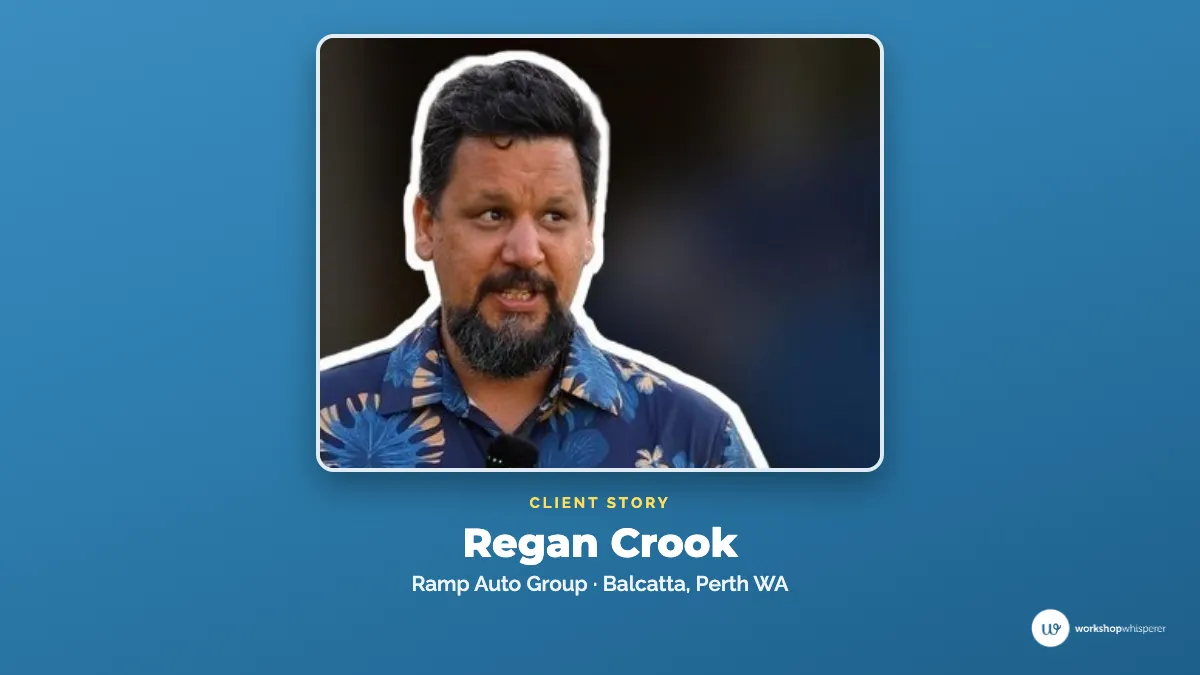
Regan runs Ramp Auto Group, a European specialist mechanics workshop in Perth, Western Australia. He's been operating since 2011. Today the team is Regan, a service advisor (a service writer, if you're in the US), a technician and an apprentice.
From the outside it looked like a business doing well. Here's how he describes it:
"We had always been a very very busy workshop but we never actually really made any money."
The turnover was there and so was the work, but every week, month and quarter ended the same way:
"End of the week, end of the month, end of a BAS was always a killer and we were sprinting and trying to pull money everywhere."
(BAS is the Business Activity Statement, the quarterly tax bill Australian businesses pay. If you're in the US, think of your quarterly sales tax and payroll tax landing at once.)
And it was getting worse. In his words, "we're just slowly edging backwards and backwards and backwards." There was ATO debt, with a bunch of other debts on top of it.
What stays with me is what happened when he tried to talk about it. His friends would say, "oh you're busy. You're flat out. You're working all the time. You know, you must be making bank." And Regan would sit there thinking, "Oh, not really."
If you've had that conversation yourself, you'll know how lonely it is. Most of the people around you are employees, and even your mates in other trades are often a sparky with one apprentice. They've never carried a team, a building and a tax bill, so they can't help with the thing that's actually keeping you up at night.
When is it time to ask for help?
Regan first came across my content around 2017. He followed it for years and never acted on it. At the ten-year point he stopped and looked hard at the business:
"If I'm not doing this right after 10 years, something's wrong."
He was, in his words, "basically on my last legs of going how do I shut the shop down and not go completely broke." So he "shelved my ego aside" and asked for help.
I know how hard that is after ten years of working it all out on your own. Plenty of auto repair shop owners put it off until the bank makes the decision for them.
What did Regan change to start making money?
He stopped buying on a gut feeling. Regan is honest about this one. Over the years the shop bought things "on a gut feeling", and a month or two later the BAS would come through and the money wasn't there, because it had gone on a new piece of kit. Looking back, what he needed sooner was better financial management, and "actually understanding what dollars we do actually have to spend".
He turned up to his tune-up call every single week. In his program, clients have one-on-one tune-up calls with a business coach, and Regan does his "every single week regardless". He's open that he didn't use them well at first, and it took him "a good 2 3 months to actually get really stuck into everything". He also knows what happens when he lets them slide: "all of a sudden you go, 'Oh, it's been 2 months and I done nothing towards what I was hoping to do.'"
Some weeks, he admits, the work gets done in the half hour before the call: "Oh, I've got to do that. Better get it done." That still counts. Without the call on the calendar, it wouldn't have been done at all.
He let a game plan say no to the shiny things. Regan calls it "shiny thing syndrome", the rabbit holes that pull an owner away from what matters. When he wants to dive off in a new direction, his coaches ask him one question: "Does that align to your game plan?"
He found people who understand. His biggest takeaway was the community, a room of other auto repair shop owners carrying the same weight. With them he can say "not really" out loud and get an answer that helps.
What did it get him?
Ten years in, Regan had a busy shop sprinting from one BAS to the next, carrying ATO debt, and an owner looking for the least painful way to close. This is where he is now:
"We've paid off a hell of a lot of ATO debt that we had, a bunch of other debts..."
He can't remember the exact number, but his own estimate is that by the end of this year it should be close to half a million dollars in debt paid off, from a shop that by his own account never made any money.
The team changed too. At one point Regan had four technicians working for him. Now:
"We actually turn over more now with one tech and an apprentice and me very occasionally being on the tools."
When he grows the team again over the next three years, he wants to do it "effectively", so each new hire shows up in the results. He's also moved premises in the last six months, and there's a dyno on his wish list.
None of that came from finding more customers. He already had plenty. It came from managing the money those customers were already paying him, and from the weekly rhythm that kept him to it.
His one regret is timing. If he'd started three or four years earlier, "we definitely wouldn't have been in the position of how much debt we had."
Watch Regan tell it himself (6 minutes). He talks through how close he came to shutting the doors, and what changed once he stopped going it alone.
What can you change in your own shop?
Each thing Regan changed is something you can start on.
- If your garage is busy and the bank account doesn't show it, start by finding where the money is leaking. Why am I busy but not making any money? walks through the three places it usually goes.
- If the end of every quarter is a scramble, the fix is knowing what's owed before you spend. How do I fix cash flow in my auto repair shop? covers it step by step.
- If you're making buying decisions on a gut feeling, put a small set of numbers in front of you every week instead. Start with the numbers an auto repair shop owner should check every week.
- If you think another technician will fix it, remember Regan turns over more with one tech and an apprentice than he did with four. Read will hiring another technician fix my cash flow? before you advertise.
- If you're at your own ten-year point, ask honestly whether you'd be further ahead with help. The weekly accountability Regan leans on is built into The Engine Room, with one-on-one coaching from a business coach who is a current or former auto repair shop owner. Is business coaching worth it for an auto repair shop? lays out what it costs and what it returns.
Questions auto repair shop owners ask
Why is my shop busy but I never make any money?
Because busy measures the work coming in, and profit depends on how much of it you keep. Regan's automotive workshop always turned over well and had good clients. The money went on debt, tax bills and purchases made before anyone checked what was owed, and for ten years that kept the shop going backwards while it looked flat out.
Will hiring more technicians fix it?
Often it won't. Regan had four technicians at one point. Today he turns over more with one technician and an apprentice. More people on the floor only helps once the money and the systems underneath them are working.
How long does it take to see a difference once you get help?
Regan says it took him a good two to three months to really get stuck in. What made the difference after that was consistency: a tune-up call every single week, regardless, and a game plan to check every new idea against.
What can I do about it tonight?
Open your bank account and write down three numbers: what's in it today, what's owed in the next 90 days (your BAS or quarterly tax, wages, loan repayments and any tax office debt), and the gap between them.
Then look at the last thing you bought for the shop and ask it the question Regan's coaches ask him: "Does that align to your game plan?" If you don't have a game plan to check it against, that's the place to start.
Related questions:
- What Is a Healthy Profit Margin for an Auto Repair Shop?
- Markup or Margin: How Should I Price Parts?
- Why Isn't My Auto Repair Shop Paying Me?
See what changes for the people who do this work. On our Our Clients page, auto repair shop owners like Regan, named and on camera, tell you what actually changed in their shops and their numbers.
More on this topic: all Money & Profit articles.
Whenever you're ready, here's how we can help.
- Not ready to spend anything yet? Start free with Shop Talk, a 30-day reset for auto repair shop owners on our YouTube channel, and our free resources for auto repair shop owners.
- Over $50,000 a month and busy but not seeing the money? The Engine Room changes how the whole business runs, from your numbers to your team, delivered online with weekly accountability and one-on-one coaching on demand from a business coach who is a current or former auto repair shop owner.
- Running an auto repair shop under $50,000 a month? Auto Superstars Academy builds the foundations, with one-on-one coaching on demand from a business coach who is a current or former auto repair shop owner.