
How Do I Fix Cash Flow in My Auto Repair Shop?
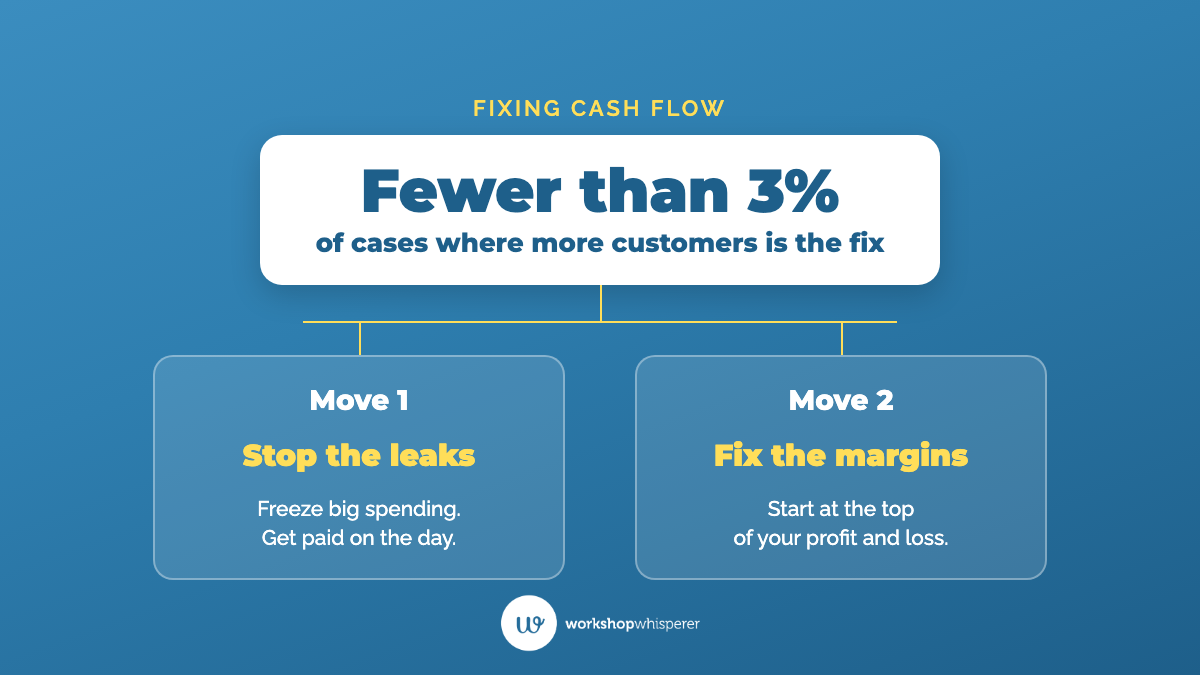
You fix cash flow in your auto repair shop in two moves. First you stop the leaks: freeze the big spending, put the tax and super money somewhere you can't touch it, get paid on the day, and pull the cash that's sitting on your shelves back into the bank. Then you fix the margins at the top of your profit and loss, so every job leaves enough behind to cover the bills. More customers is almost never the answer. In the shops that come to us with tight cash flow, it's the fix in fewer than 3% of cases.
If money is tight right now, you're in good company. I can't think of a single business, my own included, that hasn't had a period of tight cash flow. The warning signs are the same in every mechanics workshop, automotive workshop and garage we work with, and so is the way out.
Why am I always short of cash when we're so busy?
When our own shop was young, getting to the end of the month without enough money to pay every bill happened most months. There wasn't enough work coming in to cover the fixed costs, and at least we could see it.
A busy shop usually can't see it, because of the EFTPOS machine. Almost every one of us takes card payments every day, so a settlement lands in the bank account every day you trade. That daily top-up lets you cover a shortfall without ever seeing it. It can save your bacon for a couple of months, sometimes for two or three years. Then one month the hole is wider than the daily injection can fill. That's when the tax office comes calling, wages get hard to pay, the owner has already cut their own pay, and some suppliers have put you on stop credit.
Being bigger doesn't protect you. Shops turning over $100,000 a month or more often have the tightest cash flow, because the growth that got them there was chaotic. Only recently we were talking with a shop doing half a million dollars a month in revenue with no profit, and it already had hundreds and hundreds of customers coming through every month.
So watch for the early signs. Any one of these is enough to act on:
- The month has ended and not every bill is paid.
- You're using the GST to pay suppliers, the team or yourself. Or sales tax, if you're in the United States.
- You're dipping into your team's super. Or their KiwiSaver, or 401(k) contributions. That's your own people's retirement money.
- You can't meet a quarterly tax instalment. Even one short quarter counts.
- You're avoiding your accountant. If you don't look at it, it feels like you don't have to deal with it.
Stress makes the hole deeper too. When you're awake at 2am wondering how you'll pay the team this week, it's hard to make good decisions. That's when owners sign up for advertising that won't bring the right customers, or finance a shiny new ute because it makes them feel better. Neither one fixes the leak.
What should I do first when cash is tight?
Stop and look. After one lower cash flow month, or the moment any of those signs show up, give yourself a morning, an afternoon or a weekend to go through the numbers. Don't wait for your accountant to ring you. If you only speak to them once or twice a year, you can be broke between visits.
Freeze the big spending. No large withdrawals to yourself, no new equipment, no new cars, and no new hires until you understand your true financial position. Only hire when you can see the business case in front of you. If you're still guessing whether you can afford a new team member or that finance, you're not running your business, it's running you.
Move the money that was never yours. Open at least two extra accounts, one for GST and tax and one for super, and move the money in as it arrives. If you're still tempted to dip in, pay it to the tax office and the super fund weekly so it isn't sitting there. "Sales tax or GST is not your money. It's the government's money."
Stella and Selwyn King run JDM Motorsport in Brisbane. When they came to us, they were heavily oversubscribed and still couldn't keep up with the tax. "We were starting to get into trouble with paying our BAS. We couldn't afford to pay them. We could literally just afford to cover our operating expenses." They had "like a 55 grand ATO debt." From the start, they worked with Dean from our team to set up Profit First, so the tax account "always has money in it to pay our BAS." They called it "a game changer," and at home, "we're not financially stressed out all the time." Read Stella and Selwyn's story.
Get paid on the day. Every car that leaves unpaid is a job you're financing, whether the invoice wasn't ready or you felt sorry for the customer. Fleet work runs on the fleet company's terms, but your everyday customers can pay on the day. If the thought of asking makes you feel queasy, lean into that fear. The cash flow you dream of is on the other side of it. For customers who need time to pay, offer one of the third-party payment providers and let them carry the risk. You are not a bank.
Take the cash off your shelves. If you're on a good freight run and parts arrive within the hour, you don't need 15 of your most popular oil filter on the shelf. Five will do. Ring your supplier about anything you haven't sold, and they'll usually credit stock you bought in the last 12 months. Then look at the cars sitting in your yard. When we took over our first shop, three vehicles had been on the floor for three or four months with $2,800 in labour and parts sitting in them. Get the big jobs out first.
Then go through every dollar going out. List your debts and your recurring expenses, and go through them with a fine-tooth comb. Ring around for better deals, sell what you no longer need, and roll expensive credit card debt into a cheaper loan. Look honestly at what you're paying yourself too. I once saw a profit and loss where the business made a loss every single month, and the reason was the owners' withdrawals.
A worked example: one payment plan. Say a customer's bill is $1,000 and you agree to $100 a week. You've already paid your technician for the hours and you owe your supplier for the parts, but that $1,000 reaches your account over ten weeks. Agree to four of those in a month and up to $4,000 of your customers' bills is being carried with your own money. These are example numbers, so run the sum with your own.
GST works the same way. If your takings this week were $22,000 including GST, $2,000 of that belongs to the tax office before you've paid a single bill.
How do I stop cash flow problems coming back?
Those first steps give you breathing space, but they don't fix the cause. In almost every shop, that comes back to margins.
Start at the top of your profit and loss. That's the section that decides your gross profit. Ask these questions in order. Is your labour rate high enough to give you a healthy labour margin? Are your parts doing their share of the heavy lifting? Have your suppliers moved their prices without you moving yours? And how much time is being written off? Every hour written off drags down your effective labour rate, the money you really receive for each hour.
As Dean puts it, "you don't get paid off revenue, you get paid off of gross profit." His benchmark for gross profit is 58% to 62%, and he sees the same mistake time and again: shops pricing parts off the recommended retail price, which was set by someone who knows nothing about your costs. Price that way and you'll almost never hit it.
Then check the balance sheet. If gross and net profit both look healthy and there's still no cash, the money has moved onto the balance sheet. It's gone into a debt to the tax office, too many vehicles on finance, or more money taken out than the business could afford.
Stop paying for hours that aren't sold. Overtime makes sense only once your technicians are charging out their hours. Before you add overtime, we look for productivity above 90%. If they aren't, you're paying dead money. Leave a little unsold time in the booking diary each day too, so the extra work your technicians find can be done while the car is already on the hoist. That work is usually higher margin, because the technician is already on the job.
Look every week. Our clients sit down every Friday and go through a set list of financial measures, and then they make decisions from the numbers, not from a feeling. You don't need to understand the whole profit and loss on day one. Learn one more part of it each week. If your shop is turning over more than $50,000 a month, The Engine Room is where we set up that Friday finance meeting and the structure around your money with you, with one-on-one coaching on demand from a business coach who is a current or former auto repair shop owner.
We've seen the same pattern in more than 10,000 auto repair shops over more than 13 years. When an owner fixes the margins and puts a structure around the money, the cash follows.
Watch this seven-and-a-half-minute video if you still think more customers will fix your cash flow. In it, Dean asks me why more customers almost never solve cash flow problems, and I walk through where the money goes instead, from the top of your profit and loss to the balance sheet.
Questions auto repair shop owners ask about cash flow
Will more customers fix my cash flow?
Very rarely. More customers help a new shop that has labour hours it can't sell yet. In the other 97% or so of cases, more cars pour more water into a leaking bucket and make the problem worse. Fix the margins first.
Should I offer customers payment plans?
No. Every week a customer takes to pay, you're financing their job with your money. Offer a third-party payment provider so they carry the risk and the admin. A customer who says they can't pay until payday is a red flag.
Is it OK to use my GST money to get through a tight month?
No. If you've had to dip into the GST even once, it's telling you the business can't afford itself right now. Move the GST, tax and super into separate accounts as the money comes in, and work out why the business needs more than it has.
How often should I meet with my accountant?
Monthly. If you're only seeing them every six or twelve months, a cash flow problem can grow for most of a year before anyone points it out. If your accountant isn't proactive about your numbers, it may be time to change accountants.
Where to start tonight
Log in to your business bank account and open one new account. Name it GST and tax. Then work out how much of last week's takings belonged to the tax office, and move it across as soon as the transfer will go through.
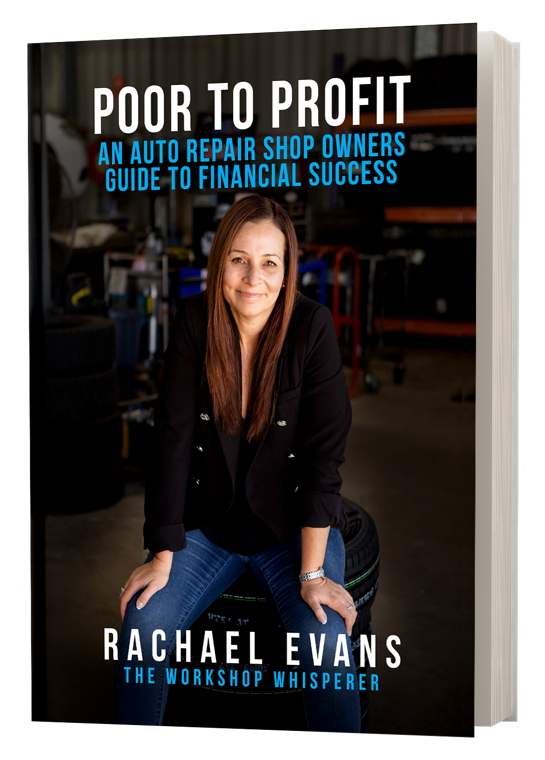
If the numbers have never made sense to you, my free ebook Poor to Profit is the place to start. It's an auto repair shop owner's guide to financial success.
Related questions:
- Markup or Margin: How Should I Price Parts?
- Why Isn't My Auto Repair Shop Paying Me?
- Busy but Never Making Any Money? How Regan Crook Turned It Around
See what changes for the people who do this work. On our Our Clients page, auto repair shop owners, named and on camera, tell you what actually changed in their shops and their numbers.
More on this topic: all Money & Profit articles.
Whenever you're ready, here's how we can help.
- Not ready to spend anything yet? Start free with Shop Talk, a 30-day reset for auto repair shop owners on our YouTube channel, and our free resources for auto repair shop owners.
- Running an auto repair shop under $50,000 a month? Auto Superstars Academy builds the foundations, with one-on-one coaching on demand from a business coach who is a current or former auto repair shop owner.
- Over $50,000 a month? The Engine Room changes how the whole business runs, from your Friday finance meeting and the structure around your money to your team, delivered online with one-on-one coaching on demand.