
Why Isn't My Auto Repair Shop Paying Me?
Your auto repair shop is probably making money. You're not seeing it because you pay yourself last, out of whatever is left after everyone else, and in most shops nothing is left. The fix is to change the order: decide your pay and your profit first, move them into their own bank accounts the day the money comes in, and let the business run on the rest. Then make sure your gross profit is big enough to feed all of it.
If you're the last one paid, it isn't because you're bad at business. Nobody ever sat you down and taught you this, and most owners would rather pay the team and the suppliers before themselves, out of pure decency.
Whether you run a mechanics workshop in Perth, an auto repair shop in Texas or a garage in Leeds, the problem is the order you pay things in, and the fix is the same.
Why does everyone else get paid except me?
Look at last month. The techs, the suppliers, the landlord, the power bill, maybe the tax office all got paid. Then you took a small amount for yourself, a couple of times a week, if there was anything left.
That's the formula almost every owner runs: sales, minus expenses, equals profit. Profit sits at the very end, so it's a leftover. As Dean puts it, "This isn't a money problem. You're making money, right? It's an order problem."
The trouble with leftovers is that an auto repair business is a hungry thing. It never gets full. Give it more money and it will find more to spend it on: one more tool, one more subscription, one more thing the shop needs. That's why a bigger month rarely fixes it, because the spending grows to meet whatever is sitting in the account.
Miles, from Adelaide, wrote in to our podcast: "Last year we turned over $1.5 million but we have almost no money in our bank account. I have no idea what we are doing wrong."
Turnover is vanity and profit is sanity. The net profit line on your profit and loss can show a couple of hundred thousand dollars that isn't in your bank account, because it's a paper profit. Your debt repayments to the tax office, your car loans and your equipment loans don't sit on the profit and loss. If you're not on the pay run and you take drawings instead, they don't sit there either. All of it comes out of that profit figure, and by the time your accountant tells you that you made $300,000, you've already spent it.
Shop owners get used to taking the dregs, whatever is left after all the expenses. It's an amazing achievement to provide employment for people. But you're the business owner, and you need a reward for that.
How much should I actually be paying myself?
There are two parts to your pay, and they're paid differently.
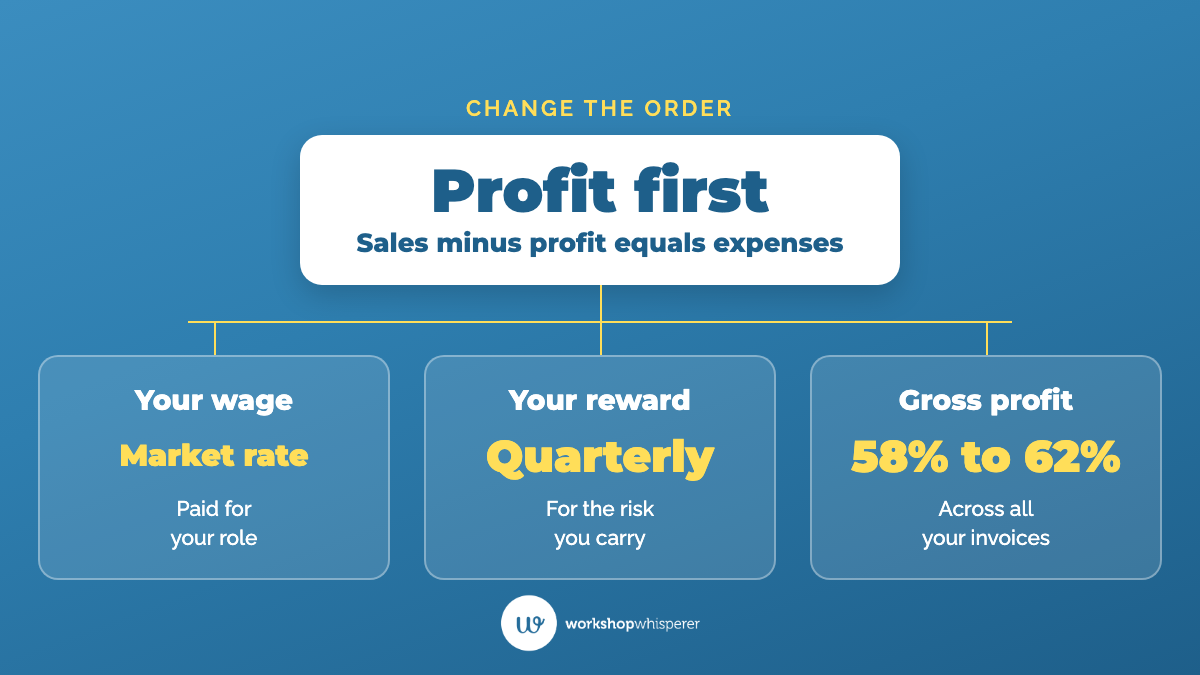
A wage for the job you do. You should be paid a market-rate salary for your role in the business. If you're still on the tools, you should be paid like one of your technicians, if not a little more. If you're running the shop, the role you do is the most important one in the business, so pay yourself accordingly.
A reward for the risk you take. On top of your wage, every quarter, you take a profit distribution. You carry the risk of the building, the equipment inside it, and the families of everyone you employ, and you're entitled to a piece of the profit for carrying that risk. If your business only covers its bills and your wage, and never pays you anything on top, it's a break-even business at best.
There's a catch on the other side, and we see it often. Plenty of owners are paying themselves more than they should be for the revenue they've got, but less than they deserve, and both can be true at once. We've seen a profit and loss where the business was making a loss every single month, probably in its final month of being able to trade, and the reason was the owners' withdrawals. Those withdrawals aren't always cash. It might be $200,000 worth of cars under finance, with repayments the business can't justify right now.
The other version is the blurred account. I spoke to a client who was using the business account for everyday expenses. "If I want a massage, I'll just go and use the business account. If I go and buy the groceries, I'll just go and use the business account." When your money and the business's money live in the same place, you can't tell what either one can afford.
So the honest answer to "how much?" is this: a market wage for your role, a quarterly share of the profit, and a plan that gets you from what the business can afford today to what you deserve. Getting there usually takes us around 18 months with a new client, because it depends on the debt, the margins and the cash flow you're starting from.
How do I start paying myself first?
Flip the formula. Instead of sales minus expenses equals profit, run sales minus profit equals expenses. Take your profit off the top, then tell the business how much it has to run on. What we see time and time again is that the business adapts. It learns to run on a smaller serving.
Dean explains it like a personal trainer. A good trainer doesn't put you straight on the treadmill. They measure where you are, agree where you want to be, then build a plan that works the muscle and trims the fat. Your profit and your pay are the muscle. Your operating expenses are the fat.
Give every dollar its own account. Most owners who come to us run their shop on one, two, or at most three bank accounts. That isn't enough. We set up five:
- Income. Every customer payment lands here first. The GST comes straight out, because it's the government's money, not yours.
- Profit. A set percentage moves here before anything else happens. It pays down debt, builds a war chest for emergencies, and funds your quarterly reward.
- Owner's pay. Your wage, any drawings or dividends, and your own super. This is the money you transfer to yourself for the business of living your life.
- Tax. Company tax, personal income tax, PAYG or PAYE. Your tax bill is coming either way, so the money for it gets put aside the day the job is paid.
- Operating expenses. Suppliers, team wages, rent and bills. For most owners, it's the first time they've told the business how much it gets to spend.
The percentage for each account isn't a number off the internet. It depends on where your business is today, which is why we work it out shop by shop. If your shop is turning over under $50,000 a month, Auto Superstars Academy builds your numbers and your cash flow with you, with one-on-one coaching on demand from a business coach who is a current or former auto repair shop owner.
If you're worried about the bank fees on five accounts, Dean has the best answer I've heard: "That's not a fees question, that's a sleep question."
Check the money is there to divide. Paying yourself first only works if the business keeps enough of every dollar it brings in. That's your gross profit, what's left after parts and materials. Dean's benchmark for a healthy, profitable independent auto repair shop is gross profit of 58% to 62% across all your invoices. It's fed by two numbers: labour gross profit at 70% to 74%, and parts gross profit at 48% to 52%. If either one is low, money leaks out before it ever reaches your accounts. As Dean says, you don't get paid on what you make, you get paid on what you keep.
What a few points of gross profit are worth. This is an illustration, not a client's figures. Take a shop selling $45,000 a month. At 50% gross profit it keeps $22,500. At 60% it keeps $27,000. That's $4,500 a month, or $54,000 a year, from the same work. For a lot of owners, that gap is the wage they haven't been paying themselves. Work it out with your own sales and your own gross profit.
Owners who've done it. Reagan, one of our clients from Perth, paid off nearly $400,000 of debt by changing the order he paid things in. We have another client in Western Australia who came to us with $450,000 of tax office debt, and with this cash flow system cleared all of it in four years. Sarah, from New South Wales, finally had the money for her bills sitting in its own account at the end of every month, instead of scrambling for it. In more than 13 years, we've helped more than 10,000 auto repair shops.
Dale and Tanika Nolan run Performance 4x4 in Capalaba, Queensland. When they came into The Engine Room, every day was chaos, and money was the thing they avoided. "I wouldn't worry about money. I refused to look at it." Now they know exactly where they stand, "even if it's not a good spot." And the order changed. "We'd never taken a profit from the business and now we take our quarterly profits every quarter." Their first ever dividend "was like 60 bucks", enough to treat themselves to McDonald's. It doesn't matter how small the first one is. What matters is that you're finally on the list. Watch Dale and Tanika's story.
Watch this 28-minute video to see Dean walk through the whole system: why you're the last one paid, and how your money splits into accounts that pay you first.
Questions auto repair shop owners ask about paying themselves
Should I pay myself a wage or take drawings?
You should be paid a market-rate wage for the role you do, then take a share of the profit every quarter on top. Your owner's pay account covers your wage, drawings and dividends, so whichever way your accountant structures it, the money comes from one place and you know what the business can afford.
Why does my profit and loss show a profit when I have no money?
Because it's a paper profit. Loan repayments, tax debt and drawings don't appear on your profit and loss, but they all come out of that profit figure. Look at your balance sheet alongside it, and look at both monthly, not once a year.
How many bank accounts does my auto repair shop need?
Five: income, profit, owner's pay, tax and operating expenses. Each one has one job, and any dollar can only sit in one of them. The bank fees are tiny next to knowing your tax and your wage are already safe.
What percentage should I put into my profit account?
It depends on your current financial position: your debt, your margins and your cash flow. The split is designed for each shop, with a plan that walks you from where you are today to a healthy benchmark over about 18 months.
Where to start tonight
Pull up last month's bank statement and write down who got paid, in the order they got paid. Then mark where you sat in that line, and be honest with yourself. For most owners, the answer is dead last again, and once you've seen it written down, you can start changing it.
Related questions:
- How Do I Fix Cash Flow in My Auto Repair Shop?
- Markup or Margin: How Should I Price Parts?
- How Do I Pay Off My ATO Tax Debt? How Megan and Adam Cleared $80,000 in a Year
See what changes for the people who do this work. On our Our Clients page, auto repair shop owners, named and on camera, tell you what actually changed in their shops and their numbers.
More on this topic: all Money & Profit articles.
Whenever you're ready, here's how we can help.
- Not ready to spend anything yet? Start free with Shop Talk, a 30-day reset for auto repair shop owners on our YouTube channel, and our free resources for auto repair shop owners.
- Running an auto repair shop under $50,000 a month? Auto Superstars Academy builds the foundations, including your numbers and your cash flow, with one-on-one coaching on demand from a business coach who is a current or former auto repair shop owner.
- Over $50,000 a month? The Engine Room changes how the whole business runs, starting with a profit report and a rollout plan that gets you paid first, delivered online with one-on-one coaching on demand.