

Will Hiring Another Technician Fix My Cash Flow?
Almost never on its own. If the technicians you already have aren't selling at least 80% of the hours you pay them for, another technician adds a full wage to the same leaks, and the money runs out faster. Hire when your mechanics workshop has more work to charge out than hours in the week to charge it, and not before.
If you've been thinking about it, it's because you're flat out and you can feel the pressure on your team. Wanting to take the load off them is a decent instinct. The trouble is that hiring before you've checked the numbers usually makes the money tighter, not looser.
The test is the same whether you call your business an auto repair shop, an automotive workshop or a garage. Your numbers will tell you if you need another set of hands, so you never have to guess.
Why doesn't another technician fix my cash flow?
Picture the week most owners describe to us. You're booked out three or four weeks ahead. Cars are everywhere, jobs are on the board and the phones are ringing. Then Friday comes, you open the bank account, and you're left scratching your head wondering where all the money went.
So you think, if I had one more tech, we'd clear the backlog and make more money. It makes complete sense, and it's usually the wrong read. As Dean puts it on the A-Grade Auto Repair Shop Show, "you've got a profitability problem, not a capacity problem."
Between a car rolling in and money landing in your account, there are five checkpoints where the money is either made or lost. Dean lists them as:
- Your labour rate (labor rate, if you're in the US). Is it enough to hit your gross profit target?
- Your labour sold. Is every minute a technician spends on a job being captured and charged?
- Your efficiency. Is a four-hour job finished in four hours, or is it creeping out with nobody tracking the extra time?
- Your margins and markups. Are parts priced to a benchmark, or on gut feel?
- Your average repair order, or average job value. When a technician finds more work, is it offered to the customer, and does the customer say yes?
Every broken checkpoint is a hole in the bottom of the bucket, and a new technician doesn't plug any of them. You pay 100% of their wage however productive they are, and every hole drains part of what they bring in. As Dean says, hiring into that is "like changing hoses to fill a bucket full of holes." You get more pressure, more noise and the same result on Friday.
It gets worse when you're already rushing. A team that's redlining has no time to recommend extra work, so the average repair order drops. Quality slips, comebacks rise, and that time gets written off.
The same thing happens when revenue goes up and nothing reaches the bottom line. If more work flows through at the same poor margins, all you've got is an amplified bad gross profit result. If your wages already sit above benchmark, a bigger wages bill makes that gap bigger. As I put it on Talking Shop, if the simple equation to profitability was more jobs and more hands, The Workshop Whisperer probably wouldn't exist.
Tanya and Godfrey Nardone run GTN Services in remote Western Australia. They went through about two months of not being able to pay wages and using their own money to cover it. In Tanya's words, "We are at a point where we have no money. We can't pay our bills. We can't pay our wages." They didn't fix it with another set of hands. They lifted their labour rate from $120 an hour to $150 an hour. "Everyone's fear is oh my god we'll lose all our customers," they say. "We're actually doing less work and more money. But the workshop's happier." Read Tanya and Godfrey's story.
How do I know if my technicians are productive enough?
Productivity is the number that answers this. It's the hours your team sold, divided by the hours you had available to sell. Take last month, add up every hour you paid your technicians to be on the floor, and put it next to the hours you actually charged out.
You want 80% or more. That figure has room built in. Once you take out public holidays, annual leave and sick leave, a technician who sells 80% across a year is giving you close to 100% of their available time. Anyone above that is doing a great job for you, so make sure you recognise it.
Most owners are a long way short when they first measure it. Dean says a good shop usually starts somewhere between 50% and 60%, and he's seen some as low as 30% to 40%. When we bought our first workshop, we were selling 15% to 30% of our available hours. It was a business in decline, and it was really rough. When you're that low, you're not taking a wage for yourself and you can't afford to hire anyone.
If your team is sitting at 50% to 60%, there are only two reasons. Either you don't have the work to give them, or they're taking far longer than the job should take. Both of those are on you as the owner, and both can be fixed without another wage.
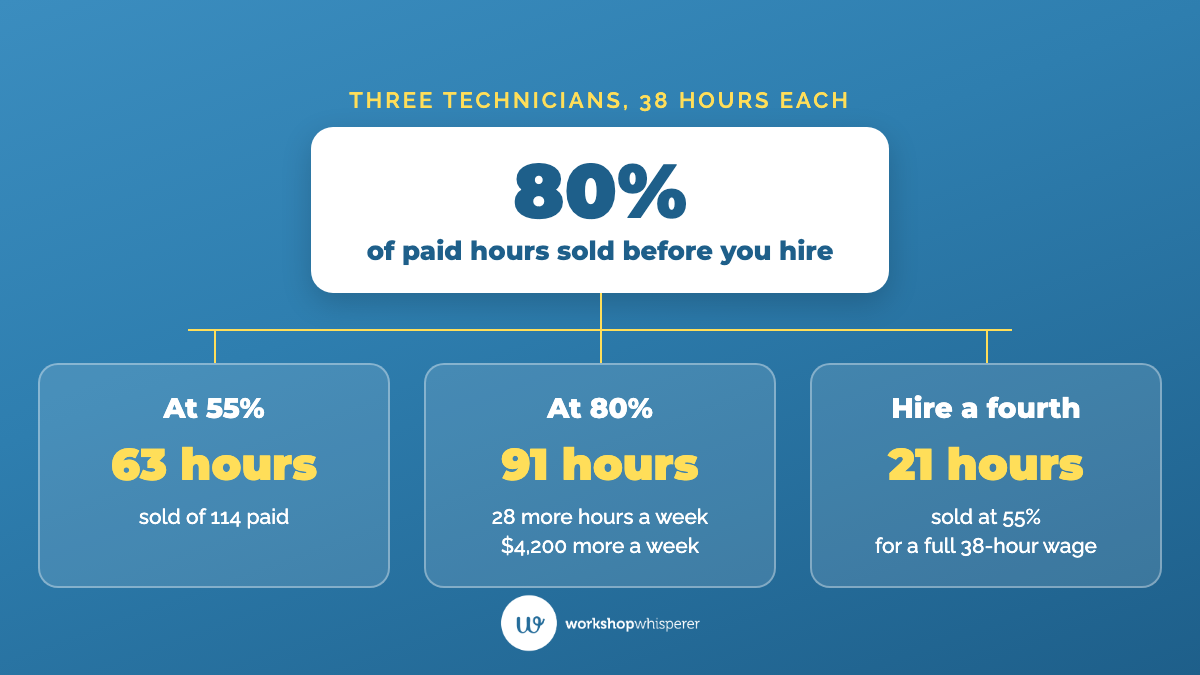
A worked example. These are my own example numbers, so run yours. Take a shop with three technicians, each paid for 38 hours a week. That's 114 available hours. At 55% productivity, the shop sells about 63 hours. Lift that to 80% and the same three technicians sell about 91 hours. That's 28 more hours a week. At a labour rate of $150 an hour, it's $4,200 more labour a week, and you've already paid the wages, so nearly all of it lands as profit.
Now hire a fourth technician instead, into the same shop. You pay all 38 of their hours. At the shop's 55%, they sell about 21. You've added a full wage and around half a technician's worth of income, and you've still got the leaks.
Small lifts add up too. A few extra minutes an hour on the invoice is worth more than most owners think, and I've worked through what that's worth here.
It still blows my mind that some shops come to us without continuous time clocking. When it's not there you have no reliable way of holding technicians to selling the hours you pay them for. Switch it on and it's bumpy for the first month or so. Stay on it, and you'll see a natural lift of around 6% in workshop productivity.
If your shop is turning over more than $50,000 a month and this sounds like your floor, this is the work we do with you in The Engine Room, with one-on-one coaching on demand from a business coach who is a current or former auto repair shop owner.
When is the right time to hire another technician?
It's the right time to hire another tech when you have more work to charge out than you have hours in the week to charge it. Before you start recruiting, check four things:
- Productivity is over 80% and your technicians are selling the hours you pay them for.
- Written-off hours are down to about 10% to 15% a week, not drifting above that.
- Your effective labour rate is equal to or better than your advertised rate. This is the hiring test from our Talking Shop episode How to Hire Out of a Hole, and it's a higher bar than the everyday benchmark of landing within 10% to 15% of your advertised rate (here's how to work out your effective labour rate). If you charge out at $150 an hour but jobs blow out and the time isn't added on, Dean points out you might only be making $75.
- Your gross profit on labour and parts is where it should be. Selling the hours means little if they're sold at the wrong margins.
If you don't know your break-even, start there. If the hours you sell don't cover what your shop costs to run, a bigger wages bill makes it harder to cover. And when the numbers do say it's time to hire, our free checklist 5 Smart Questions to Ask Before You Hire helps you choose the right person.
When all four are true, recruit a little before you need the person. Hiring into a shop that's already redlining means nobody has time to train them, and they arrive into the stress you're trying to fix. Bring them in while there's still some space, show them how you do things, then fill them up with work. Have your systems written down first, so a new technician isn't left to work out the way you do things from what's in your head.
There's a gauge for what a team should produce, too. We know a solidly profitable auto repair shop with two fully qualified technicians and two apprentices should be able to generate $1.2 million a year in revenue. If your team is the same size and well short of that, look at productivity before you look at a job ad.
More often than not, we see the opposite of what owners expect. When an owner scales down to fewer technicians, the business gets healthier financially and stronger culturally, because fewer of the right people are doing more of the right work and you've stopped carrying unproductive wages.
Watch this before you put a job ad up. In about 20 minutes, Dean walks through the five checkpoints one by one and shows what he calls the hiring hole, where a new technician's wage sits against every leak in the shop.
Questions auto repair shop owners ask about hiring another technician
How do I calculate technician productivity?
Add up the hours you paid your technicians to be available last month, then add up the hours you actually sold. Divide the hours sold by the hours available. Aim for 80% or more across the year.
We're booked out for weeks. Doesn't that mean I need another tech?
Not on its own. Being booked out tells you about demand. It doesn't tell you whether your current team is selling the hours you pay for. If productivity is under 80%, or you're writing off more than 10% to 15% of hours, fix those first. The extra work will fit into hours you're already paying for.
Should I hire one really good technician to lift the whole team?
One great tech won't counterbalance a team that's underperforming. As Dean says, "a champion team will always beat a team of champions." A small lift across every technician is worth more than one person billing 120%.
What if my technicians are slow because they're inexperienced?
Then the gap is training and expectations. If you've got a green apprentice or a newly qualified technician, they won't sell every hour yet, and you plan for that. If an experienced tech fills their hours without selling them, that's a performance conversation, and it's yours to have.
Where to start tonight
Pull up last month. Add up the available hours for every technician on your floor, then the hours you actually sold, and divide one by the other. That one number tells you whether you have a hiring problem or a productivity problem, before you spend a dollar on a job ad.
Related questions:
- How Do I Move to a 4 Day Work Week Without Losing Profit?
- How Do I Measure Technician Efficiency and Productivity?
See what changes for the people who do this work. On our Our Clients page, auto repair shop owners, named and on camera, tell you what actually changed in their shops and their numbers.
More on this topic: all Productivity articles.
Whenever you're ready, here's how we can help.
- Not ready to spend anything yet? Start free with Shop Talk, a 30-day reset for auto repair shop owners on our YouTube channel, and our free resources for auto repair shop owners.
- Numbers say it's time to hire, and you want to get it right the first time? No More Bad Hires is a complete recruitment system for finding and keeping the right people.
- Running an auto repair shop under $50,000 a month? Auto Superstars Academy builds the foundations, with one-on-one coaching on demand from a business coach who is a current or former auto repair shop owner.
- Over $50,000 a month? The Engine Room changes how the whole business runs, from your numbers to your team, delivered online with one-on-one coaching on demand.