

What Numbers Should an Auto Repair Shop Owner Check Every Week?
Check five numbers every week: your gross profit, your net profit, your effective labour rate, your average repair order and your labour versus parts split. Add one more for the shop floor, the hours each technician sells against the hours they had available. Sit down with those numbers for 30 minutes every Friday and you'll know how your business is travelling weeks before your accountant tells you.
If you don't do this yet, it's not because you're lazy with money. Nobody ever taught you, and you've been flat out doing the work.
The list is the same whether you run a mechanics workshop in Australia, a garage in the UK or an auto repair shop in the US, and whether you call it your labour rate or your labor rate, your average repair order or your average job value.
Why isn't my accountant's report enough?
Most auto repair shop owners believe their accountant handles their finances, and it makes sense. You see your accountant four times a year. They show you a report and tell you how things went, and it feels like financial management, even though it isn't.
By the time your accountant sits across the table and tells you something's wrong, it has already happened. If you're lucky, it happened in the last three months. Sometimes it's six to twelve months since the problem started, and you had no idea it was there.
Think of a pilot in the cockpit. The instrument panel tells them their airspeed, altitude, direction and distance to the destination, and every decision they make comes from it. Cover that panel up and you wouldn't want to be a passenger on that plane. Plenty of auto repair shops run every week with the panel covered.
This is also where a shop stuck at six figures and a shop running at seven figures part ways. The six-figure owner looks at these numbers when they see the accountant, maybe four times a year. The seven-figure owner looks at them 52 times a year and uses them to decide what needs fixing next week.
As I put it on the show: "Your accountant manages your history. But the Friday Finance Meeting allows you to manage your future one week at a time."
Which numbers should I check, and what does each one tell me?
Inside The Engine Room we track a wider set of benchmarks with our members. These five are the ones every owner can pull from their own software this Friday.
- Gross profit. The percentage of your total revenue left after the cost of the labour and parts that went into the work. It's the first number to know every week, not every quarter. Rachael teaches that, averaged across your invoices, gross profit should sit between 58% and 62%. That's your labour profit and your parts profit added together.
- Net profit. What's left after everything else is paid: wages, rent, utilities, every bill it takes to keep the doors open. It's the number that's meant to end up in your back pocket, and in a lot of shops it doesn't.
- Effective labour rate. The money you actually receive for every hour of labour you charge out. It's rarely the rate on your board, because callbacks, warranty work, diagnostic time you didn't charge and time on a job nobody recorded all pull it down. Averaged across all your jobs and technicians, it's what your business really earns per hour.
- Average repair order. The average value of every job that leaves your workshop that week. You want to know whether it's going up, staying flat or quietly going backwards.
- Labour versus parts split. How much of your revenue comes from labour and how much from parts. It shows you where your profit is really coming from.
Rachael teaches a version of this list too. When a stressed owner messaged her because he could never get all the work out, she pointed him to three numbers: effective labour rate, average repair order and average car count per day. Read side by side, they show what's going on. As she put it, "the more cars you try and fit in, the less value of your average sale."
The sixth number lives on the shop floor. Rachael recommends a scoreboard, even if it's a whiteboard on the workshop wall and even if it's only you on the tools. Each technician has the hours they can sell that day. When a job is ready for invoicing, the technician who did it walks up and updates their own total. Two hours already on the board, 1.5 hours on this invoice, so 3.5 out of the 8 they had available. Her reasoning: "what gets measured gets improved over time." She's also honest that "winners love KPIs and love showing they can hit their KPI", and the board will show you anyone who's coasting.
Your service advisor has numbers too, whether you call them a service writer or a service adviser. Rachael is clear the role is measured by results, and those measures sit inside our service advisor training.
What do I do when one of the numbers is off?
When profit drops or your average repair order goes flat, the usual reaction is to book more jobs and push more cars through. It's an understandable instinct, and it's usually why the numbers keep dropping.
Think about a customer who pulls in with a warning light on. You don't tell them to drive it harder until the light goes out. You grab the scan tool, find the fault code, trace it back to the source and fix it. The light is telling you something specific is wrong somewhere specific.
Your five numbers work the same way. A soft gross profit, a flat average repair order or a tight bank balance is a warning light, and none of them is telling you to get busier. So when a number is off, read the range it should sit in, find which one is outside it, and trace it to the cause. The cause might be underpriced labour, parts that aren't marked up properly, or a technician whose efficiency is dragging because of a skills gap. Each of those is a different fault with a different fix.
One of our Engine Room members, turning over around $800,000 a year, came to us convinced he needed more customers. His gross profit was soft, his average repair order felt flat and cash was tight at the end of every week. His plan was to spend more on ads. When we ran his numbers against the benchmarks for a shop his size, the fault was his labour rate. He was charging $30 an hour below where a shop like his should sit, so every job he did was underpriced, and more cars at that rate would only have made the cash problem worse. We didn't get him more customers. We lifted his labour rate to the benchmark, and the next quarter he made more money on the same number of jobs.
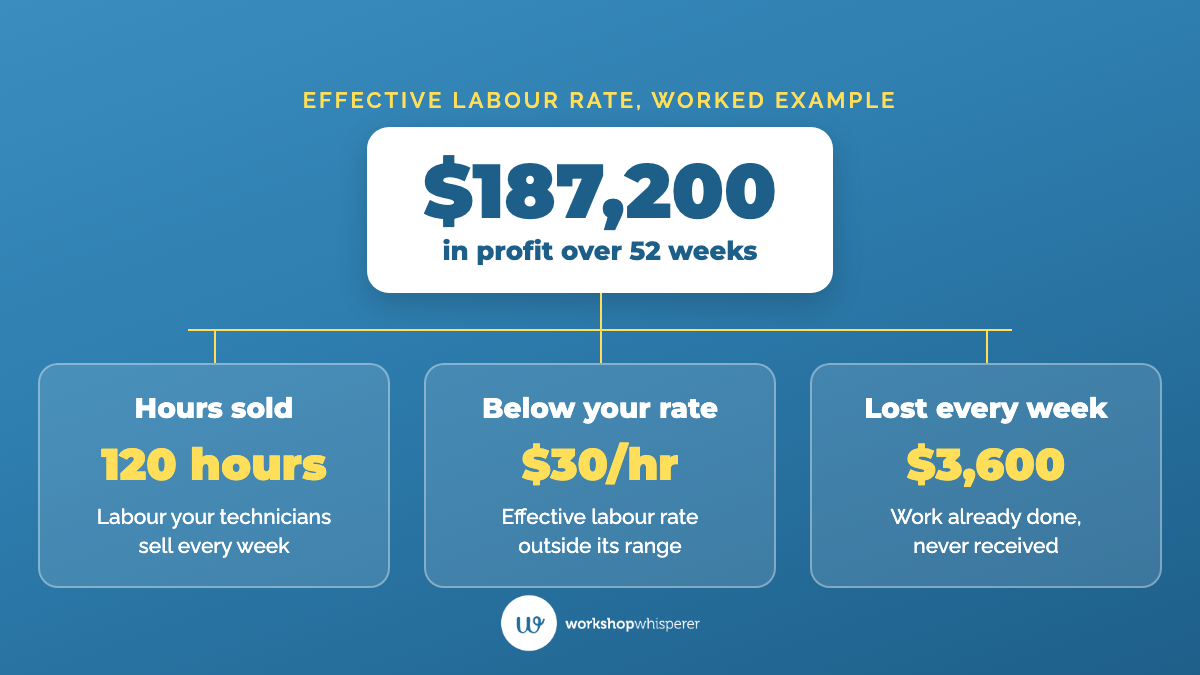
A worked example. These are my own illustrative numbers, not his. Say your technicians sell 120 hours of labour a week between them, and your effective labour rate is $30 an hour below where it should be. That's $3,600 a week you've already done the work for and never received. Over 52 weeks it's $187,200 in profit. You'd never feel it in a busy week, but your effective labour rate would sit outside its range on the first Friday you looked.
How do I run a Friday Finance Meeting?
Keep it to 30 minutes, tops, booked in your calendar as a standing appointment with your business partner or whoever else holds a stake in the numbers. Pull the five numbers from your workshop software, compare them with last week and with the range they should sit in, and name the one that's out. Then decide what you're fixing next week. The value comes from doing it every week without fail. If your shop turns over more than $50,000 a month and you'd rather not read these numbers on your own, The Engine Room is where members check theirs against benchmarks for a shop their size every week, with a business coach one-on-one on demand.
Nicola and Brett Van Huenen run Coastal Autos in Papamoa, New Zealand. In their words, "We might have looked like we were doing okay, but underneath the water, we were panicking." Brett would come home on a Friday and say, "That's it. I'm selling. I'm done." They started using Profit First, so the money for bills and wages sits "in a separate account every week," and they turned up every week to do the work bit by bit. Now "we don't ever stress about paying our bills," and "our turnover is up 70% from last year. Our sales are up 50%." That's why the meeting goes in the calendar every week.
Watch this 16-minute video before your first Friday meeting: I walk through each of the five dials and how the meeting runs.
Questions auto repair shop owners ask about their weekly numbers
Why weekly and not monthly?
Because a problem you find on Friday can be fixed on Monday, while quarterly reporting gives you surprises. A monthly check is better than nothing, but four weeks of underpriced jobs or a technician coasting is four weeks of profit you don't get back.
Where do I get these numbers from?
From your workshop management software. Gross profit, average repair order, effective labour rate and your labour and parts revenue should all be reportable there. If you're running the business without software, now's the time to get some, because you can't keep track of this in your head.
How long should a weekly numbers meeting take?
Thirty minutes, tops. Read the numbers, find the one outside its range and decide what you're fixing next week.
What should I do first if a number is off?
Find the cause before you act. The first reaction is usually to book in more work, but more jobs never fix a broken system, they only help you break it faster. Trace the number back to its source: price, parts margin, technician efficiency or the front counter.
Do I need to understand accounting to do this?
No. You don't need to be a trained accountant, but you do need to take ownership of reading your own numbers, because your accountant isn't in your workshop every day and you are.
Where to start tonight
Open your workshop software and write down last week's five numbers on one page: gross profit, net profit, effective labour rate, average repair order, and your labour and parts revenue as two separate lines. Then put 30 minutes in your calendar for this Friday, and the Friday after that, and make it repeat.
Related questions:
- Do I Need a Business Coach for My Mechanic Workshop?
- How Do I Hold My Team Accountable Without Micromanaging?
- How Do I Stop Winging It in My Auto Repair Shop?
See what changes for the people who do this work. On our Our Clients page, auto repair shop owners, named and on camera, tell you what actually changed in their shops and their numbers.
More on this topic: all Performance articles.
Whenever you're ready, here's how we can help.
- Not ready to spend anything yet? Start free with Shop Talk, a 30-day reset for auto repair shop owners on our YouTube channel, and our free resources for auto repair shop owners.
- Running an auto repair shop under $50,000 a month? Auto Superstars Academy builds the foundations, with one-on-one coaching on demand from a business coach who is a current or former auto repair shop owner.
- Over $50,000 a month? The Engine Room changes how the whole business runs, from your numbers to your team, delivered online with one-on-one coaching on demand. It's where members check their numbers against benchmarks for a shop their size every week.