

Why Am I Busy but Not Making Any Money?
You're busy but not making money because being busy measures how much work comes through the door, and profit depends on how much of that work you keep. In most shops I see, the money leaks out in three places: margins that are too thin, so more work only means more thin work; hours you pay your technicians for but never bill; and a diary so full there's no room left to sell the extra work each car needs. Fix those three and the same busy shop starts paying you.
If this is you right now, it's not because you aren't working hard enough. You're probably working harder than anyone in the building.
It looks the same whether you call your business an auto repair shop, a mechanics workshop, an automotive workshop or a garage, and so does the way out.
Why is there no money in the bank when we're flat out?
Miles, a listener from Adelaide, sent us a question for the podcast that I hear in some form every week: "Last year we turned over $1.5 million but we have almost no money in our bank account. I have no idea what we are doing wrong."
The old saying goes that turnover is vanity and profit is sanity. It doesn't matter if you're turning over $1.5 million or $3 million. If you don't make a profit out of it, it's all for nothing.
Part of what catches owners out is the difference between a paper profit and money in the bank. Your profit and loss might show a couple of hundred thousand dollars of net profit, and you look at the bank account and think, where is it? Your debt repayments don't sit on your profit and loss. The tax office, the car loans, the equipment loans and your own drawings all come out of that figure. If you only see your numbers once a year, when your accountant finishes the financials, you find out you made $300,000 and you've already spent it.
The bigger trap is believing more work will fix it. When revenue goes up and the bank balance doesn't move, I can tell you there are leaky buckets somewhere between the top line of your profit and loss and the net profit line. As Dean puts it, most owners respond by getting a bigger hose instead of fixing the holes in the bucket. More cars get booked in, the team looks busier, and the bucket still ends up nearly empty.
There's a trick of the ego too. After a run of tight quarters, a couple of good months feels like you've earned a reward, so you trot down to Ford and order yourself a new Raptor. Straight away the gains you've made are supporting a new debt. You do deserve rewards. They need to come later, once the extra revenue has turned into profit.
Where is the money going in my auto repair shop?
Start with the margins. If your labour and parts margins are out, more work at the same margins gives you a bigger version of the same bad result. Across all your invoices, your gross profit should sit between 58% and 62%, and your parts gross profit around 48% to 52%. If your overall gross profit is short, there are only two places to look: your parts pricing or your labour rate.
Then look at the hours. A few years ago a survey by Capricorn found 52% of the shops who responded were measuring their efficiency by whether they could pay their bills at the end of the month. As I said at the time, "That's not good management. That is just good luck." And because EFTPOS settles money into your account every day, you can outrun a cash flow hole for two or three years before you hit the moment you realise you're $40,000 or $50,000 short.
Daniel Barry from Danbar Automotive in New Norfolk, Tasmania, ran his shop that way. "We used to gauge how well we did the day based on what the EFTPOS reconciliation report was. That was our KPI." His team was flat out, and still, he told us, "we're billing so much, but we're not making any money, we're going backwards." When he joined us, he wrote down everything going out of the business and put his labour rate up. "Bumping our labour rate up was huge. That was a game changer." Now the tax money is set aside before the bill arrives. "I don't need to worry about the bill because the money's there."
When new clients start measuring properly, they're astonished. All they've seen is the team running around like busy bees all day, and the numbers show productivity sitting at around 50%. I've also heard people suggest that four and a half billable hours per technician per day is a fair target. That's a dangerous lie, because you pay your technicians for eight or ten hours, and four and a half billable hours will let you break even at best. In our Engine Room community, 80% to 85% productivity is the bare minimum.
A team can look flat out and still lose hours every day to paperwork, parts runs and phone calls. Dean explains why technicians look busy but bill so few hours.
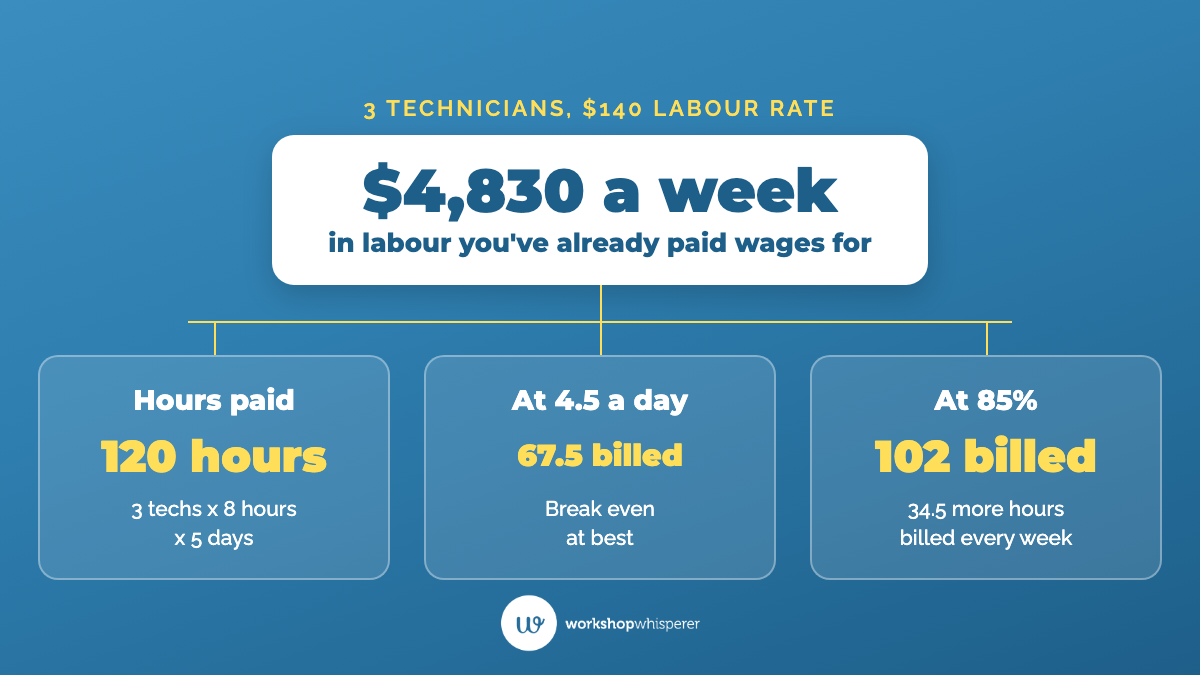
What those unbilled hours are worth. Here's an example with round numbers, so you can run it for your own shop. Three technicians, eight hours a day, five days a week, gives you 120 hours to sell. At four and a half billable hours a day each, you bill 67.5 of them. At 85% productivity, you bill 102. That's a gap of 34.5 hours a week. At a $140 labour rate (or labor rate, if you're in the United States), that's $4,830 a week in labour you've already paid wages for, and more than $250,000 a year. Because the wages are already paid, every extra labour dollar you sell goes straight to the bank.
The last leak is the one that feels most like hard work: overbooking. There's a direct link between owners who overbook the diary and owners in financial distress. When every hour is booked before the day starts, there's no space for the extra work your technicians find on each car, so your average job value, or average repair order, stays flat. Under that much pressure, nobody focuses on upselling anyway. Overbookers don't make the margin they need to get the gross profit result they need to fund everything else in the business.
How do I turn a busy shop into a profitable one?
As Dean says, this has nothing to do with effort or work ethic. It comes down to working on the right things, at the right time, in the right order. Here's the order I'd take them in.
1. Check your margins before you chase more work. Pull your gross profit for last month and split it into labour and parts. If either one is below the benchmark, more cars will only amplify the problem. My free ebook Poor to Profit walks you through the numbers behind a shop that's busy and making money.
2. Stop squeezing cars in where they don't fit. Learn to say no to work that isn't right for you, and to other people's emergencies that put the whole team under pressure. Set an ideal daily car count and reserve a couple of hours in each day for upsells. That space is where the extra margin comes from.
3. Measure productivity every day, not by the bank balance. Your management software should give you a productivity and an efficiency report at the touch of a button. If it doesn't, put a whiteboard in the workshop and have each technician update their sold hours at the close of every job card. As Dean likes to say, feelings aren't facts, and what feels busy and what is productive can be two separate things.
4. Sit down with your numbers every week. A lot of our Engine Room members hold what we call Finance Friday: 9:30 on a Friday morning, the reports from the week on the table, a look at what's coming in and what has to be paid. With daily tracking you start to see the connections, like the Wednesday you squeezed two extra cars through and your gross profit dropped. In The Engine Room, a business coach who has run an auto repair shop helps you build that rhythm into every week.
5. Pay yourself first. Shop owners are used to taking the dregs, whatever's left after everyone else is paid. Stop letting the business tell you how much money it needs to run. You tell the business how much it has. Pay yourself a market rate for the role you do, and take a profit distribution every quarter as the reward for the risk of owning the business.
6. Carve out CEO time. While you're doing a bit at the front counter, a bit on the floor and a bit of everything else, nobody is looking a month or a year ahead. Before you walk out the door this afternoon, plan tomorrow, and put thinking time in it.
Nine out of ten businesses over $50,000 a month that come into The Engine Room had a busyness and overbooking problem when they started. In the first two or three months we tackle the margins and the spending, and the change is often simple once it's found. New members hear from owners who felt the same discomfort, made the changes anyway, and took their net profit from 10% to 18% in 12 months. About 18 months in, I watch the same owners on Hamilton Island, and their phones aren't ringing with calls from the team.
As I said on the podcast, busyness is the slow way to go broke. Chasing more cars at the same thin margins is a tyre shop mentality, and you can't run an auto repair shop on a tyre shop mentality.
Watch this nine-minute episode if your revenue has gone up and your bank balance hasn't. Dean and I talk through why growth can still leave you broke, from the leaky bucket to the new ute that eats your gains.
Questions auto repair shop owners ask about being busy but broke
Why does my profit and loss show a profit when there's no money in the bank?
Because net profit on paper isn't cash. Loan repayments, tax debts and your own drawings don't appear on the profit and loss, but they all come out of that figure. Look at your balance sheet alongside it, and look at both every month instead of once a year.
Should I hire another technician if we're flat out?
Not until you know how productive the technicians you have are. Track every technician's time for one week first. A team can be flat out and still be selling well under the hours you pay for. You may also be carrying more technicians than your work can support.
How productive should my technicians be?
At least 80% to 85% of the hours you pay them for, and that's the minimum in our Engine Room community. Four and a half billable hours a day on an eight or ten hour day lets you break even at best.
How full should my diary be?
Not completely full. Reserve a couple of hours in each day for the extra work your technicians find, and have your service advisor (service writer in the US, service adviser in the UK) present it to the customer. A diary booked to the last minute leaves no room to sell that work.
Where to start tonight
Grab last week's numbers for one technician. Write down the hours you paid them for, and the hours they billed. Divide the second by the first. If the answer is under 80%, you've found where some of your money is going, without booking in a single extra car.
Related questions:
- What Is a Healthy Profit Margin for an Auto Repair Shop?
- Markup or Margin: How Should I Price Parts?
- Can't Pay Your BAS? How Stella and Selwyn's Workshop Fixed It
See what changes for the people who do this work. On our Our Clients page, auto repair shop owners, named and on camera, tell you what actually changed in their shops and their numbers.
More on this topic: all Money & Profit articles.
Whenever you're ready, here's how we can help.
- Not ready to spend anything yet? Start free with Shop Talk, a 30-day reset for auto repair shop owners on our YouTube channel, and our free resources for auto repair shop owners.
- Over $50,000 a month and flat out without the profit to show for it? The Engine Room changes how the whole business runs, from your numbers to your team, delivered online with one-on-one coaching on demand from a business coach who is a current or former auto repair shop owner.
- Running an auto repair shop under $50,000 a month? Auto Superstars Academy builds the foundations, with one-on-one coaching on demand from a business coach who is a current or former auto repair shop owner.