Is Business Coaching Worth It for an Auto Repair Shop?
Business coaching is worth it for an auto repair shop when two things are true: the coach knows the numbers of an auto repair business from the inside, and you do the work between sessions. When both are in place, the coaching usually pays for itself many times over. When either is missing, you're paying for an expensive subscription.
If you've been sitting on the fence about it, that's a sensible place to be. You've worked hard for every dollar and you don't want to hand one over on a promise. So rather than judging a business coach on the price, weigh the price against what it costs you to keep working it out alone. That holds whether you run a mechanics workshop in a country town, an automotive workshop in the suburbs or an independent garage.
What should I weigh the fee against?
Weigh it against what not knowing your numbers is already costing you. If you're still deciding whether you need a coach at all, the warning signs are in do I need a business coach for my mechanic workshop. Here I'm looking at whether the money comes back.
I call the cost of not knowing stupid tax. It's the money you find out you've paid in hindsight, and when you look back at how you made the decision, you feel bloody stupid. We've all paid it, me included. In our first 12 months owning our own shop, we got caught by a scam and had to hand around $25,000 back to the bank. It really hurt, and the shame that comes with it hurts too.
Most stupid tax is quieter than that: the technician you hired out of desperation, or the supplier account that went a minute overdue and copped a massive interest charge. If you're trading out of overdraft, you're paying stupid tax every single month, and you don't need to be. We've helped hundreds of owners get out of it.
The biggest one is the gross profit that never makes it to the bottom line, and you can measure yours tonight.
A worked example. On average across every invoice, your gross profit should sit between 58% and 62%. Take a shop turning over $70,000 a month with its gross profit sitting at 52%. That's 8 points under the middle of the benchmark. 8 points of $70,000 is $5,600 a month, or $67,200 a year in gross profit the business has already done the work for and never kept. Nobody in that shop is lazy. The labour rate, or labor rate if you're in the US, and the parts margin were set years ago and nobody checked them. This is my arithmetic on an example shop, so run it with your own figures.
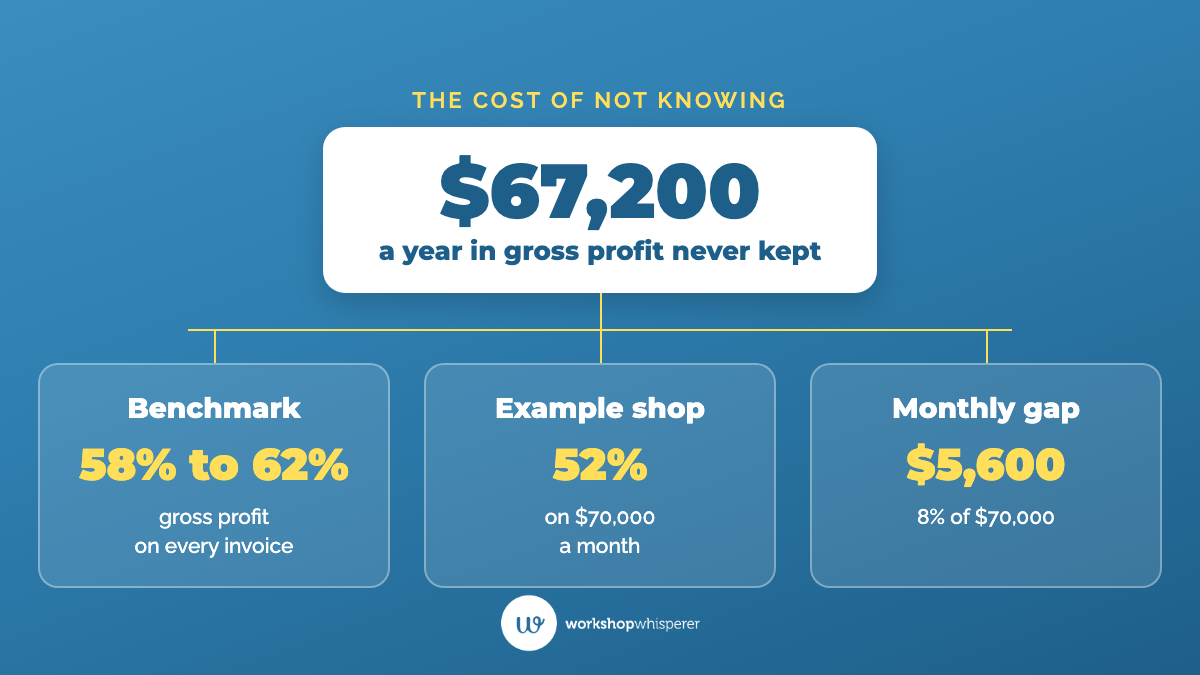
That's the number to put beside the price of any coach. If your shop is losing $5,600 a month, the real question is how many more months you can afford to keep losing it.
Plenty of owners try to fix it by working harder. More cars, more jobs, another technician. As we said on Talking Shop, if the simple equation to profitability was more jobs and more hands, The Workshop Whisperer wouldn't exist. If your gross profit is the leak, start with how to raise your labour rate without losing customers.
How do I know it will pay for itself?
Look at where these owners started, and where they ended up.
Jeff Hazzeldine, at SCS 4WD Centre in Melbourne, was our very first client. Before we met, he'd had to sell a house to keep the business afloat. "We just saw money in the account, thought we had money, so we're spending," he told me. Then the bills came in at the end of a good month and showed they were going backwards. Within weeks of starting, he'd worked out his break-even and what an hour in his shop actually cost him to run. "I think it already paid for the course by week four," he said. Years later he put it plainly: "I wouldn't be here today if it wasn't for the coaching... like most of us, I'm just a mechanic. I have no idea how to run a business."
Marcus Skilbeck, at Skilly's Tyre and Auto in regional Victoria, was about to pull down the roller door and not come back on Monday the first time we spoke. Six years on, he'd moved from a cramped three-bay shop with a two-seater couch for a customer area into a 960 square metre building. Tyres went from around 150 a month to 350. The team grew from Marcus and one other to six, and his last job ad drew more than 35 good applicants, where he used to be lucky to get 10. When I asked what made the difference, he named three things: structured quarterly planning, knowing his numbers, and running the business like a business instead of turning up to a job. He used to think "the business must be good because there's money in the bank this month".
Josh and Cassie had been in business for years before they joined The Engine Room. Ten years in, Josh says he found out he'd "been winging it". In their first six months, their bottom line went up roughly 50%. In the 12 months after that, it went up by another 75% on top. "I didn't know that was possible in such a short period of time," Josh said. Cassie's verdict: "We were fence sitters to start with and it's the best thing that we've done for personal life and business life."
The money is only half of what changes. Katie Stepanek and her husband run GenTech Automotive in Canberra. Before coaching, he was out the door early and home late, six or seven days a week. Now the business trades Tuesday to Friday over extended hours, the team has grown to seven specialists, and the family gets a long weekend every weekend. Katie calls that time "guilt-free".
Across 13+ years we've helped more than 10,000 auto repair shops in 5 countries, and generated $175 million in additional profit, and every one of those results came from an owner who did the work.
Watch Cassie and Josh before you decide. In under six minutes they talk about sitting on the fence, why they chose an industry-specific coach over a generic one, and what happened to their bottom line.
What makes business coaching work, and what makes it a waste of money?
A coach who knows your industry. Cassie and Josh met with a generic business coach before they chose us. What decided it was having industry-specific numbers "that has already been tried and tested in other automotive businesses", so Josh knew where his targets should be. Knowing the target is what lets you measure the return.
You doing the work. Someone in our free Facebook group, Your Profitable Auto Repair Shop, once asked whether The Engine Room was worth it. We were so pleased to see our own clients answer: don't think paying the fee will magically fix your business, you have to do the work. As we said on the podcast, if you're going to hide when the conversations get hard, don't hire a coach. Don't make donations to your coach's holiday fund.
Katie said it best: "The greatest thing we ever did was ask for help, and in asking for that help, then you have to commit to what you're learning." If you don't follow the advice, nothing changes. I can only ever meet a client halfway.
Kirsty Gardner, in a mining town in central Queensland, shows what doing the work looks like. In her first eight months in The Engine Room she wrote a list a mile long and worked through it every week. She set up profit accounts and started paying herself a quarterly profit distribution, paid out a vehicle, wrote her procedures, and closed for a full team day to roll them out. When I asked if closing for a day scared her: "Not at all. You've got to spend the money to make the money." Her husband now works a four day week while the business stays open five.
Someone to answer to. Doing the work is easier when someone checks that you did it. Jeff is one of our longest-serving Engine Room clients, and when people ask why he stays, he says it's accountability. In flat-out months he slips back into old habits, the results slide, and people in the group go, "Hang on a sec, why are you doing this?"
Questions auto repair shop owners ask about business coaching
How long does business coaching take to pay for itself?
It depends on what's leaking and how quickly you act on it. Margins and money are what we tackle in the first two to three months with a new client, because once they're found they're often simple to change. Jeff felt the return by week four.
Can't I learn it all from free videos and podcasts?
You can learn a lot, and we put plenty out for free. What free content can't give you is someone who looks at your numbers, tells you which one to fix first and checks that you did it.
What if I can't afford a coach right now?
Work out what you're already paying in stupid tax: overdraft interest, late fees, the gross profit gap. For a lot of owners that number is bigger than the cost of help. If your shop is under $50,000 a month, Auto Superstars Academy is built for that stage: it builds the foundations, with one-on-one coaching on demand from a business coach who is a current or former auto repair shop owner, so you don't have to wait until you're bigger to get help.
What if I've had a coach before and it didn't work?
Ask what was missing. Was it industry knowledge, accountability or the work between sessions? Be honest about your share of it, then choose help that fixes the missing piece.
Where to start tonight
Pull up last month's profit and loss. Divide your gross profit by your total sales to get your gross profit percentage, and compare it with 58% to 62%. If you're under, multiply the gap by your monthly sales. Write that number down. That's what not knowing costs you every month, and it's the figure to weigh any coach against, including us.
Related questions:
- What Results Do Auto Repair Shops Get From Business Coaching?
- Who Is the Best Business Coach for Auto Repair Shops?
- How Do I Stop Winging It in My Auto Repair Shop?
See what changes for the people who do this work. On our Our Clients page, auto repair shop owners, named and on camera, tell you what actually changed in their shops and their numbers.
More on this topic: all Performance articles.
Whenever you're ready, here's how we can help.
- Not ready to spend anything yet? Start free with Shop Talk, a 30-day reset for auto repair shop owners on our YouTube channel, and our free resources for auto repair shop owners.
- Running an auto repair shop under $50,000 a month? Auto Superstars Academy builds the foundations, with one-on-one coaching on demand from a business coach who is a current or former auto repair shop owner.
- Over $50,000 a month? The Engine Room changes how the whole business runs, from your numbers to your team, delivered online with one-on-one coaching on demand.