

Markup or Margin: How Should I Price Parts?
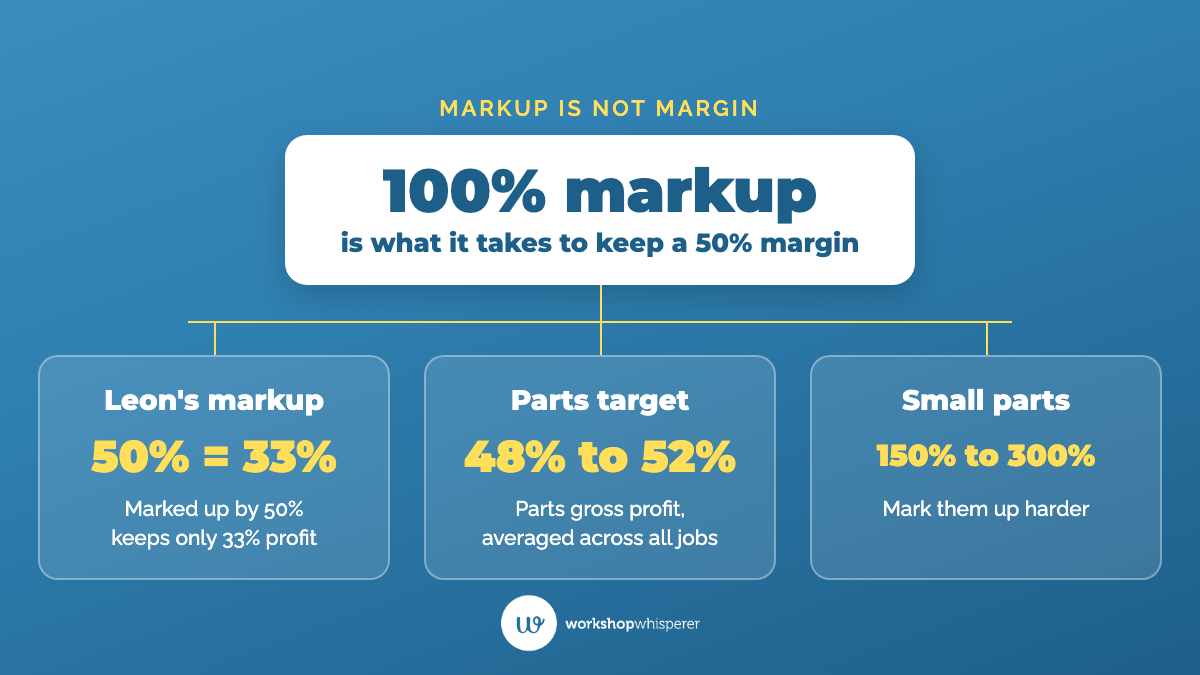
Price your parts to a margin, and use markup to get there. The target is a parts gross profit of 48% to 52%, and to make 50% you mark a part up by 100% on what it cost you. Small parts and fluids need more than that, often 150% to 300%, and your expensive parts shouldn't drop far below it.
If you've been mixing the two words up, you're in good company. It's one of the most common money conversations I have with auto repair shop owners, and the maths works the same in a mechanics workshop in Queensland, an automotive workshop in Auckland or an independent garage in the UK.
Why do markup and margin get mixed up?
Leon runs a shop in Gladstone, Queensland. He wrote in to our podcast with a simple question: "We mark our parts and fluids up by between 30 and 50%. Is that enough?"
My short answer was no. Mark a part up by 50% and your profit on it is only 33%. Mark it up by 30% and your profit is 23%. Those markups sound healthy, which is why so many owners assume they've got it right.
In plain English:
- Markup is how much you add on top of what the part cost you. Gross profit divided by cost.
- Margin is how much of the selling price you keep. Gross profit divided by the sale.
Same dollars, divided by a different number, so the two percentages never match. I hear owners talk about "the margin they got on that part" all the time, when what they're describing is their markup.
It's not your fault you weren't taught this. Most of you are trade-qualified technicians, and there's no room for it in an apprenticeship. You learnt pricing on the job, and if the owner you trained under didn't have a handle on the money side, there was nobody to learn it from.
The other trap is the supplier's recommended retail price. It's printed right there on the invoice, so it feels official. The supplier who set it has no idea what it costs to run your business. As Dean puts it, it's a random retail price. Price off RRP and breaking even is the best you can hope for.
How much markup do I need to hit my parts margin?
Start with the margin you want, then work out the markup that delivers it. The benchmark we use at The Workshop Whisperer for parts gross profit is 48% to 52%. Anything above that and you're doing really well.
Here's how markup converts to margin. Keep a table like this next to the computer where you do your pricing:
| If you mark up by | Your gross margin is |
|---|---|
| 30% | 23% |
| 43% | 30% |
| 75% | 42.9% |
| 100% | 50% |
If you'd rather work it out yourself, the formula is: markup = margin ÷ (100 − margin). For a 50% margin, that's 50 ÷ 50, or 100%.
Three things make this work in a real shop.
1. Set it in your software, so nobody has to guess. Most mechanic-specific invoicing systems let you load your markup for each product or service and show the margin before you invoice. If you price by gut feel, I guarantee you're getting it wrong most of the time. You might win on the odd cheap item, but it won't do much more than help you break even.
2. Mark small parts and fluids up harder. Your oils and other fluids should carry a markup of anywhere between 150% and 300%, not the 30% to 50% Leon was using. Lower-cost parts sit at the top of that range.
3. Be careful with any parts matrix you download. A parts matrix is a sliding scale that sets a different markup by cost price. There are thousands of them online. Many are good at the low end and then taper right off once a part goes over a thousand dollars. On a $5,000 engine, some will have you earning a 5% to 10% margin. Some of the ones near the top of a Google search were built for heavy trucking, not light vehicle repair.
The question I always ask is why you should make less money because a part costs more to buy. Your customer still needs the part, and they're still paying for your years of experience and critical skill.
That doesn't mean you'll put 52% on a second-hand engine. You might price yourself out of the market. What it means is you look at the whole invoice. If the engine sits lower, the rest of the job has to carry enough margin that the invoice as a whole lands where it needs to.
What the gap is worth. Here's an example with round numbers. Say your shop buys $5,000 of parts in a week.
- At a 50% markup, you sell them for $7,500. Your gross profit is $2,500, a 33% margin.
- At a 100% markup, you sell them for $10,000. Your gross profit is $5,000, a 50% margin.
That's $2,500 a week in gross profit, on the same parts, fitted by the same technicians in the same hours. Across a year it's $130,000. Run it on your own parts spend and see what your number is.
Consistency matters as much as the target. If some jobs make 20% and others make 50%, your average lands somewhere around 35%. That isn't enough to pay your bills, pay your team and have some left for you. Some jobs will always come in lower, which is why it's your average that has to hit the benchmark.
Won't my customers go somewhere else?
Olivia, from Albury in New South Wales, wrote in with a question about our markup matrix. The percentages felt like a big jump from where they'd been. Her market was competitive, and she was worried about losing customers.
I commended her for saying it out loud, because almost everyone feels it. I've helped auto repair shop owners implement this for years, and they all feel a bit uncomfortable and a bit scared. When they implement it, they get the result without the customer pushback they were expecting.
You've got your head in pricing all day long, so you're the price-sensitive one. You've got two or three customers who always tell you they can get it cheaper somewhere else, and you assume everyone thinks that way. Most of your customers don't. They want the job done right the first time, so they're safe on the road, and they've been coming to you for a long time.
When someone does move their parts margin closer to the benchmark, they usually come back within the month and tell us the same thing: "I've had no complaints, no arguments, no one's even questioned it." Often that's followed by their most profitable month on record. On average, a shop loses one or two customers when it fixes its pricing.
Mick Manzi has run M&R Auto Care in Sandgate, on the north side of Brisbane, for 15 years. When he first looked at the parts matrix, he felt exactly what Olivia felt. "We were looking at it going, 'Can't charge these people. This is ludicrous.'" He put it in anyway. "The total sales within my business, probably for the first sort of six months or so following that, the total sales didn't change, but the profit did." Same customers, same work, more of the money kept. Now his sales are climbing too, and with the systems in place, he knows the profit follows them up.
There's another objection I see often in our free Facebook group, Your Profitable Auto Repair Shop. "If we're getting 70% on labour, why do we have to worry so much about our parts margin?" I'm always compassionate when I see it, because it shows how easy this is to misunderstand. Your whole business needs 58% to 62% gross profit on all jobs to fund its running costs. Labour can't carry it on its own. Your parts margin has to lift its own share of the weight, otherwise your labour is paying for your team, your power bill and you, while your parts barely break even.
Thin margins made up with volume is what we call the tyre shop mentality. High volume at low margin works for a tyre retailer. In a shop that services and repairs vehicles, you don't have the bays, the hours or the people to turn work over fast enough, so you can't run an auto repair shop that way. Sell at 25% or 30% consistently and you will go broke in five years or less.
A good matrix is fair to you and to your customer. It gives you the margin you need to fund the business and have something left over for you, which is why you're in business in the first place.
Watch this nine-minute video before you change a single price. I walk through markup, margin and the parts matrix, including what a matrix should do on your most expensive parts.
Questions auto repair shop owners ask about pricing parts
What is the difference between markup and margin?
Markup is what you add on top of the cost price, measured against cost. Margin is the share of the selling price you keep as gross profit, measured against the sale. A part that costs $100 and sells for $200 has a 100% markup and a 50% margin.
What should my parts margin be?
The benchmark we use at The Workshop Whisperer is a parts gross profit of 48% to 52%, averaged across all your jobs. Combined with your labour, your whole shop should land between 58% and 62% gross profit.
Should I use the supplier's recommended retail price?
No. The supplier who set it doesn't know your rent, your wages or what you want to pay yourself. Pricing off RRP will almost never get you to the benchmark. Set your own markup from the margin you need.
Should expensive parts have a lower markup?
A little lower, yes, but not the steep drop most downloaded matrices use. Check what any matrix does once a part goes over $1,000. If it falls to 10% or 15% there, don't use it. Where one big part has to sit lower, make sure the rest of the invoice makes up the difference.
What if I can't bring myself to charge the matrix price?
We call it emotional discounting: shaving parts margin off the invoice to make yourself feel better about the total. If pricing parts gives you that guilty feeling, have someone else do it on your behalf, such as your service advisor (service writer, if you're in the US). Better still, load the markup into your software so the price is set before anyone's nerves get involved.
Where to start tonight
Pull your last 20 invoices. For every part on them, write down two figures: what it cost you and what you charged. Divide the gross profit by the selling price and you've got your real parts margin, job by job. Then average it.
If that number sits under 48%, you're doing the work and not keeping the money for it. Next, check what your software is set to charge on fluids and on parts over $1,000, because that's usually where the margin goes.
If your shop turns over more than $50,000 a month, The Engine Room is where a business coach works through your pricing and margins with you, alongside the rest of your numbers.
Related questions:
- What Is a Healthy Profit Margin for an Auto Repair Shop?
- How Do I Fix Cash Flow in My Auto Repair Shop?
- Busy but Never Making Any Money? How Regan Crook Turned It Around
See what changes for the people who do this work. On our Our Clients page, auto repair shop owners, named and on camera, tell you what actually changed in their shops and their numbers.
More on this topic: all Money & Profit articles.
Whenever you're ready, here's how we can help.
- Not ready to spend anything yet? Start free with Shop Talk, a 30-day reset for auto repair shop owners on our YouTube channel, and our free resources for auto repair shop owners.
- Over $50,000 a month? The Engine Room changes how the whole business runs, from your pricing and margins to your team, delivered online with one-on-one coaching on demand from a business coach who is a current or former auto repair shop owner.
- Running an auto repair shop under $50,000 a month? Auto Superstars Academy builds the foundations, with one-on-one coaching on demand from a business coach who is a current or former auto repair shop owner.
- Want your service advisor to stop discounting at the counter? Superstar Service Advisor trains the person at your front counter to present the work and hold the price.