
What Is a Healthy Profit Margin for an Auto Repair Shop?
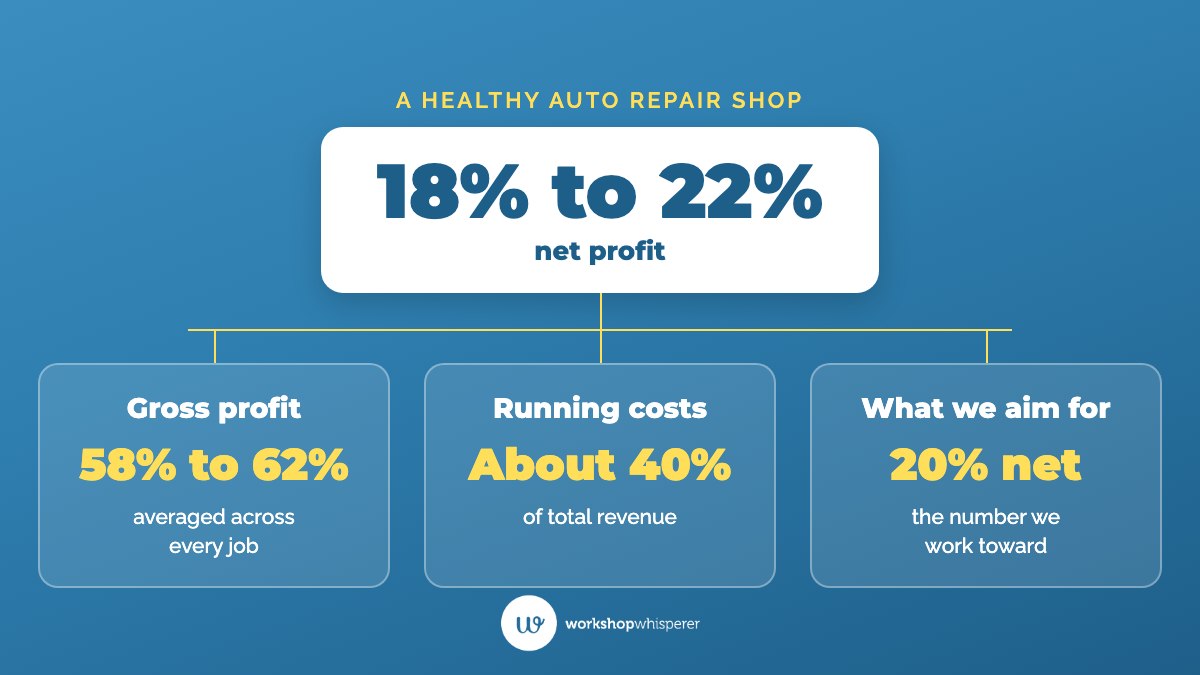
A healthy auto repair shop makes between 18% and 22% net profit. To get there, your gross profit has to average between 58% and 62% across every job you do. That leaves roughly 40% of your revenue to run the business, and about 20% on the bottom line.
If your numbers are nowhere near that, it isn't because you don't work hard enough. Most auto repair shop owners were never shown what the numbers should look like.
These benchmarks hold whether you call your business a mechanics workshop, an automotive workshop, a garage or an auto repair shop. The maths underneath is the same in every country.
What profit margin should my auto repair shop be making?
When owners first come to us, there's a huge spectrum of what they think a healthy profit margin looks like. Some walk around with the notion that as long as they get 20% profit on their invoices, they'll be okay. That is wildly inaccurate.
There's no secret to it and no guesswork. There are two margins to know, one at the top of your profit and loss statement (P&L) and one at the bottom.
Gross profit margin: 58% to 62% on every job, on average. Take the revenue for a job and subtract the parts cost. The percentage left over needs to sit between 58% and 62%. Some jobs will come in lower and some higher. Your average across all of them is what counts. Your parts on their own should sit around 48% to 52%, which means your labour has to do the heavy lifting.
Net profit margin: 18% to 22%. That's the benchmark for a profitable auto repair business, and the number we work toward with our clients is 20%.
Between the two sits everything it costs to keep the doors open. Your team's wages, super and annual leave, your rent, utilities, software subscriptions, all the bills you pay. Those operating expenses take about 40% of your total revenue. Pick the middle of the gross profit range, 60%, take 40% away for running costs, and you're left with 20%. Net profit on your P&L also isn't money you can spend yet. Your loan repayments come out of it, because debts live on the balance sheet, not the profit and loss. Then the tax man wants his share. This is why so many owners look at a $100,000 net profit and scratch their heads, because there's nowhere near $100,000 in the bank.
Why is my profit margin so far below that?
Most auto repair shop owners achieve a net profit of only three to five percent. That's a long way from 18% to 22%.
It almost always starts at the top of the P&L, with a gross profit that's too thin. Plenty of owners tell us they throw 20% or 30% on everything. If you're only adding 20% or 30% to your parts and labour costs, you end up with a tiny sliver of gross profit that's supposed to fund the whole business and still leave something for you. Within a couple of years you can't make payroll, you can't pay your suppliers, and eventually you can't put the roller door up.
What hides it is the EFTPOS machine. It settles every day, money comes in every day, and you get fooled into thinking you can outrun it. So you start shuffling who gets paid today and who waits until next week. If that's you, your business is screaming at you that your margins are too fine.
The second cause is volume, and it's why I say you can't run an auto repair shop on a tyre shop mentality. The old tyre-selling approach of high volume at low margin kills a business that services and repairs vehicles. You don't have the space, the hours in the day or the people to turn cars over fast enough to make thin margins work. Every time the labour hours get trimmed off an invoice, or a service advisor (a service writer in the US) quietly discounts the parts to keep a customer happy, your gross profit slides toward 20% or 30%. As I've said on Talking Shop, at that level you will go broke in five years or less. The third cause shows up when things finally improve. Revenue goes up, the shop is busier, and the net profit line doesn't move. Somewhere between your revenue line and your net profit line you've got leaky buckets. Sometimes the leak is a reward you give yourself. After a few tight years, a couple of good months feel like permission, so you trot down to the dealer and order a new Raptor. Now the gains you made are servicing a new debt. If your labour and parts margins are wrong, more work only gives you more of the same bad gross profit.
As Dean puts it, revenue is the figure you tell your mates around the barbecue. Gross profit funds the business. Net profit decides how much fun you have with your family over your whole life.
What the gap costs, as a worked example. Take two shops, each turning over $100,000 a month, with the same team, the same rent and the same $40,000 a month in operating expenses.
- Shop A averages 60% gross profit. That's $60,000 to work with. Take away $40,000 in running costs and it keeps $20,000 a month in net profit, or 20%.
- Shop B averages 45% gross profit. That's $45,000. Take away the same $40,000 and it keeps $5,000, or 5%.
Both shops do the same work with the same team, and Shop B ends up $15,000 a month behind. That's $180,000 a year in profit. And if Shop B slips to 30% gross profit through discounting and written-off hours, it's $10,000 a month in the red. These are example figures, not a real shop, so run the same sums with your own numbers.
In my Poor to Profit book I put it another way. At a 10% net profit, you spend $90,000 to make $100,000. A $10,000 profit on that much work isn't really a business anymore. It's more like having a job.
How do I get my profit margin up?
Start at the top of the P&L and work down, because nothing you do with expenses will rescue a gross profit that's in the 30s or 40s.
- Split your labour and parts revenue. Ask your accountant to show them as separate lines. You can't tell which one is leaking while they're lumped together.
- Fix your parts margin. Stop downloading a parts matrix off the internet or relying on the supplier's recommended retail price. Matrices with a steep sliding scale cost owners thousands of dollars in profit every year. Price so your parts average 48% to 52% gross profit.
- Fix your labour. That means two things: charging a labour rate (labor rate, if you're in the US) built from your own break-even, and actually selling all the hours your technicians have available.
- Hold the price at the counter. Make sure the price you set is the price the customer hears, with no labour hours written off and no parts discounted to keep someone happy.
- Then look at your operating expenses, line by line, against the 40% they should take. Wages are the first line to check.
- Delay the reward. Let the extra profit land and stay for a while before it turns into a new vehicle loan.
Jenny and Tom ran a small performance workshop with a line of credit nearing $100,000. When they joined the Engine Room, our pricing review found their gross profit on parts was under 25%. Their labour rate was $90 an hour plus tax, against a break-even of $146. For seven years, instead of making the very achievable 18% net profit, they'd run at a small loss. Eighteen months later they had no debt other than the mortgage on their home and no credit line.
Brad and Joanne Lowe, at Geelong Transport Repairs, joined in May 2020 sitting in their office in tears, virtually ready to close the doors. Two years later their revenue was up around 23% and their net profit was up 78%. Their bills get paid on time every month, and they've bought an investment property.
Aaron and Claire Hills run Angus Car Service in Penrith, New South Wales. Before, they had "more bills than we knew how to pay", and "finding the money at the end of every month was getting more and more difficult and there was no profit." When they wanted a holiday, they had to close the workshop. Today, in their words, "we're turning over a third more than we were before. We've just hit the million-dollar club and we're making around about 25 to 30% profit." The numbers in this article aren't a fantasy. Shops like theirs reach them. Watch Aaron and Claire's story.
In 13+ years and more than 10,000 auto repair shops, we've seen the same order work every time. Get your margins and systems right first, then go after more volume.
Watch this if you want the whole picture in under eight minutes. In Talking Shop Episode 20, Dean and I walk through the 58% to 62% gross profit range, the 40% for running costs and why throwing 20% or 30% on everything keeps an owner broke.
Questions auto repair shop owners ask about profit margin
What is a good net profit margin for an auto repair shop?
Between 18% and 22% of your total revenue, with 20% the number to aim for. Many shops sit at three to five percent, so if that's you, there's a lot of room to move.
What gross profit margin should my shop be making?
An average of 58% to 62% across every job, where gross profit is revenue minus the parts cost. Some jobs will be lower and some higher. Your parts on their own should average around 48% to 52%.
Is a 10% net profit good for an auto repair shop?
No. At 10%, you spend $90,000 to make $100,000. In our industry that's too thin, and it leaves very little for a bad month or for you.
Why does my P&L show a profit but there's no money in the bank?
Because net profit isn't cash in your hand yet. Loan repayments come out of it, and they don't appear on the profit and loss because debts live on the balance sheet. Tax comes out of it too.
Will more customers fix my profit margin?
Not on their own. If your margins are wrong, more cars means tipping more people into the same system and getting the same result, with a busier team. Fix your gross profit and your systems first, then go after more work.
Where to start tonight
Pull up your profit and loss for the last financial year and find three numbers: total revenue, gross profit and net profit. Divide gross profit by revenue, then net profit by revenue. If the first is under 58% or the second is under 18%, you now know roughly how much is leaking, before you change a single price.
Related questions:
- Why Am I Busy but Not Making Any Money?
- Markup or Margin: How Should I Price Parts?
- How Do I Pay Off My ATO Tax Debt? How Megan and Adam Cleared $80,000 in a Year
See what changes for the people who do this work. On our Our Clients page, auto repair shop owners, named and on camera, tell you what actually changed in their shops and their numbers.
More on this topic: all Money & Profit articles.
Whenever you're ready, here's how we can help.
- Not ready to spend anything yet? Start free with Shop Talk, a 30-day reset for auto repair shop owners on our YouTube channel, and our free resources for auto repair shop owners.
- Want your service advisor to stop giving away margin at the counter? Superstar Service Advisor trains the person at your front counter to present the work and hold the price, without more cars or more hours from you.
- Want your margins measured and fixed every week, all the way to 20% net? The Engine Room changes how the whole business runs, from your numbers to your team, delivered online with one-on-one coaching on demand from a business coach who is a current or former auto repair shop owner.