
Why Are My Technicians Busy but Billing So Few Hours?
Your technicians are busy because the hours are leaking out around the jobs, not on them. Paperwork, cleaning benches, walking to the parts room, ringing around for parts and sitting on hold while a car waits on the hoist all take real time. Your team is on the clock for every minute of it, and the customer pays for none of it. You fix it by measuring where each hour goes, moving the leaks off your technicians, and booking a day your team can actually get through.
If this sounds like your shop, your team probably isn't lazy, and you're not imagining how hard everyone works. The trouble is that a busy team looks productive, so nobody goes looking for the lost time. It happens the same way whether you run a mechanics workshop, a garage or an automotive workshop.
Where are my technicians' hours actually going?
I think of every job as a production line. The customer drops the keys off at one end and drives the car out at the other, and the hours leak out all the way along.
There are four leaks I see in almost every shop:
- Admin. Your technician is updating the job card halfway through a job, or wandering up to talk to the service advisor about the next car before this one is done.
- Cleaning. Wiping benches, sweeping the bays, putting the tools away, walking to and from the parts room again.
- Calling. Ringing around for parts, chasing a supplier, listening to hold music while a customer's car sits on the hoist with the bonnet open.
- Everything and anything else. Anything that isn't a technician with their hands on the job.
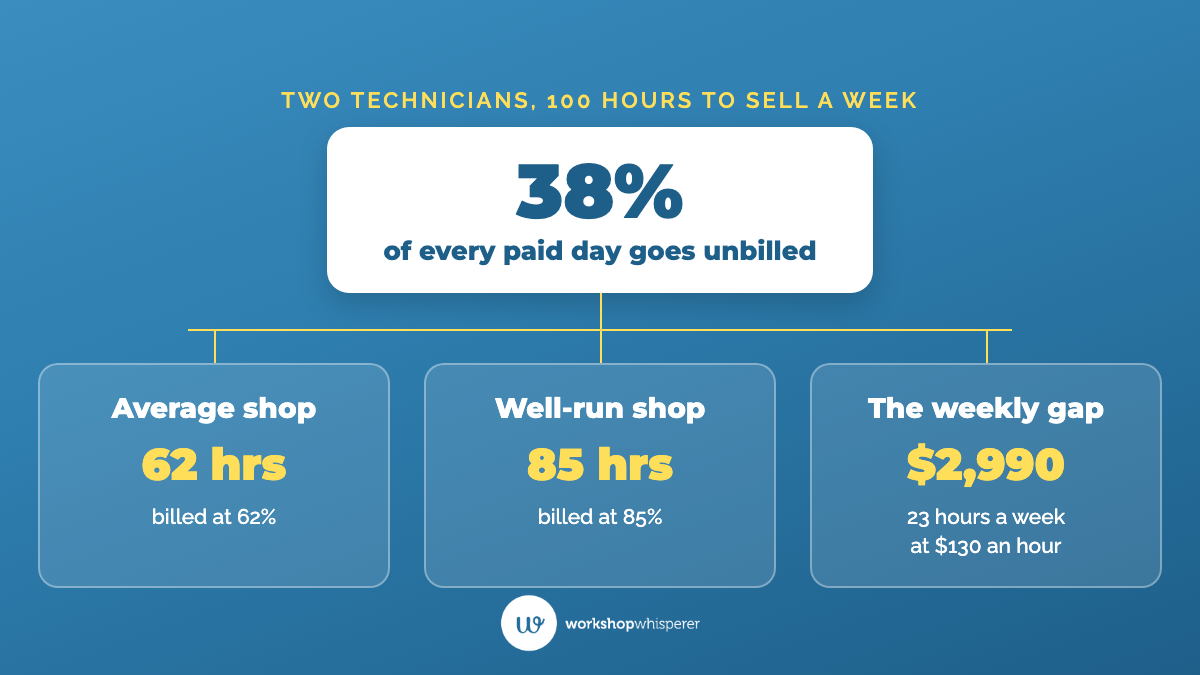
I call it the time bomb, and it's bigger than most owners think. The average auto repair shop across Australia and New Zealand sits at about 62% productivity. That means 38% of every paid day goes unbilled, nearly four hours per technician on a ten-hour day.
New clients often tell us the team is working really well. Then we look at the data, and productivity is usually 10 to 20% lower than they felt it was. I always say feelings aren't facts, they're feedback. Rachael puts the other half of it bluntly: plenty of owners would rather keep their head in the sand on this one. As she says, "they fight for the right not to know."
One of our Engine Room members told me on a coaching call that his team was flat out. He was positive they couldn't take on another job. I asked him to do one thing. For one week, every technician wrote down what they actually did in 15-minute increments, with old-style pen and paper. Nothing else was to change.
When we caught up the following week, he was white as a ghost. Across his three technicians, he was losing about 22 billable hours every week. That's nearly a full day of paid work per technician. He'd been about to hire a fourth, and it turned out he didn't need one. He needed to stop the time leaking out of the three he already had.
Why does a flat-out day make it worse?
The usual response to a busy-but-broke month is to book in more cars, and that makes the leak bigger.
When you say yes to every job and squeeze cars in where they don't fit, your team doesn't speed up. They slow down, and they do it out of self-preservation rather than laziness. Nobody can redline for ten hours straight, any more than a footballer could play the whole match without coming off to recover.
When the day feels like a roller coaster, with no certainty about what's coming next, a team under that kind of stress does one of four things. They flock together and the whole workshop slows down. They fight, and you get arguments on the floor. They take flight, through sick days or resignations. Or they freeze and shut down. On paper it looks like a productivity and efficiency problem, and it is, but working them harder won't fix it.
Rushing costs you in two more ways. When people rush, they miss things, and work comes back. And as Rachael teaches, when there's too much stress to get all the cars out, nobody's looking for the extra work the car actually needs. Your average repair order, or average job value, drops on the very days you feel busiest.
You can be one of the leaks too. Rachael's list of the usual time traps starts with reps who lean on the shelf with the oil filters on it for a yak, and customers who still have your personal mobile number. They ring you directly, you take the booking while you're under a car, and the front counter knows nothing about it. The car turns up, your service advisor has to come and find you, and now two people have stopped selling hours. Rachael's estimate is that these distractions cost the owner about two hours a day.
How do I get my technicians billing more of their hours?
Make the leaks visible, then close them one at a time.
- Audit one week. Every technician records what they did in 15-minute blocks for five days. Don't change anything else, and don't guess. If your team refuses, that's a leadership problem to solve first, not a reason to skip it.
- Clock every job, keys to keys. In the 62% shop, job cards get filled in loosely, after the fact, or never, and the owner can't tell you how many hours were billed yesterday. In an 85% shop, every technician clocks on and off every job, every time, there's a number on the board, and when productivity drops, somebody notices. Rachael walks through how to measure technician efficiency and productivity.
- Run a daily huddle. Fifteen minutes first thing, covering three things: what work is on today, who is doing which job and by when, and how you'll make the day run smoothly. That last one is where your service advisor spots the problems before a technician is standing around waiting.
- Book a day your team can win. Learn to say no, or "not now", and book the customer in at a time that works for your shop. Watch two numbers every day: your daily car count and your average repair order. They tell you whether the day is manageable before your gross profit tells you it wasn't.
- Move the leaks off the floor. Parts chasing, phone calls and paperwork belong at the front counter, with your service advisor (or service writer, if that's what you call the role). Divert your own mobile to the shop phone during work hours, and give your front counter a simple script for the customers who want you. This is the one Rachael teaches:
"Dale is working on a vehicle right now. We've got a job we need to get finished, but he will come in and grab his messages at 12:30 and give you a call back before the day's out. Does that sound okay?"
A worked example. This is an example, so run it with your own numbers. Take a shop with two technicians, each paid for ten hours a day, five days a week. That's 100 hours to sell every week. At the 62% average, the team bills 62 of them. At 85%, it bills 85. That's 23 hours a week. At a labour rate of $130 an hour, that's $2,990 a week. Over 46 working weeks, allowing for leave and public holidays, that's more than $137,000 a year from the same team and the same hoists. Rachael says it best: "every extra labor dollar that you're able to sell and convert goes straight to the bank because you have already paid your team's wages."
Why 85% and not 100%? Because in a well-run shop that last 15% is held back in the daily bookings on purpose. Your technicians use it for the extra work they find on the cars already in, and your service advisor sells it. Rachael covers the target in more detail in how many billable hours a technician should produce. That's how your team earns more from the jobs already in the bays, without doing more of them.
Some shops go well past it. One of our clients, who started in The Engine Room and now sits in our Million Dollar Mechanics Boardroom, had his team at 120% productivity in March, billing more hours than they technically had to sell. His technicians aren't stressed or running around. The distractions, the parts chasing and the admin have been taken off them.
Alberto Magistro runs Autodelta in Malaga, Perth, an Italian car specialist with two senior technicians and an apprentice. He took over his dad's shop and kept running it the way it had always been run. Two years on, as he put it, "we're busy, but the figures aren't reflecting what's going on in the workshop." Every day "was almost like flying blind." The number one change since joining, in his words, is "actually knowing how much time technicians are spending," with systems and processes around it. He's still new to the program, and he's already "noticed the bank account is a lot more healthier than it was two years ago."
Measuring changes the team, too. Your A-grade and B-grade technicians feel like they're winning, often for the first time, because somebody finally sees what they produce. Inside The Engine Room, where you work through it with a business coach, we call this the productivity power-up: measure it, lift it, then lock it in as the new standard for every technician, every day.
A busy team isn't the same as a productive team. If you're not measuring, you're giving your team's time away for free, and you're running a business, not a charity.
Watch this before you hire another technician. In about 21 minutes I walk through the time bomb, the three rungs of the productivity ladder and the three questions that tell you which rung your shop is on.
Questions auto repair shop owners ask about busy technicians and low billed hours
Are my technicians lazy if they're busy but not billing?
Usually not. A team that's overbooked slows down to protect its energy, and a technician who spends half an hour chasing a part was busy the whole time. Before you judge the person, measure where their day went and look at what you're asking them to carry.
Should I hire another technician if my team is flat out?
Measure first. The Engine Room member I mentioned was about to hire a fourth technician and found 22 billable hours a week he was already paying for. More people on a leaking line means more wages and the same leaks.
What's a good productivity percentage for a technician?
Around 85% is the benchmark for a solidly profitable shop in Australia and New Zealand, with the other 15% held back for the extra work your team finds on the cars already in. The average sits at about 62%. Shops with strong systems can go past 100%.
How do I check whether lost hours are hurting my cash flow?
Work out your effective labour rate, which shows what every hour your technicians had available to sell actually brought in.
Where to start tonight
Print one sheet per technician for tomorrow, with the day broken into 15-minute rows. Ask each of them to write down what they did in every block, for one week, and tell them nothing else is changing. At the end of the week, add up the hours they were paid for and the hours you billed. The gap between those two numbers is the size of your time bomb, and it's the first thing to fix before you book in another car.
Related questions:
- Will Hiring Another Technician Fix My Cash Flow?
- How Do I Move to a 4 Day Work Week Without Losing Profit?
See what changes for the people who do this work. On our Our Clients page, auto repair shop owners, named and on camera, tell you what actually changed in their shops and their numbers.
More on this topic: all Productivity articles.
Whenever you're ready, here's how we can help.
- Not ready to spend anything yet? Start free with Shop Talk, a 30-day reset for auto repair shop owners on our YouTube channel, and our free resources for auto repair shop owners.
- Running an auto repair shop over $50,000 a month? The Engine Room changes how the whole business runs, from your numbers to your team's productivity, delivered online with one-on-one coaching on demand.
- Under $50,000 a month? Auto Superstars Academy builds the foundations, delivered online, with one-on-one coaching on demand from a business coach who is a current or former auto repair shop owner.