

What Is Effective Labour Rate and How Do I Calculate It?
Your effective labour rate is the money you actually receive for every hour your technicians have available to sell. To calculate it, add up the labour dollars you invoiced for the week and divide them by the total hours your technicians were available to work. Then compare the answer with the rate you advertise. If it sits within 10% to 15% of your advertised rate, you're inside the benchmark we use at The Workshop Whisperer. Below 85%, you have work to do.
If you've never worked it out, you're in good company. Your workshop software probably won't calculate it, and it doesn't appear on any report your accountant sends you.
Whether you run an auto repair shop, a mechanics workshop or a garage, and whether you say labour rate or labor rate, the sum is the same. It's also one of the fastest ways to find out why the team is flat out and the bank account isn't keeping up.
Why isn't my labour rate what I actually get paid?
Say you have $140 an hour loaded in your software. That's what you charge for every hour you manage to put on an invoice. It tells you nothing about the hours you didn't.
I've seen this in shop after shop over the years. The labour rate you're charging out is likely not the one you're receiving back in, even where you can see it written on your invoices.
The money goes missing in a handful of predictable places.
- Written-off hours. A job estimated at two hours takes four. Nobody wants to give the customer a shock, so the extra two get wiped.
- Unsold hours. If you're a smaller shop, or still building, you may not have enough cars to fill every technician's day. You paid those hours in wages and never sold them.
- Diagnostics charged short. Dean's example is a complex electrical fault that takes two or three hours to find, and you charge one because that felt reasonable.
- Comebacks, goodwill and warranty. The car that comes back with the same fault and gets fixed again at no charge. The labour you waive to keep a long-standing customer happy. The warranty job that only pays part of the time. Dean counts these, along with diagnostics, as the four labour leaks.
None of it shows up on your profit and loss. Your accountant tracks money in and money out. As Dean says, the gap between what you charge and what you keep is "a measurement problem", and it doesn't appear on any report they produce.
The gap is rarely small. A number of our clients find their effective labour rate sitting somewhere in the seventies when they're advertising $110 an hour. Close to a third of every hour they charge for never reaches them.
Every one of those hours hurts more than it looks, because the wages are already paid. Every extra minute you're able to bill, provided no other expenses go up, transfers as money to your bottom line.
How do I calculate my effective labour rate?
You need two numbers and a calculator. Do it for one week at a time.
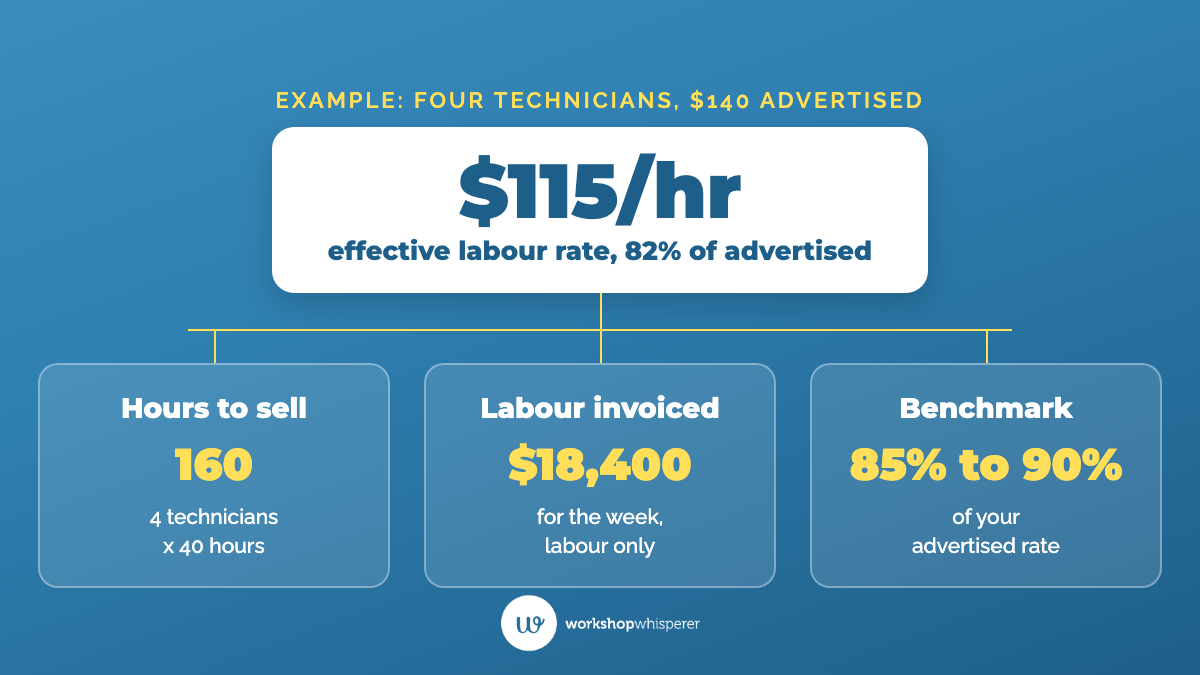
Step 1: Work out your hours available to sell. Multiply the number of technicians by the hours each one is rostered for the week. Four technicians on 40 hours each gives you 160 hours.
Step 2: Add up your labour dollars for the same week. Labour only, not parts. Pull it from your invoices or your workshop software.
Step 3: Divide your labour dollars by your hours available. The answer is your effective labour rate.
Step 4: Compare it with your advertised rate. Divide your effective labour rate by your advertised rate. The benchmark we use is 85% to 90% or better, which is the same as sitting within 10% to 15% of the rate you advertise.
A worked example. These are example numbers, not a client's. Take that four-technician shop with 160 hours to sell and an advertised rate of $140. If every hour were sold at full rate, labour would bring in $22,400 for the week. Say the invoices actually show $18,400 in labour.
$18,400 ÷ 160 hours = $115 an hour.
$115 is 82% of $140, so this shop sits below benchmark. To reach 90%, an effective labour rate of $126, the same four technicians need to bring in $20,160 in labour. That's $1,760 a week, or more than $91,000 a year, from hours you're already paying wages for. With the wages covered, nearly all of it is profit.
The rate on the board never changed in that example. The money went missing in the hours that weren't sold.
Dean's version of the sum. Dean calculates it slightly differently: total labour revenue divided by the hours you actually billed, rather than the hours you had available. If a job took 10 hours and you only billed for five, you count five hours.
Run the same example his way. Say that shop billed 140 of its 160 hours. $18,400 ÷ 140 billed hours comes to about $131 an hour.
Both numbers are useful, and they answer different questions. Dean's tells you what each billed hour actually brought in after discounts, goodwill and short-charged work. Mine also counts the hours your team was paid for and never sold. In this example, those 20 unsold hours are worth $2,800 at the advertised rate, which is most of the $4,000 gap. The other $1,200 slipped away on hours that were billed.
Pick one method and use it every week, so you're always comparing like with like.
What do I do once I know my number?
Measure it every week. At least weekly. Inside The Engine Room, clients work on it in their Friday finance meeting.
Find out why it's low before you change anything. There are three, sometimes four reasons an effective labour rate drops, and each one points you somewhere different.
- Not enough cars. You're under capacity, so there's no work to fill the hours. That's a customer and retention question.
- The work isn't being found. Your technicians aren't picking up what the car needs on inspection. That's upsell identification, and it sits on the technician side.
- The work isn't being sold. Your service advisor, or service writer if you're in the United States, isn't converting the recommendations. That's upsell conversion, and it sits at the front counter.
- Hours are lost on the floor. Jobs blow out, work bottlenecks, the day gets overbooked. That's an efficiency and systems question.
Capture every minute. Small amounts add up fast. Even an extra three minutes an hour per technician, captured and moved onto the invoice, equates to an extra $10,000 a year in labour profit for every technician you have. That's 24 minutes a day.
Fix the leak, then look at the posted rate. Dean describes two levers. Lever one is to reduce the leak: comebacks, goodwill, warranty recovery and charging properly for diagnosis. Lever two is to raise your advertised rate. He always suggests starting with lever one, because a higher rate on a leaking shop still leaks.
He illustrates it with two shops. Shop A advertises $180 an hour, but after its leaks its effective labour rate is $113. Shop B advertises $150 and keeps $145. Shop B is the more profitable business, because it keeps more of what it charges. If your leaks are under control and your rate is still too low, here's how to raise your labour rate without losing customers.
It's also worth knowing what every hour costs you to keep the doors open. Our free break-even calculator works it out from your last 12 months of costs, so your effective labour rate has something real to be measured against.
Check it before you hire. When the team feels flat out, the first instinct is another technician. The numbers tell you whether you need one. The time to consider hiring is when you're writing off only 10% to 15% of hours a week and your effective labour rate is equal to or better than your advertised rate. Until then, another set of hands pours more water into a bucket with holes in it.
It is possible to beat your advertised rate. After working with us for a while, many of our clients see their effective labour rate go higher than the rate they advertise. That means the team is consistently selling more hours than they had available to work, and it usually comes from having an A-player on the tools and an A-player at the service desk selling the extra hours.
Watch this before you run your own numbers. In under ten minutes I walk through effective labour rate on a four-technician shop, the benchmark to aim for, and the reasons it drops.
Questions auto repair shop owners ask about effective labour rate
What is a good effective labour rate?
Within 10% to 15% of your advertised rate, so 85% to 90% of it or better. If you advertise $140, that's somewhere between $119 and $126 an hour. Below 85% means hours are being written off or going unsold. Well-run shops can push it above their advertised rate.
Is effective labour rate the same as productivity or efficiency?
No, though they're connected. Productivity is how many of the available hours you sell. Efficiency is how long a job takes compared with how long it should take. Effective labour rate puts a dollar figure on both, which is why we use all three when we set up technician bonus plans.
Why doesn't my software or my accountant show it?
Your profit and loss shows labour revenue without the hours behind it. Most workshop software reports productivity and efficiency, but you'll usually need to work out effective labour rate yourself. Two numbers and a calculator is all it takes.
Should I raise my labour rate if my effective labour rate is low?
Fix the leaks first. If you raise your advertised rate while hours are still being written off, the gap comes with you. Once your effective labour rate is close to benchmark, check whether your advertised rate is high enough for your costs.
Does effective labour rate tell me when to hire another technician?
Yes. Hire when you have more work to charge out than hours in the week to charge it, which shows up as written-off hours of only 10% to 15% and an effective labour rate equal to or better than your advertised rate. If it's well below that, another technician adds wages before it adds profit.
Where to start tonight
Work out last week's effective labour rate. Count how many technicians you had and how many hours each was rostered, and multiply them. Then pull last week's labour dollars, labour only, from your workshop software. Divide the dollars by the hours and put the answer next to your advertised rate.
If it's within 10% to 15%, you're inside benchmark and you've earned the right to look at your rate. If it isn't, you've found money you're already paying wages for, and you know where to start looking for it.
Related questions:
- How to Work Out What Your Labour Rate Should Be
- How Should I Charge for Diagnostics?
- Can't Pay Wages in Your Auto Repair Shop? How Tanya and Godfrey Turned It Around
See what changes for the people who do this work. On our Our Clients page, auto repair shop owners, named and on camera, tell you what actually changed in their shops and their numbers.
More on this topic: all Pricing articles.
Whenever you're ready, here's how we can help.
- Not ready to spend anything yet? Start free with Shop Talk, a 30-day reset for auto repair shop owners on our YouTube channel, and our free resources for auto repair shop owners.
- Want your front counter to sell the work your technicians find? Superstar Service Advisor trains the person at your front counter to present the work and hold the price, so more of your available hours get sold.
- Want your effective labour rate measured and fixed every week? The Engine Room changes how the whole business runs, from your Friday finance meeting to your team, delivered online with one-on-one coaching on demand from a business coach who is a current or former auto repair shop owner.