

How Many Billable Hours Should a Technician Produce?
A technician should bill at least 80% of the hours you pay them for. On an eight-hour day that's around 6.5 billable hours. On a ten-hour day it's eight or more. Inside our coaching community, 80 to 85% is the bare minimum, and the best shops go well past it.
If your team is nowhere near that, it's rarely because your technicians are lazy. Most auto repair shop owners have never been shown how to measure it.
Whether you run a mechanics workshop or a garage, and whether you call it billable hours, sold hours or productivity, the maths is the same. You pay for every hour your technician is on the floor, and the question is how many of those hours a customer pays you back for.
Why isn't 4.5 billable hours a day good enough?
You'll hear 4.5 billable hours per technician per day quoted as an industry benchmark. I think it's a ludicrous suggestion, and accepting it as the standard is you being fed a lie.
There's only one way you could be satisfied with 4.5 hours, and that's if you only paid your technicians for 4.5 hours. You know and I know that will never happen. You pay them for eight hours, or ten. So they have to be charging out as close to that as they can. As a target, it will only let you break even at best, and you'll spend your ownership journey having a couple of good months followed by twice as many bad ones.
The gap matters because your technicians' wages are already paid. As I tell our clients, every extra labour dollar you sell and convert goes straight to the bank, because the wage behind it has already gone out.
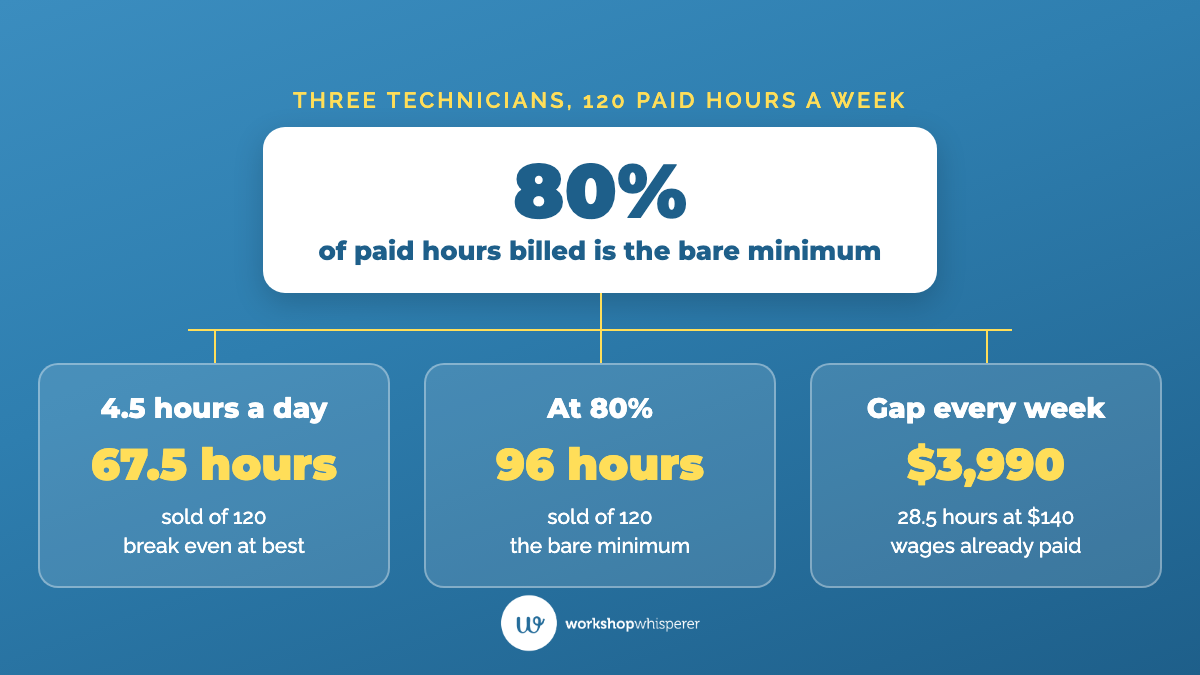
A worked example. Take a shop with three technicians, each paid for eight hours a day, five days a week. That's 120 hours available to sell every week. At 4.5 billable hours a day, the team sells 67.5 of them. At 80%, it sells 96. That's a gap of 28.5 hours a week. At a labour rate (or labor rate) of $140 an hour, that's $3,990 a week in labour you've already paid wages for and never billed. Allow for leave and public holidays, call it 46 working weeks, and it comes to more than $180,000 a year. Run it with your own numbers.
Dean, who works alongside me coaching our clients, sees the same pattern across the industry. The average auto repair shop across Australia and New Zealand sits at about 62% productivity. That means 38% of every paid day goes unbilled, nearly four hours per technician on a ten-hour day.
That's why the target you measure against matters. Cassie and Josh Lole run Auto Air Electrical, and they'd been in business for 10 years when they joined us. As they put it, "for the first eight, basically, well, now I find out that I've been winging it. So, with a lot of inefficiencies." What changed was having "industry specific metrics to know where my target should be", and working to them. In the first six months, their bottom line went up by "roughly about 50%", and it grew again on top of that over the following year. Read Cassie and Josh's story.
How do I work out how many billable hours my technicians are producing?
Start by separating two words that get used as if they mean the same thing.
- Productivity is the hours sold against the hours available to sell. If a technician has eight hours to sell and sells four, they're 50% productive.
- Efficiency is the time a job took against the time you set for it. Experienced, skilled technicians often run above 100% efficiency, and some of our clients' whole teams do.
Billable hours is a productivity question. Efficiency is one of the reasons behind it. A technician who takes three hours on a 2.25-hour job has lost time that can't be sold, and that drags their productivity down with it. There's more on how to measure technician efficiency and productivity, technician by technician.
An industry survey here in Australia found that more than half of auto repair shop owners measure efficiency by whether they can pay their bills at the end of the month. A bank balance tells you nothing about which hours went missing. And because EFTPOS settles money into your account every day, you can outrun a cash flow hole for two or three years before you discover you're 40 or 50 grand short.
So pull the real numbers. Any good shop management software will print a productivity and efficiency report for each technician in a couple of clicks. If yours can't, it's time to change software. Then sit down and read the reports properly. If Mike is at 105% efficiency and 85% productivity, and Sam is at 50% productivity and 75% efficiency, you know who's doing a stellar job and which conversations you need to have this week.
Then check one more number: your effective labour rate, your labour sales divided by the hours your team had available to sell, which shows what every one of those hours actually brought in.
How do I get my technicians closer to 80%?
Don't start by pushing your team harder. Start by finding out what's stopping them. There are at least five possible causes, and they need different fixes:
- The person. They may lack the work ethic or the experience to charge out more hours. That's more training to lift their productivity and efficiency, or performance management. Sometimes it means performance managing them out of the business.
- Bottlenecks. Workflow problems stop them charging out their time.
- Not enough work. You may not have the cars to give them, which is a marketing problem.
- Too many technicians for the work you have.
- Unconverted work. The cars are there, but the upselling on the vehicles you already have isn't happening.
Dean calls the hidden version of number two the time bomb. Every job runs like a production line, from the customer dropping the keys off to the car driving out, and the line leaks the whole way along. It leaks through admin and job card updates, cleaning benches, walking to the parts room, and ringing around for parts while a car waits on the hoist with the bonnet open. Every one of those minutes is paid for, and none of it is billed.
Dean has written about where those hours go and how to find them.
Once you can see the leaks, make the number visible. Put a whiteboard on the workshop floor. Every time a technician finalises a job card, they walk to the board and write up the hours they sold. Not the service advisor, not the receptionist: the technician. No one wants to be the lowest number on the board, and that bit of healthy competition alone gives you a natural lift of at least 3%. Time clocking on every job gives you at least another 3%. If a technician pushes back on writing up their hours, it's usually because they're not working as efficiently as they could be, and that's a conversation worth having.
And look at your own role. Your technicians can't bill hours while they're walking to the front counter to answer the phone, and neither can you. If you're still on the tools, you can stay there as a producer at around 80% productivity, or step into the service advisor or service writer role and make sure every job gets a proper sales conversation. Either way, make the role clear.
Jeff Hazzeldine, at SCS 4WD Centre, is one of our longest-serving Engine Room clients. When an injury took one of his mechanics off the floor, Jeff's team hit 110% productivity for the first time in a long time. With two on the floor instead of three, they landed within about $2,000 gross of the numbers they usually hit with three. It was a big eye-opener for him. When he looked at the figures properly, his foreman had the lowest proficiency in the shop, possibly because he was having to do other jobs as well, and it made Jeff look hard at everyone's role.
Watch this five-and-a-half-minute episode before you set a target for your team: Dean asks me why 4.5 hours a day is a dangerous benchmark, and I walk through the five things to check first.
Questions auto repair shop owners ask about billable hours
Why aim for 80% and not 100%?
Because your technicians aren't on the floor every paid hour of the year. Once you take out public holidays, annual leave and some sick leave, a technician who bills 80% across the year is giving you close to 100% of the time they're actually there. Anyone above that is doing a really good job, so recognise it in a way that person values, which isn't always money.
Can a technician bill more than 100% of their hours?
Yes. A technician who beats the time set for a job can sell more hours than they were on the clock. One of our long-standing clients had his whole team at 120% productivity in a single month. It happens when the parts chasing and the admin come off the technicians' plate.
Should every hour be booked in advance?
No. Dean's benchmark for a solidly profitable shop is around 85%, with the remaining 15% held back deliberately in the daily bookings for the extra work your technicians find on the cars already in. That's how your average repair order (or average job value) grows without booking in more cars. Overbook the day and your stressed technicians stop looking for that work, because they don't have time.
Should I hire another technician if my team is flat out?
Measure first, because a team can be flat out and still be selling well under its available hours. If your team is selling well under 80% of its available hours, more people means more wages and the same leaks. Track every technician's time for one week before you advertise the role.
What if my technicians won't record their time?
Getting time recorded is a leadership job. It's your business, and if you decide this is how it's done, then that's how it's done. Set it up simply, train it in ten minutes, and talk through the numbers in your morning huddle each day.
Where to start tonight
Pull up last month. Add up the hours your technicians had available to sell, then the hours you actually sold, and divide one by the other. If you're under 50%, you'll feel it in your cash flow. If you're at 50 to 60%, that's a start and there's work to do. The aim is 80 plus.
If your shop turns over more than $50,000 a month and you want help closing that gap, The Engine Room is where we work through your numbers and your team's productivity with you, with a business coach one-on-one on demand and group sessions over Zoom.
Related questions:
- Will Hiring Another Technician Fix My Cash Flow?
- How Do I Move to a 4 Day Work Week Without Losing Profit?
See what changes for the people who do this work. On our Our Clients page, auto repair shop owners, named and on camera, tell you what actually changed in their shops and their numbers.
More on this topic: all Productivity articles.
Whenever you're ready, here's how we can help.
- Not ready to spend anything yet? Start free with Shop Talk, a 30-day reset for auto repair shop owners on our YouTube channel, and our free resources for auto repair shop owners.
- Running an auto repair shop over $50,000 a month? The Engine Room changes how the whole business runs, from your numbers to your team's productivity, with one-on-one coaching on demand, group sessions over Zoom and three two-day intensives a year.
- Under $50,000 a month? Auto Superstars Academy builds the foundations, delivered online, with one-on-one coaching on demand from a business coach who is a current or former auto repair shop owner.