

How Do I Measure Technician Efficiency and Productivity?
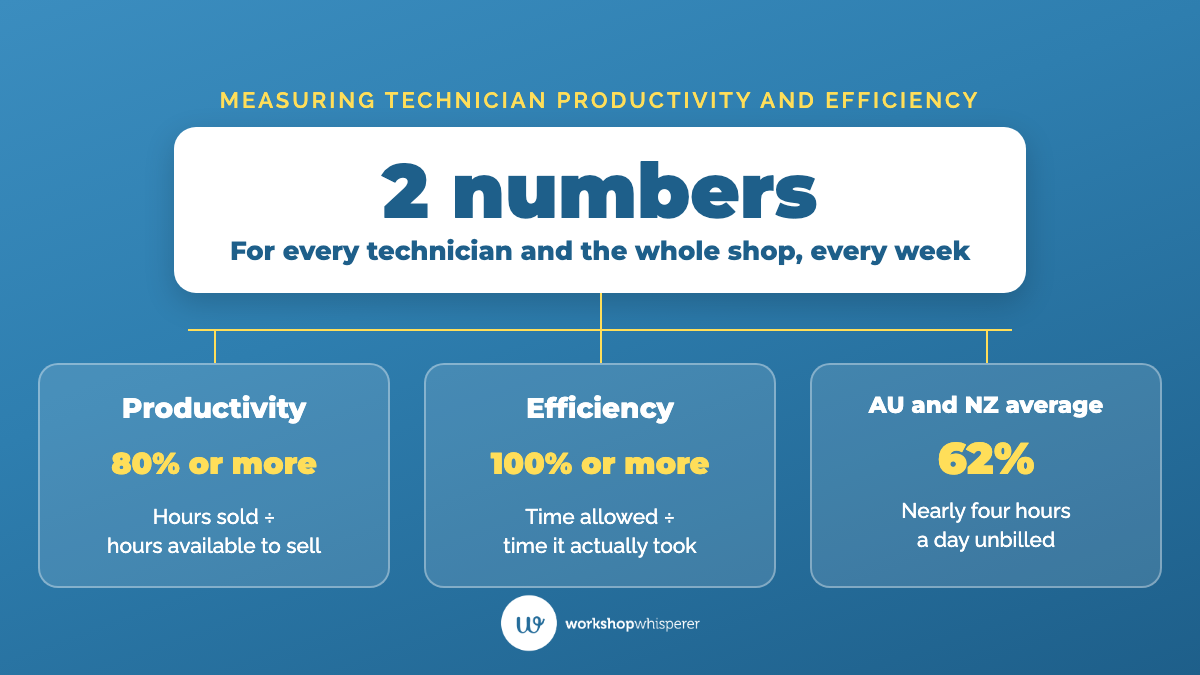
You measure two numbers, for every technician and for the whole shop, every week. Productivity is the hours you sold divided by the hours your team had available to sell. Efficiency is the time allowed for a job divided by the time it actually took. Your workshop management software can produce both in a couple of clicks, as long as your technicians clock on and off every job. Aim for productivity of 80% or more, and efficiency at or above 100%.
If you've been going by feel, you're far from alone. When an industry survey here in Australia asked shop owners how they measure efficiency, more than half said it was whether there was enough money in the bank to pay the bills at the end of the month. That's rarely carelessness. Most of us were never shown another way.
It works the same whether you run an auto repair shop, a mechanics workshop, an automotive workshop or a garage, and whether you call them billable hours or sold hours.
What's the difference between productivity and efficiency?
The two words get used as if they mean the same thing. They measure different things, and you need both.
Productivity looks at the day. If one technician has eight hours available to sell and you sell four of them, that technician is 50% productive. Add it up across the team and across the month and you have your shop's productivity.
Efficiency looks at the job. You set a time for the work, then measure the time it actually took. A job allowed 2.25 hours that takes three hours is 75% efficient. Experienced, highly skilled technicians often beat the time, which puts them over 100%. Some of our Engine Room clients run their entire workshop above 100% efficiency.
The two feed each other. When a job blows out, the extra time gets written off, so it's never sold. Your productivity drops, and so does your effective labour rate, which is the money you actually receive for every hour against the labour rate (or labor rate) you advertise. Plenty of clients come to us advertising $110 an hour and discover their effective labour rate is somewhere in the $70s.
That's why the bank balance is no measure at all. Card payments settle into your account every single day, so money keeps arriving even while hours leak out the back door. You can outrun a cash flow hole for two or three years before the day you realise you're $40,000 or $50,000 short. If you've stayed open that long without measuring, it's more about good luck than good management.
What should my technicians' productivity and efficiency be?
Productivity: 80% or more, for each technician and for the shop. I get asked this all the time, and anything under 80% isn't a target worth setting. There's a reason it isn't 100%. Once you take out public holidays, annual leave and some sick leave, a technician who achieves 80% across the year is actually giving you 100%. Anyone above that is doing a really good job for you. I've written more about how many billable hours a technician should produce.
If you're selling only 50% to 60% of your available hours, that's a start, and there's work to do. At that level you may not be covering your break-even costs, the money it takes to open the roller door before a single part is sold.
I know the bottom of that ladder well. In the first shop we bought, we were selling 15% to 30% of our available hours. It was a business in decline, its heyday long past, and we had to attract a whole different type of customer. At that level you don't take a wage, and you can't afford to hire anyone to help.
Dean, who hosts our A-Grade Auto Repair Shop Show, puts the average auto repair shop across Australia and New Zealand at 62% team productivity. That means 38% of a ten-hour day goes unbilled, nearly four hours per technician, every day, that you're paying wages for. The benchmark Dean uses for a solidly profitable shop is 85%, with the rest held back deliberately in the daily bookings for the extra work your technicians find on the cars already in the bays. And one of our Million Dollar Mechanics Boardroom clients hit 120% team productivity in March. His team billed more hours than they technically had to sell, because the distractions had been taken away from them.
Efficiency: 100% is the line. Below it, jobs are taking longer than the time you set. Above it, your best people are beating the time.
A worked example. Take a shop with four technicians, each available for eight hours a day, five days a week. That's 160 hours to sell. Last week the shop sold 96 of them, so it's 60% productive. At 80%, it would sell 128 hours. Those 32 extra hours at a $130 labour rate come to $4,160 a week. Over 46 working weeks, allowing for leave and public holidays, that's more than $190,000 a year in labour sales. Your wages haven't changed, because those hours are already paid for. This is an example, so run it with your own hours and your own rate.
How do I start measuring, and what do I do with the numbers?
1. Clock on and off every job, every time. Your numbers are only as good as what goes into your software. If your technicians fill in job cards loosely, or after the job from memory, the reports are a guess too. If your software can't do continuous time clocking yet, put a big whiteboard in the workshop. At the close of every job card, the technician walks up and updates their sold hours for the day. There's often a fear around putting numbers on the board, but we're grown-ups. As I've said before, "It's only people that want to hide and that know their performance isn't up to par that will have a problem with their numbers going on the whiteboard."
2. Print the reports and read them technician by technician. Say Mike is sitting at 105% efficiency and 85% productivity, and Sam is at 75% efficiency and 50% productivity. Mike is doing a stellar job and Sam isn't. Then ask yourself: what decisions do I need to make here, and what meetings do I need to have with the team? That's what managing your business looks like: you read the report and make the call, rather than guessing from the bank balance and flying by the seat of your pants.
3. If you don't believe the numbers, audit one week. Have every technician write down what they actually did through the day, with pen and paper, changing nothing else. Dean explains why technicians look busy but bill so few hours, and what that week usually shows.
Dean names where those hours go. Paperwork and updating job cards halfway through. Walking to the parts room. Ringing around for parts and sitting on hold while the car waits on the hoist. Going to the front counter to talk to the service advisor (your service writer, if you're in the United States) about the next job before this one is finished. And where there's no service advisor at all, I see the owner and the technicians lose time walking back and forth to answer phones and do invoices.
4. Make the time on every job clear. The most common efficiency problem I see is simple. Nobody has told the team what time frame the job should be done in, so technicians fill the day with the jobs they have. Put the time on the job card before the work starts. Then sit down one-on-one with anyone below 80% in a feedback forum, and ask what's getting in the way of them selling their time.
The team changes once the numbers are visible. As Dean puts it, your A-grade and B-grade technicians suddenly feel like they're winning, because for the first time someone is noticing what they produce. Some of the others lift, because they know they're being watched. A few sort themselves out and leave. "A busy team is not a productive team," Dean says, and the numbers are how you tell the difference.
Ben McSparron runs Automech in Warrnambool, Victoria. Before he joined us, he says, "our business was running okay, just scraping by from month to month, really." The change started with the numbers. "We were starting to report on our KPIs with our productivity, efficiencies, our financials as well," Ben says, and those reports drove the business toward its benchmarks. Today Automech has a team of seven, gross and net profit have both grown, and Ben is off the tools: "I have more free time in the business now to actually work on the business instead of being stuck on the tools." Watch Ben's story.
In The Engine Room, this is the work we do with you every week: your team's productivity and efficiency measured, read technician by technician and acted on, with one-on-one coaching on demand from a business coach who is a current or former auto repair shop owner.
Watch this before you pull your first report: in under nine minutes I explain the difference between efficiency and productivity once and for all, and what to look for in each technician's report.
Questions auto repair shop owners ask about measuring technician productivity
Can technician efficiency be over 100%?
Yes. Efficiency compares the time taken with the time allowed, so a skilled technician who finishes a two-hour job in an hour and a half is over 100%. Some of our clients run their whole workshop above 100% efficiency.
Is 100% productivity realistic?
Across a year, 80% is the target, because leave and public holidays come out of available hours. Dean's benchmark for a solidly profitable shop is 85%. One of our clients reached 120% in a month, billing more hours than his team technically had to sell, because the distractions had been taken away from them.
Should I measure productivity per technician or for the whole shop?
Both. The shop number tells you whether you have a problem. The individual numbers tell you where it is, and who needs a conversation.
What if my software doesn't produce productivity and efficiency reports?
Any good mechanic-specific management software should produce both in a couple of clicks. An accounting package on its own won't. If your software can do it and you don't know how, call the help desk and ask for training. If they can't or won't help, it's time to change.
Should I pay my technicians a bonus on productivity?
Not until your technicians are at 80% or above. Bonusing people who aren't yet doing the basic requirements of the job wastes your money. When they are there, set targets on three numbers: productivity, efficiency and effective labour rate. Budget the bonus pool for the year before you offer it. And ask each technician first, because some will value time off more than money.
Where to start tonight
Pull up last month. For each technician, add up the hours they were available to sell, then the hours you actually sold for them. Divide the sold hours by the available hours and write each technician's percentage on one sheet of paper, with the shop's total at the bottom.
That one page tells you whether you have a workload problem or a time problem, before you hire anyone or go chasing more cars.
Related questions:
- Will Hiring Another Technician Fix My Cash Flow?
- How Do I Move to a 4 Day Work Week Without Losing Profit?
See what changes for the people who do this work. On our Our Clients page, auto repair shop owners, named and on camera, tell you what actually changed in their shops and their numbers.
More on this topic: all Productivity articles.
Whenever you're ready, here's how we can help.
- Not ready to spend anything yet? Start free with Shop Talk, a 30-day reset for auto repair shop owners on our YouTube channel, and our free resources for auto repair shop owners.
- Want your team's productivity measured, lifted and held every week? The Engine Room changes how the whole business runs, from your numbers to your team, delivered online with one-on-one coaching on demand from a business coach who is a current or former auto repair shop owner.