

How Do I Move to a 4 Day Work Week Without Losing Profit?
You keep your profit on a 4 day work week by keeping every paid hour available to sell. Your team works the same weekly hours in four longer days, you pick the model that fits the size of your team, and you run a three-month trial with a productivity floor everyone agrees to before it starts. Done that way, profit holds or goes up, because overtime falls away and your team works hard to protect a long weekend they don't want to lose.
If the idea scares you, that's normal. Most auto repair shop owners worry about losing customers, productivity and money when they first look at it. Those worries are the same whether you run a mechanics workshop in Perth, an automotive workshop in Queenstown or an independent garage in the UK, and the method below answers all of them.
Will a 4 day work week cost me money?
Not if you set it up properly. Your money comes from the hours you sell, not the days you're open, so the risk is giving hours away. When the same hours get worked in fewer, longer days, nothing is lost.
There are two ways to make up the missing day. The first is to extend your open hours. If you open at 8:30, you open at 7:30, and if you close at 4:30, you close at 5:30. Your technicians work all of their hours, you charge the same labour hours as before, and your profitability should at least stay the same.
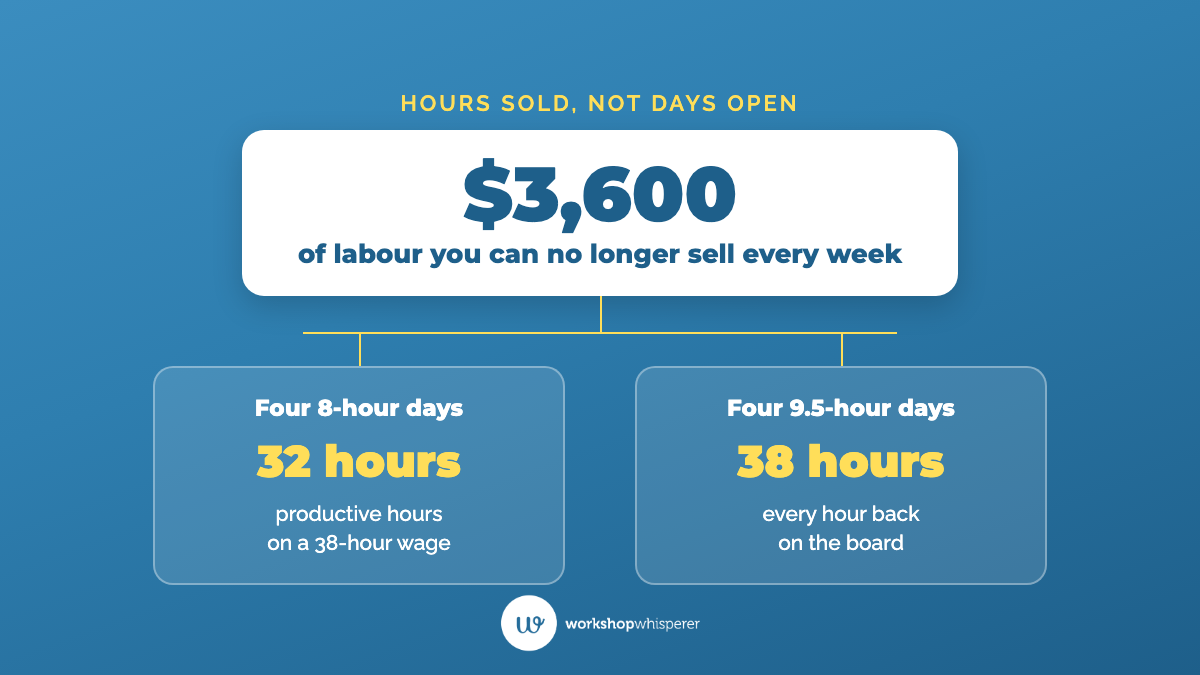
The second is to keep eight-hour days and pay the other hours anyway. That's 32 productive hours a week on a wage that covers 38 or 40. Those extra hours are dead hours. You pay for them and they never come back to you as a return.
What those dead hours cost. Here's an example, so you can see the maths. Take a shop with four technicians on a 38-hour week. If they move to four 8-hour days on full pay, each technician has 6 paid hours a week that can't be sold. Across four technicians that's 24 hours a week. At a labour rate of $150 an hour, that's $3,600 of labour you can no longer sell every week, or more than $187,000 a year, while your wages bill stays exactly where it was. Move the same team to four 9.5-hour days and every one of those 38 hours is back on the board. Run it with your own team, your own hours and your own rate.
On top of that, profit improves in three places. Overtime, one of the biggest expenses in most shops, drops sharply. Communication improves, because nobody wants to leave a half-finished job for the person covering their day off. And longer trading days usually lift the average sale per invoice, the figure some of you call average job value and others call average repair order, because your service advisor, or service writer, has more time to plan the day and present the extra work.
Chloe and James own an auto repair shop in Queenstown, with four technicians and a service manager. For years they worked eight to five, five days a week, and the business crept into their weekends. "Whenever we got just one day off, we would feel very lucky," Chloe told me.
Then came a scorching summer. By three in the afternoon the team in the shop could barely handle the heat, so everyone started at seven and finished earlier. A couple of weeks in, one of the guys suggested cutting Friday entirely. Everyone laughed. Then Chloe and James started thinking about it, and worked out there was nobody they had to ask. "It's a liberating feeling once you realise that you are totally in control," Chloe said.
They trialled Monday to Thursday, 7am to 6pm. It took about three months of showing customers the work was getting done faster before everyone settled in. Their newest service manager joined because of the four day week, and their profits went up.
If you want the whole model in one place, my free ebook The 4 Day Work Week sets out how auto repair shops make the move without losing profit or customers.
Which 4 day work week model suits my shop?
There's no one-size-fits-all 4 day work week. We help our clients choose from five models, and the right one depends mostly on the size of your team.
- Close on a Monday or a Friday. The whole team has the same day off. This suits small teams of one to three people, and shops doing restoration or booked specialist work with little drop-in trade.
- Stay open five days and rotate. Each person works four days, and the days off rotate. It works for teams of three or more. Plenty of shops give the Monday and Friday days off to their longest-serving people as a reward, and junior team members take a midweek day.
- Run two crews. One crew works Monday to Thursday, the other Tuesday to Friday, so every day is covered and everyone still gets a long weekend. It works from about five people up.
- The nine-day fortnight. Each person works a fortnight's hours in nine days. It's the easiest step for an owner who can't get comfortable closing for a whole day.
- The hybrid. The technicians run a 4 day work week and the front office runs a nine-day fortnight, or any mix that suits your business.
The wrong model shows up fast in your productivity. We had a client with a two-person shop where the owner took Wednesdays off and the technician took Thursdays off. That left one person carrying the entire shop two days a week, and productivity dropped on both days. Closing on the same day would have kept it level.
Noah, who runs an auto repair shop in Perth with a 13-strong team, couldn't close on a weekday. Before the change his shop was open eight to five, but people came in half an hour early and stayed half an hour late, and he paid for it in overtime. He moved to rotating days off and stretched his open hours. Customers loved the 7:30 drop-off and the later pick-up. Productivity stayed high, profit improved once the overtime stopped, and Noah picks up his kids from school every Friday.
How do I make the switch without losing productivity?
Make the decision yourself. Don't put it to a vote. If you ask your team whether they'd like to try a 4 day work week, most will say no, because they can't picture it and none of us likes change. Make the call as the owner, and call it a trial.
Run a trial of at least three months. Twelve weeks gives you time to sort out the hiccups, like the Thursday afternoon handover when one crew passes jobs to the next. It also gives everyone a way back. If it doesn't work, you return to the old week. I haven't seen a business do that yet.
Let the team write the rules. The decision to trial is yours. The rules it runs by belong at the table with your team, because people hold each other to rules they helped write. What happens when a day off lands on a public holiday? At The Workshop Whisperer we take Mondays off, and our team agreed that with 52 Mondays off a year, there's no banking of public holidays.
Set a productivity floor before day one. Productivity is what decides whether the trial succeeds. It must not drop below where it sits on your current week, and every team member should hit at least 80%. If it slips, you bring everyone in, work out why, and agree that if you can't get it back, you go back to the old week. Once they've tasted a three-day weekend, your team won't want that, and they'll police the numbers for you.
Write down your handovers. On rotating days or two crews, more people need to know how to do more things. Clear procedures for handing over a job keep the work moving and keep people accountable. It also forces the systems you've been meaning to build, so the shop runs on the days you're not there.
Tell your customers early. Let them know you're opening earlier and closing later. Most prefer it. They drop the car on the way to work and collect it on the way home. Jesse and Mia, who run a family auto repair shop in Newcastle, had a few customers who wanted them open on Fridays, so they bought a courtesy car and kept them. What surprises our clients most is how their own customers applaud it: "I wish my employer would do the same."
Ward and Diana Lamley run K&M Mechanical Repairs in Newcastle, with their son and a couple of apprentices on the team. Ward is a self-confessed sceptic. "I thought I was going to lose customers," he said. So he told Diana they would give it a month. The shop now opens 7:30 to 5:30, the team still does a 38 hour week with no overtime, and Friday, Saturday and Sunday are theirs. "Our customers worked around it," Ward said. "They come to us because we're good." In his words: "give it a month and we're still going." Watch Ward and Diana's story.
If you'd rather run your trial with every step laid out, our online program The 4 Day Work Week takes you through the models, the team conversations, the trial checklist and the customer comms, at your own pace.
Watch this 15-minute training before you change your roster: the five models, the trial and the rules that keep productivity up.
Questions auto repair shop owners ask about the 4 day work week
Will my customers go elsewhere if I close on a Friday?
Very few, if you tell them early and stretch your hours. Most customers find a 7:30 drop-off and a later pick-up easier, because they're not rushing to get the car in before work. Where a handful of customers need you on the day you're closed, a courtesy car can keep them.
Will my team take a pay cut on a 4 day work week?
Not if they work the same hours. Those hours are spread over four days instead of five, so their pay stays much the same. You may also want to move your team from wages to salary at the same time, which brings overtime under control. Whatever the employment rules are where your shop is, the minimum entitlements stay. A 4 day work week is a benefit added on top.
Should I ask my team before I start?
Ask them to help write the rules, not whether to do it. Put it to a vote and most teams will choose what they already know. Decide to trial it, then bring them to the table to set how it will run.
How long should a 4 day work week trial run?
At least three months. Twelve weeks is enough to work through the handovers, settle the roster and see whether productivity holds. Set the end date before you start, and track your numbers the whole way through.
What if productivity drops during the trial?
Stop and find out why, with the team. The deal you agreed at the start was that productivity stays at or above your old week. If you can't bring it back, you return to the old roster. In practice, the fear of losing the long weekend is what keeps the numbers up.
Where to start tonight
Open your booking diary and find your furthest-out booking. Draw a line after it. That's the date your trial can start, without moving a single customer.
Then write down how many hours each technician sold last month. That's the baseline your trial has to match, and in twelve weeks it will tell you whether the long weekends stay.
Related questions:
- Will Hiring Another Technician Fix My Cash Flow?
- How Do I Measure Technician Efficiency and Productivity?
See what changes for the people who do this work. On our Our Clients page, auto repair shop owners, named and on camera, tell you what actually changed in their shops and their numbers.
More on this topic: all Productivity articles.
Whenever you're ready, here's how we can help.
- Not ready to spend anything yet? Start free with Shop Talk, a 30-day reset for auto repair shop owners on our YouTube channel, and our free resources for auto repair shop owners.
- Ready to run the trial? The 4 Day Work Week is a self-paced online program with everything you need to move to a four day week without losing profit or customers: the models, the team conversations, the trial checklist and the customer comms.
- Running an auto repair shop under $50,000 a month? Auto Superstars Academy builds the foundations, with one-on-one coaching on demand from a business coach who is a current or former auto repair shop owner.
- Over $50,000 a month? The Engine Room changes how the whole business runs, from your numbers to your team, delivered online with one-on-one coaching on demand.