What Do I Say When a Customer Asks What Our Labour Rate Is?
Answer with a question. "Can I ask what job you're looking to get done, please? Because I won't know the answer to that until we know what we're looking at." Then ask when they want the work done. If it's a regular customer asking at the counter, find out why they're asking, because the question often means there's something about the work you did that they haven't understood.
If asking a question back feels like dodging, it isn't. Until you know the job, it's the most honest answer you can give.
It's one of the most common questions I get, from clients and from owners in our free Facebook group. The conversation goes the same way whether you run a mechanics workshop, a mechanical workshop or a garage, and whether the caller says labour rate or labor rate.
How often do customers really ask what our labour rate is?
Far less often than you think. The people who ask for your labour rate are a very small part of your customer base, a couple of percent. In most shops that's maybe one a month, unless your shop is already full of price shoppers.
It feels like everyone asks because you deal in prices all day. I have this conversation with auto repair shop owners all the time, and by the end of it they realise they're more price sensitive than many of their customers. You assume your customers know your hourly rate, or want to, and very few of them do.
Stella and Selwyn King, who run JDM Motorsport in Brisbane, know this one well. Whenever they talked about putting their prices up, the discussion was always the same: "Well, what does X, Y, or Z charge for their hourly rate?" They were at $120 an hour including GST. Once they stopped comparing themselves to other workshops, they quickly ramped to $150, and when they recorded their story they were charging $175 an hour, with another increase on the way. In their words, "you don't have to charge the same rate or less as another workshop. That was a big one." Read how Stella and Selwyn turned their workshop around.
Expecting the question costs you money. Dean describes what happens at the counter when an owner expects a customer to flinch: the hours get dropped, a bit comes off the margin, and a "fair" discount slips in before anyone has pushed back. As he puts it, "the conversation you think the customer is going to have is harder and louder in your own head than almost any real conversation with a real customer really is."
What should I say when someone rings and asks for our rate?
When the first thing a caller says is "What's your labour rate?", they're almost always price shopping you. You've got a split second to decide whether you want that conversation. Either way, the fastest move is the same.
1. Ask what work they want done.
"Can I ask what job you're looking to get done, please? Because I won't know the answer to that until we know what we're looking at."
I always say that in any conversation, questions are the answers, and this is where it pays off.
2. Ask when they want it done. Once you know the job, you'll have a figure in your head. Don't say it yet. Ask: "Are you looking to have this work done in the next seven days?"
3. Decide what happens next. If they do, take the booking and give them a proper estimate once you know what you're dealing with. If they say "Oh no, I'm just ringing around for a price," you can tell them you're only able to prioritise people looking to get the work done in the next seven days. In one of our Talking Shop episodes I put it this way:
"At the moment, we're only doing estimates for people looking to book in work in the next seven days. If you decide that you do want to get the work done within a confirmed date, please let us know. We'll be happy to do the estimate."
Some callers are only ever going to shop you on price, and sorting them from the ones who'll book is a job of its own. I cover how to triage those calls, and when to send someone to the shop down the road, in how to stop customers price shopping your workshop.
Why one number is the wrong answer. Dean's line is that a quote is a fixed price on a flexible process. You don't know what you'll find until the car is up on the hoist. A labour rate has the same problem, because you shouldn't have only one.
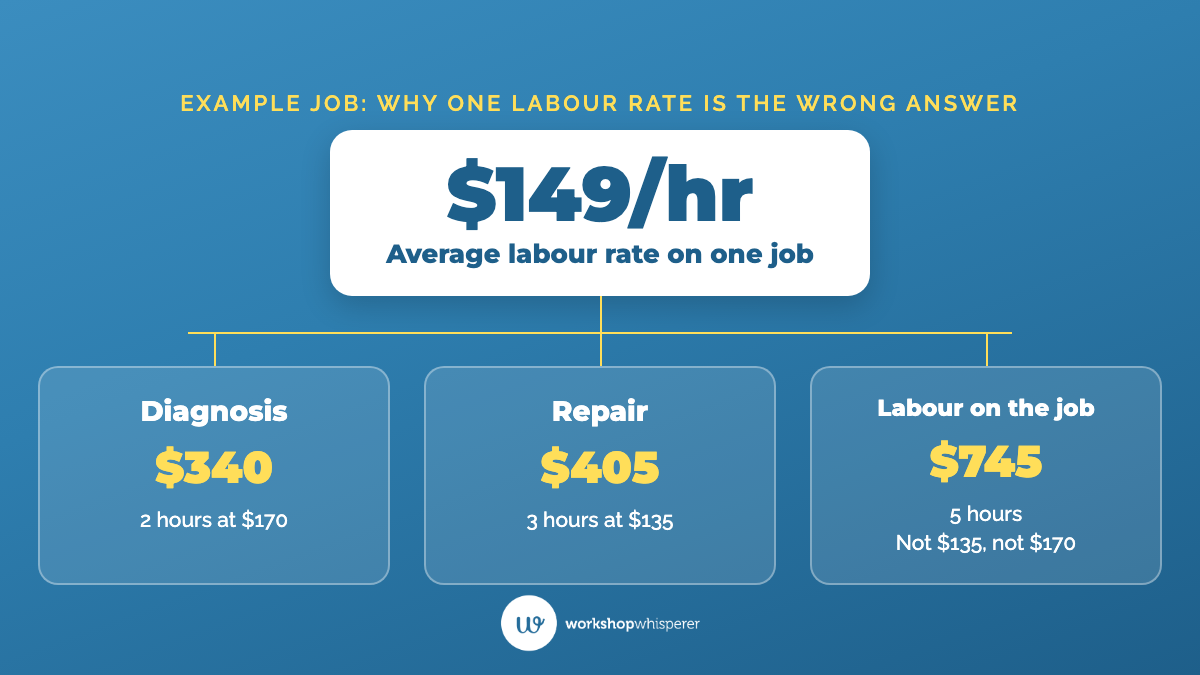
Here's an example, with numbers I've made up to show the maths. Say your advertised rate is $135 an hour plus GST, which is the kind of rate a price shopper is after when they ask "how much do you charge per hour?" Diagnostic work should sit 25% to 50% above your advertised rate, because while your technician is diagnosing you can't sell any parts. That puts your diagnostic rate somewhere between $168.75 and $202.50. Say you settle on $170.
A customer rings about a warning light. The job turns out to be two hours of diagnosis and three hours of repair:
- Diagnosis: 2 hours at $170 = $340
- Repair: 3 hours at $135 = $405
- Labour on that job: $745 for 5 hours, an average of $149 an hour
Your labour rate on that job was neither $135 nor $170. If you'd said "$135" on the phone, you'd have handed the caller a number to compare against the shop down the road, and it would have been the wrong number anyway. "I won't know until we know what we're looking at" is the true answer.
What if a regular customer asks about our labour rate at the counter?
This one is different. Someone who already brings their car to you isn't shopping. So before you answer, ask yourself why they're asking. Is there something they haven't found value in? Is there something about the work you did that they haven't understood? Often the answer is sitting on your invoice.
Stop showing hours on the invoice. If your invoice reads "Labour, 1.5 hours at $90, $135", you've put the calculation in front of them. You're teaching your customers to question what you charge, and the next time your rate goes up they can hold the old invoice next to the new one and see that $90 became $100. Set up a kit in your workshop software so the labour shows as one technician's fee, or one line for the service, with no hours on it. Every mechanic-specific program I know of lets you do this.
Put the story on the invoice. The more story on the invoice, the more valuable the invoice can be. Write down what was done in words the customer understands: the functional checks, the inspection of the wheels, the fluids checked, the service indicator reset, the safety stop test. Your average mum and dad don't know what a list of part numbers means. A customer who can read what you did for them is far less likely to challenge you on price. I walk through this in more detail in how to raise your labour rate without losing customers.
Set up the conversation before the work starts. When a customer pushes back on the bill at the counter, it's often bill shock, and bill shock comes from a job where nobody checked in. When a car comes in that needs diagnosing, tell the customer up front: diagnosing attracts two hours of labour and this is what it costs. "At the end of that 2 hours, I'll update you and if we need more time, I'll let you know and I'll get your permission to proceed." Then keep that promise at every point you said you would. Do that, and no one will question your higher diagnosing rate.
This is the job of your service advisor, or service writer as they're called in the United States, or service adviser in the UK. If it's you on the phone and at the counter, it's your job until you've trained someone else to do it. That training is what Superstar Service Advisor is for: it teaches the person at your front counter to present the work and hold the price, in 13 self-paced modules you keep for life.
Watch this under-seven-minute episode before your next phone call to hear me answer this exact question. On Whispering Loudly, Mel puts a listener's question to me and I walk through what to say back, including the triage idea. The labour rate question starts about halfway through, after a short answer on service stickers.
Questions auto repair shop owners ask about giving out the labour rate
Is it rude not to tell a customer our labour rate?
No. You're asking what job they need done so you can give them a real answer instead of a misleading one. A labour rate on its own tells the customer almost nothing about what their job will cost, so the question back is the more helpful response.
What if the caller keeps pushing for a price?
Then they're shopping on price, and you can say so kindly. Offer to book them in and give them a proper estimate once you know what you're looking at. If they won't book, that's a price shopper, and the price shopping article walks through what to say next.
When they do want a figure, should I give them a fixed quote?
Give an estimate, not a quote. A quote locks you into a number before you've seen the car. An estimate gives a range. As Dean puts it, let them know "it's going to be at least this much, perhaps up to this much." That leaves room for what you find on the hoist.
Who should take these calls, me or my service advisor?
Your service advisor or receptionist, once they know the questions. In Just Say NO! I suggest asking "that one simple extra question" the next time you're asked for a quote, "or better yet, have your service advisor or receptionist do it!" Write the questions down so everyone answering the phone asks them the same way.
Should I show the labour rate on my invoices?
No. Show labour as one technician's fee or one service line, with no hours, and describe the work in plain words. It removes the conversation about the hourly rate, and it means a rate rise doesn't jump off the page when they compare invoices. That's how we teach rate rises: don't announce it, do it.
Where to start tonight
Take a card and write two questions on it: "Can I ask what job you're looking to get done?" and "Are you looking to have this work done in the next seven days?" Put it beside the phone at the front counter. In the morning, show it to whoever answers your phone and agree what you'll say to the caller who is only ringing around for a price.
Related questions:
- How Do I Stand Out From Other Workshops Without Discounting?
- How Do I Keep Customers Coming Back to My Auto Repair Shop?
See what changes for the people who do this work. On our Our Clients page, auto repair shop owners, named and on camera, tell you what actually changed in their shops and their numbers.
More on this topic: all Customer Experience articles.
Whenever you're ready, here's how we can help.
- Not ready to spend anything yet? Start free with Shop Talk, a 30-day reset for auto repair shop owners on our YouTube channel, and our free resources for auto repair shop owners.
- Want whoever answers your phone to have this conversation every time? Superstar Service Advisor trains the person at your front counter to present the work and hold the price, in 13 self-paced modules you keep for life.
- Running an auto repair shop under $50,000 a month? Auto Superstars Academy builds the foundations, with one-on-one coaching on demand from a business coach who is a current or former auto repair shop owner.
- Over $50,000 a month? The Engine Room changes how the whole business runs, from your numbers to your team, delivered online with one-on-one coaching on demand.