How Do I Stand Out From Other Workshops Without Discounting?
You stand out by being the easiest and best shop to deal with, not the cheapest. That comes down to four things: a service advisor who looks after the customer's car like it's their own, a conversation about the work rather than the price, a text the moment the car is ready, and small extras that cost you a few dollars. People remember the experience long after they've forgotten the $10 you took off.
Wanting to stay competitive doesn't make you a discounter at heart. It usually means you care about keeping the bays full and your team paid.
Whether you call it an auto repair shop, a mechanics workshop, an automotive workshop or a garage, every customer who pulls in wants to know one thing: will this place look after me and my car?
Why doesn't a cheaper price make my shop stand out?
Alison, a long-time listener of our podcast, wrote in from Esperance in Western Australia. She wanted her shop to stay competitive, but she kept hearing my voice in her head telling her never to devalue her services by discounting. So apart from discounts, how else could she stand out?
I'm glad that voice is there, Alison. A discount wipes out your profit margin, so you have to do more jobs to make the same money, and you'll probably be cranky about it.
There's always someone cheaper. As Dean puts it, there's "a bloke working out of a shed down the road." The customer you win by being cheapest leaves the day someone else is cheaper still. "You didn't win a customer," Dean says. "All you did was rent a price shopper." So compete on the things the cheaper shop down the road can't copy overnight. Dean has a simple test for what those are: "Think more about what does your customer see, what do they hear, and what do they feel when they come to see you, not how much is the price."
There's a cost to getting this wrong that never shows up on the invoice. Dean's figure is that, on average, auto repair businesses in Australia and New Zealand lose up to 18% of their customer base every year. Some pass away, some move away, and some go wherever they think they're getting a better deal. Customers do business with people they know, like and trust, and the shop that builds that trust loses fewer of them out the back door.
Ruth and Brett Gillard bought Sherson Automotive in Tauranga, New Zealand, about four years ago. "We were working so hard, but didn't have any money in the bank at the end of the week to show for having worked so hard," they told us. They said yes to everyone. If they could start again, they'd be "charging our time, not giving it away." In their words: "Solicitors don't think twice about charging. Doctors don't think twice about charging. We keep people safe in their vehicles, so we shouldn't think twice about charging as well." They stopped chasing everyone, because "not every customer is your customer." Now, "we run the day," and as they put it, "Now I love numbers because I see them in the bank."
What does a customer actually notice about my shop?
Far more than you think, and most of it happens before anyone picks up a spanner.
I talk about two kinds of wow. Good wow is when the customer says, "Wow, that's impressive, I've had a great experience here today." Bad wow is, "Wow, what just happened? I can't believe how much that bill is. They didn't talk to me about it." Or: "Wow, that person didn't even look up from the desk when I walked in, and I stood there for three minutes while they looked at their phone."
Mel, who produces our podcast, has been on both ends. One shop gave her a loan car. Another told her to sit and wait. She had so much work on that she pulled out her laptop and perched on a child's seat for five or six hours.
Your brand is speaking before you open your mouth, too. I've seen shop website after shop website done in black, as if the web developers had agreed on it. Choose your look on purpose, from what you want to be known for. And an email address ending in gmail.com looks like you haven't taken the business seriously yet, even if you're the best technician in town. A domain and a proper email address cost a few dollars a month.
Then there's the relationship. Reasonable customers don't expect you to chat all day. They want some familiarity, a bit of banter, and to know you remember them and care that their car is safe on the road.
Marcus Skilbeck runs Skilly's Tyre and Auto in regional Victoria. When he came on our podcast he had been working with me for more than six years. When he first contacted me, he was about to close his doors. He had been the only tyre shop in town, and now there were five other workshops competing with him. The three changes he credits are structured quarterly planning, knowing his numbers, and running the business professionally instead of turning up every day to a job. Then he moved out of a three-bay shop, where the customer area was a two-seater couch, into a site of nearly 1,000 square metres.
"Customers walk in the front door now, they just go wow," Marcus told us. "I've had customers say you're bigger and better than what the dealerships look like." His tyre sales went from around 150 a month to 350, and he had four times the work of the old shop, even while his advertising had dropped off. You don't need a new building to get that reaction. You need a front counter where customers feel they've come to the right place.
How do I stand out without spending a fortune?
None of this is rocket science, and most of it is old-school customer service.
1. Put the right person at the front counter. Have a dedicated service advisor, or service writer as they say in the United States, or service adviser in the UK. They become the advocate for the customer's car, the go-between for the technician and the customer. When they report back on the work, they put the safety items first, so the customer understands you're looking after their family, not tacking things on to grow the average repair order. Ask them to add a short note to the customer file after each visit, so next time they can pick up where they left off. If your front counter is where customers drift off to the cheaper shop, Superstar Service Advisor trains that person to present the work and hold the price.
2. Talk about the work, not only the price. If the only thing you discuss is parts and labour, you teach customers to be price sensitive, and you attract more of them. Mention the price, then move on to what the job does for them, like saving labour and a second trip by doing the extra job while that part of the engine is already open. People value their time as much as their money. Dean sees the same thing on the phone: when you ask questions about what the car is doing instead of firing back a number, "you stop competing on price because you've become the only shop that listened." Put that same story on the invoice, which I cover in how to raise your labour rate without losing customers.
3. Tell them before they have to ask. Text or call the moment the car and the invoice are done, even if they said they wouldn't be back until 4:30. Then follow up a couple of days later to make sure everything's running well. Send it by SMS rather than email, or pick up the phone. When I mentioned it on the podcast, Mel's reaction was that she'd never had a mechanic do that for her.
4. Make it easy to come to you. Think about who finds a service hardest. The mum doing school drop-off and pick-up. The one-car family juggling work around your opening hours. Ask how you could give that customer something extraordinary: loan cars, car seats to go with them, and pick-up and drop-off when the loan cars are out. If you've moved to a four day work week, open earlier and close later on the days you're open, say 7:30 to 5:30, so you're more convenient than before.
5. Add value that costs almost nothing. If a customer has to wait a while, set up an arrangement with a local cafe and send them there for a coffee on you. It costs about five dollars. At the end of a service, a tyre shine, a windscreen clean, a dash wipe or a fragrance tree. One I've used is a little bag of sweets in every car that comes in for a service or repair. It sounds like nothing, but it gives customers an easy way to describe you to family and friends: "my mechanic leaves a bag of sweets in the car," and those are the messages that win you new customers.
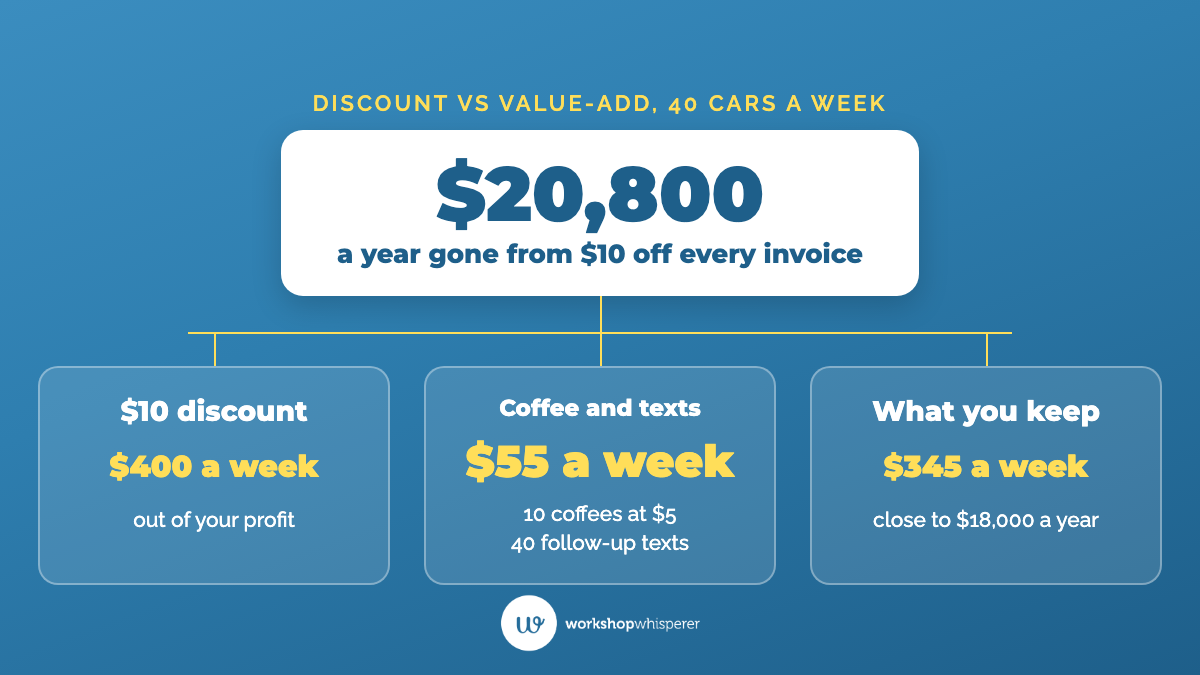
A worked example. Say your shop sees 40 cars a week. Knock $10 off every invoice and it costs you $400 a week, or $20,800 a year, and every dollar comes out of your profit, because the parts, wages and rent haven't moved. Now spend that week differently. Buy a coffee for the 10 customers who wait, at $5 each, and send a follow-up text to all 40 for a few cents each. That's around $55. You've kept roughly $345 a week, close to $18,000 a year, and given customers something they'll talk about. These are example numbers, so run the sum with your own.
Watch this eight-minute video before you change anything at your front counter: I walk through good wow, bad wow, and the three places to start when your feedback is hit and miss.
Questions auto repair shop owners ask about standing out without discounting
Do customers really choose a mechanic on price?
Most don't. There are people at every price point, but around 80% of your customer base will pay your price when they know they're getting your best knowledge, your best workmanship and a team you keep investing in. The constant price shoppers are a small, noisy group, and they're the first to leave for someone cheaper.
How can a small shop compete with a dealership?
On the relationship. The main reason customers leave dealerships is that they feel like a number. A small shop can remember the customer's name, their car and what they told you last time, and that familiarity is very hard for a big operation to match.
What value-adds actually work in an auto repair shop?
The cheap, thoughtful ones. A coffee at a local cafe for customers who wait, loan cars, pick-up and drop-off, car seats for parents, a text when the car is ready and a follow-up a couple of days later. Pick the ones that solve your customers' real problem, whether that's time, safety or convenience.
Will I lose customers if I move to a four day work week?
Our clients haven't. We've run a four day week in our own business since 2016, and none of our clients have told us they lost customers because of the day they closed. Open longer on the days you trade, tell your customers why, and most will thank you for looking after your team.
Where to start tonight
Think about the feedback your customers gave you over the last month, in reviews and at the counter. Sort it into four piles: 9 or 10 out of 10 is great, 7 or 8 is good, 5 or 6 is hit and miss, and 1 to 4 is poor. If most of it sits at 6 or below, something needs to change this week.
Then pick one thing in one of three areas: how you communicate, how you explain the work, or a value-add. Maybe it's a text the moment every car is ready. Write it on a card, give it to whoever runs your front counter in the morning, and start tomorrow.
Related questions:
- What Do I Say When a Customer Asks What Our Labour Rate Is?
- How Do I Keep Customers Coming Back to My Auto Repair Shop?
See what changes for the people who do this work. On our Our Clients page, auto repair shop owners, named and on camera, tell you what actually changed in their shops and their numbers.
More on this topic: all Customer Experience articles.
Whenever you're ready, here's how we can help.
- Not ready to spend anything yet? Start free with Shop Talk, a 30-day reset for auto repair shop owners on our YouTube channel, and our free resources for auto repair shop owners.
- Want your front counter to be the reason customers choose you? Superstar Service Advisor trains the person at your front counter to present the work and hold the price, without more cars or more hours from you.
- Running an auto repair shop under $50,000 a month? Auto Superstars Academy builds the foundations, with one-on-one coaching on demand from a business coach who is a current or former auto repair shop owner.
- Over $50,000 a month? The Engine Room changes how the whole business runs, from your numbers to your team, delivered online with one-on-one coaching on demand.