

How to Raise Your Labour Rate Without Losing Customers
You raise your labour rate in small, steady steps, built from your own numbers rather than the shop down the road, and you review it every six months. Do it that way and almost none of your customers will notice. In my experience it's closer to 99% who never say a word.
If you've been putting it off, you're not alone. Every second auto repair shop owner who comes to us is afraid of raising their labour rate. They're decent people, and they worry about the customer standing at the counter.
The fear comes out once you see how it works. Whether you call it an auto repair shop, a mechanics workshop or a garage, and whether you say labour rate or labor rate, the maths and the method are the same.
Why your labour rate is probably wrong
When we took over our own shop, the labour rate was set at $80 an hour. You couldn't run a business on that even then, and that was over 15 years ago.
Nobody had worked that number out. It had been inherited, and that's how most labour rates are set. Plenty of owners picked theirs out of thin air. If you started from scratch, nobody told you about break-even. If you bought a shop, you kept the rate that came with it. And a lot of owners set it by looking at what the bloke down the road charges.
That last one is the most dangerous, because no other shop knows your cost of doing business, just like you don't know theirs. Your technicians' wages, your rent, your equipment, your fixed costs: none of it matches theirs. And that cheap shop down the road that always looks busy? You can see the cars in the yard. You can't see their bank balance. As I've said before, all you're copying is the financial distress of the business down the road.
There's one more reason your rate drifts low. You deal in prices all day, every day, so you're more price sensitive than most of your customers. You end up pricing your work with your own wallet.
You can't run an auto repair shop on a tyre shop mentality.
How do I know if my labour rate needs to go up?
Start with a question most owners can't answer. How much does your business need every hour, just to break even, before you even open the roller door in the morning?
Our free break-even calculator works it out for you. Put in your last 12 months of costs and it breaks them down to what your shop costs to run every hour the doors are open. It takes about ten minutes, and it's the number most owners have never seen.
Your labour rate should be built backwards from that number and from the profit you want to make.
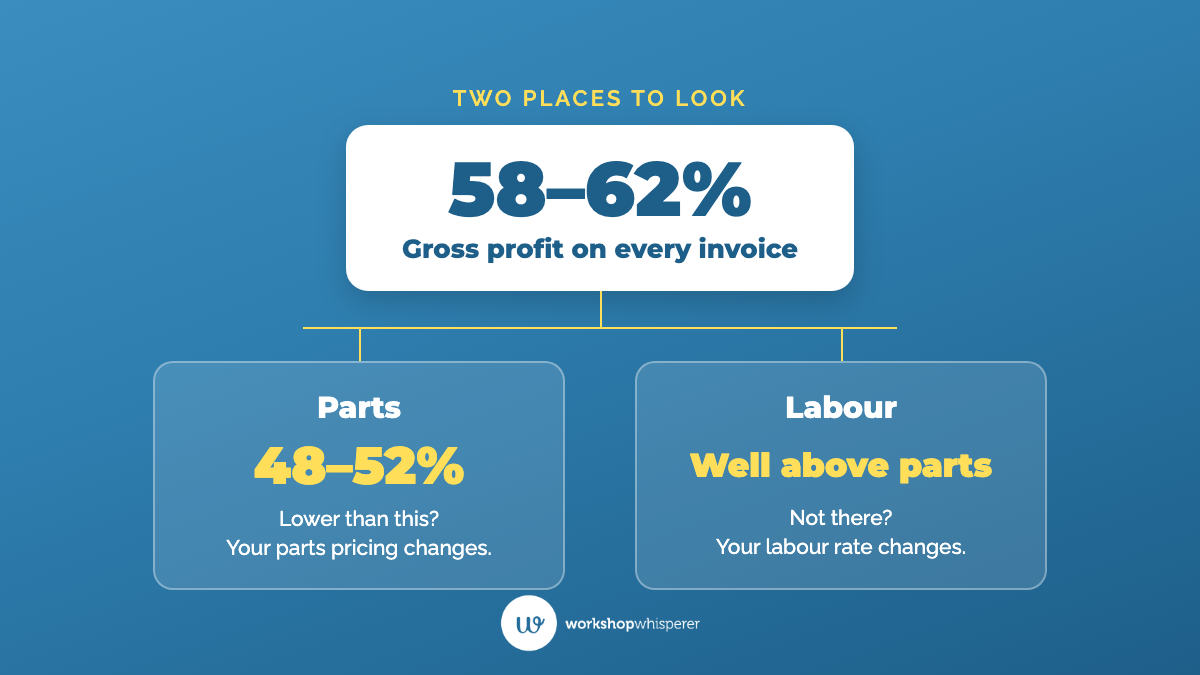
The quickest check is your gross profit. On every invoice, across the whole business, your gross profit should sit between 58% and 62%. That figure is made up of two things, your labour and your parts. So if your overall gross profit is off, there are only two places to look:
- Your parts margin. Parts gross profit should sit around 48% to 52%. If it's lower, your parts pricing has to change.
- Your labour gross profit. It has to sit well above your parts margin. If it doesn't, your labour rate has to change.
It's not rocket science. It's simple maths. And it works both ways. If your labour gross profit is already where it should be, you don't need to raise your rate. Don't drop a rate that's already right because you're worried you look expensive. That only hurts you further.
What a small rise is worth. Take a shop with four technicians selling 130 hours of labour a week. A $10 increase on every hour sold brings in an extra $1,300 a week, or more than $67,000 a year. Your wages haven't changed, your rent hasn't changed, and the hours are already being worked. That money goes almost straight to the bottom line, in profit. Work it out for your own shop with your own hours.
The rate on your board isn't always the rate you receive. Hours written off, diagnostic time not charged and jobs that blow out all drag down your effective labour rate, which is the money you actually receive for every hour you have to sell. As Dean puts it, if you raise your rate without fixing the leaks, you're losing more money at a higher number. Check both.
How do I raise it without losing customers?
This is the part owners dread, and it's the part that goes most smoothly.
Raise it in steps, not one big jump. You don't go and whack $50 an hour on top of your labour rate. Make a feasible, sustainable increase, often around $10 an hour, a couple of times across the financial year. Then review it every six months. Your wages, your rent and the cost of keeping experienced technicians all move every year, so your labour rate has to move with them.
Don't announce it. Do it. Your suppliers don't send you a letter every time their prices go up, and your customers don't need one from you. Change the rate in your system on the date you've chosen and carry on. If you feel you have to say something, keep it to one sign at the front counter:
"Due to the increased costs of running our business, and to make sure we can keep the best technicians on the job with the best equipment, we'll be increasing our labour rate by $10 on the 1st of July."
No letter, no apology, no long explanation.
Put the story on the invoice, not the hourly rate. If your invoice shows 1.5 hours at $90, you're teaching customers to compare $90 against $100 the next time they see it. Show the labour as a single technician's fee instead, and describe the work that was done: the inspection, the checks, the test drive. The more story on the invoice, the more valuable the invoice can be, and the less anyone questions the price.
Hold the price at the counter. Your service advisor, or service writer if you're in the United States, is where a labour rate gets defended or quietly given away. A rate rise means nothing if the estimate gets trimmed before it's even said out loud.
Then do it scared. This is what I see with new clients every time. They go away and they do it scared, but they do it anyway. A couple of months later they come back and say, "No one has even raised it with us."
Jeff Hazzeldine, at SCS 4WD Centre, is one of our longest-serving Engine Room clients. Over five years he took his labour rate from $75 an hour to $150, and kept going. He reckons he could charge $300 and still not lose very many customers. That's the confidence that comes from knowing your numbers and charging for the work you do.
Raising your labour rate to where it needs to be protects the profit lifeblood of your business. None of you have a business that is a not-for-profit, but some of you run your businesses like they are. Making a profit is a decision. It doesn't happen by accident.
Watch this before you change a single price. In six and a half minutes, Dean asks me why copying the shop down the road costs you money, and I walk through how to raise your labour rate in steps your customers won't notice.
Questions auto repair shop owners ask about raising their labour rate
Will I lose customers if I raise my labour rate?
Very few, if you raise it in sensible steps. In our experience almost none of your customers notice. The odd customer who will haggle over $10 isn't valuing the problem you're solving, and you're welcome to let your competitors keep them busy.
How often should I raise my labour rate?
Review it every six months and raise it at least once a year. Wages, rent and the cost of good technicians rise every year, so a rate that stands still is a rate that's falling behind.
Should I tell my customers about a labour rate increase?
You don't need to. Your suppliers raise their prices without announcing it, and your customers expect prices to move. Change the rate and carry on. If you feel you must say something, one sign at the counter with the amount and the date is plenty.
What do I say when a customer asks what our labour rate is?
Very few customers ask, a couple of percent at most. When they do, ask a question back: "Can I ask what job you're looking to get done? I won't know the answer until we know what we're looking at." In any conversation, questions are the answers.
Should diagnostic work have a different labour rate?
Yes. While your technician is diagnosing, you can't sell parts, so your gross profit for that hour drops. Your diagnostic rate should sit 25% to 50% above your advertised rate. The customer is paying for your experience in finding the fault, not for how fast you fix it.
Where to start tonight
We've built you a free break-even calculator so you know what every hour costs you. Put in your last 12 months of costs and it shows you, down to the hour, what it takes to keep your doors open. That number is where every labour rate decision starts.
Then pull up last month's profit and loss. Look at your labour revenue and your parts revenue as two separate lines, and if your accountant has lumped them together, ask them to split them. Then work out your gross profit on each. That one page will tell you whether your labour rate is the problem, and roughly how much it's costing you, before you change a single price.
Related questions:
- How to Work Out What Your Labour Rate Should Be
- What Is Effective Labour Rate and How Do I Calculate It?
- How Do I Stop Working 70 Hours a Week in My Auto Repair Shop?
See what changes for the people who do this work. On our Our Clients page, auto repair shop owners, named and on camera, tell you what actually changed in their shops and their numbers.
More on this topic: all Pricing articles.
Whenever you're ready, here's how we can help.
- Not ready to spend anything yet? Start free with Shop Talk, a 30-day reset for auto repair shop owners on our YouTube channel, and our free resources for auto repair shop owners.
- Want your service advisor to hold the price at the counter? Superstar Service Advisor trains the person at your front counter to present the work and hold the price, without more cars or more hours from you.
- Running an auto repair shop under $50,000 a month? Auto Superstars Academy builds the foundations, with one-on-one coaching on demand from a business coach who is a current or former auto repair shop owner.
- Over $50,000 a month? The Engine Room changes how the whole business runs, from your numbers to your team, delivered online with one-on-one coaching on demand.