
How Do I Keep Customers Coming Back to My Auto Repair Shop?
You keep customers coming back by making your shop the easy choice every time. That means the right person at your front counter, an experience that is convenient and personal, and a simple system that asks every customer back before they drift away: book the next visit before they leave, remind them when it's due, and follow up the ones who go quiet. You don't need to discount to do any of it.
If you've felt customers slipping away and couldn't put your finger on why, you're in good company, because most of it happens where you can't see it.
It works the same way whether you call your place a mechanics workshop, an automotive workshop or a garage, and most of the fix sits with your service advisor (your service writer in the United States, or service adviser in the UK).
Why do customers stop coming back?
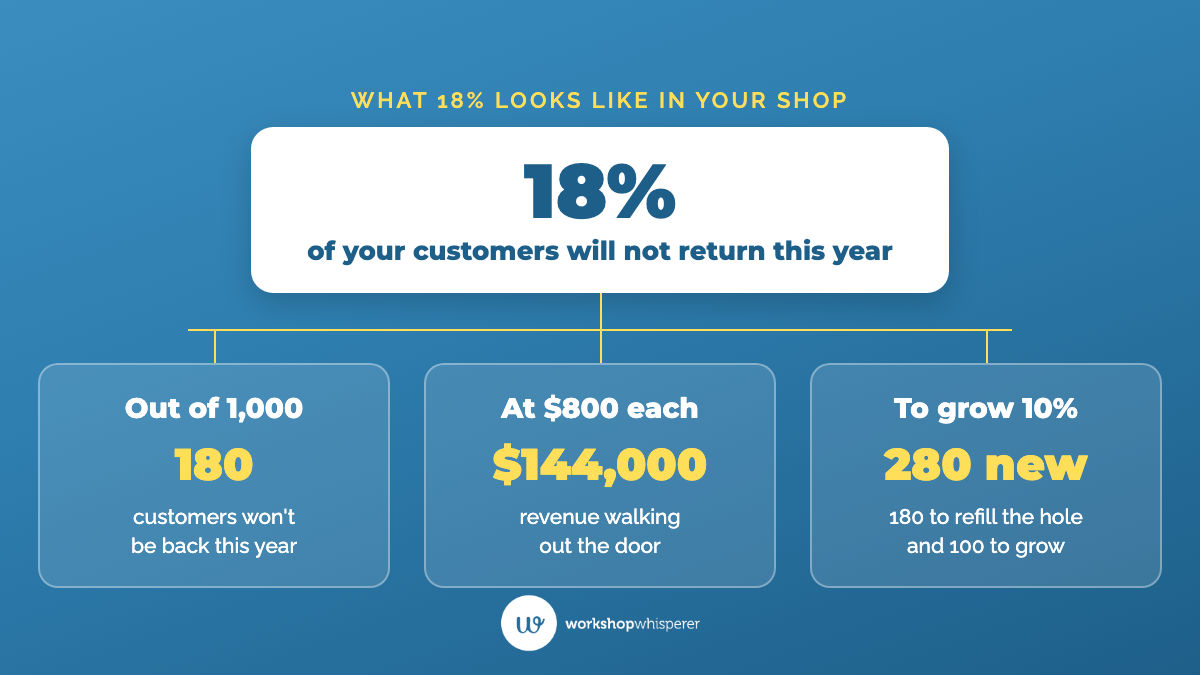
There's a benchmark number we use at The Workshop Whisperer for customer attrition in the automotive aftermarket. On average, across the board, 18% of your customer base will not return to you this year, whether you like it or not.
There are only ever three reasons for it: they've moved away, they've found another mechanic, or sadly they've passed away. You rarely hear about any of them at the time, which is why it creeps up on you.
Ray, from Burnie in Tasmania, put the question to me on our Whispering Loudly podcast: "I've got heaps of repeat clients, but I'm still not growing." Usually you think customers are coming back, but you're not tracking every single one, so a cohort slips away unnoticed. Or a busy shop feels like a loyal one, and when you're always busy it's tempting to let your marketing go. In my experience, around the three year mark of running no awareness marketing at all, owners notice their revenue is quietly on the decline, because nothing has been refilling that 18%.
Sometimes the shop itself is pushing customers away. One of our longest-serving clients, a big business in Western Australia, had a four-week wait list when he came to us. An owner's brain tells him that's a fantastic sign. The cause turned out to be him: he insisted on signing off every invoice himself, so cars sat waiting to leave and new ones couldn't get in. A loyal customer rings up with a pressing need, can't get in for three or four weeks, and goes somewhere else this one time, and then never comes back. Have that happen often enough and you get silent attrition. In general repair, a four-week wait list is more often a sign of poor systems than of success.
Chris Notte from Autoplus WA in Midvale, Perth, had a long waiting list when he joined us, and like a lot of owners he thought the bigger the wait, the better the business. A couple of tweaks to his workflow brought it down to days. Now he sees it the other way round: "If we're not getting the cars out... we're going to need to look at the processes. We miss out on customers, then it's too far ahead. They forget to come. So, now we're perfectly happy if it's one to two days." Watch Chris's story.
What 18% looks like in your shop. Take a shop with 1,000 active customers. At 18%, 180 of them won't be back this year. If each of those customers spends $800 a year with you, that's $144,000 in revenue walking out the door before you've done anything wrong. And if you want to grow your customer base by 10% this year, you need to win 280 new customers, not 100: 180 to refill the hole and 100 to grow. That's an example to show the maths. Work it out with your own customer count and your own average job value (your average repair order).
You still need marketing running all the time to refill the 18%, but every customer you keep is one less you have to pay to replace, so the better your retention, the less work that marketing has to do.
What makes a customer choose you again?
On Talking Shop, Dean asked me how an auto repair shop owner keeps customers coming back without doing the thing we tell you never to do, which is drop your prices. My answer was that the number one way is to deliver service and value at such a level that it's not even a question for them whether they should go somewhere else. The best way to do that is to be the most convenient option, and to under-promise and over-deliver.
Dean put it this way: "We think people buy on price, but they buy on experience." His example is the cheapest place you've ever been for dinner. It might have made great economic sense, but if the staff were rude, or it was too cold or too noisy, you didn't go back. As Dean says, if you're competing on price alone, it's a race to the bottom, "and that is a race you do not want to win."
You won't keep every customer at every price. What you're looking for is the 80% of your customer base who will pay your price because they know they're getting your best experience, your best knowledge and your best workmanship, and that what they pay you for it is fair.
Start at the front counter. Get the right person at your service desk first, whether that's your service advisor, your service manager or you. If they're not the best yet, put the training in place so they get there.
Make yourself easy to deal with. Dean's checklist is a good one: how easy is it for customers to communicate with you, to drop off and pick up, and to rebook? Then think about the customers for whom getting the car serviced is one of the hardest jobs of their week: the mum doing school drop-off and pick-up, or the one-car family juggling everyone's day. Ask what extraordinary service would look like for them. Where you can identify one customer like that, there's usually a whole bunch more in your database you could serve the same way.
Remember them. Customers want a relationship. Feeling like a number is the major reason people stop going to dealerships. They want some familiarity, a bit of banter, and to know you care that their car is safe on the road. Have your service advisor add little notes to the customer file, so next time they come in you can pick up where you left off.
Aim for good wow, not bad wow. Good wow is a customer walking out thinking, "Wow, that's impressive." Bad wow is "I can't believe how much that bill is, they didn't talk to me about it," or standing at the counter for three minutes while somebody looks at their phone. Text or call the customer the moment the car and the invoice are done, even if they said they wouldn't be back until 4:30. Explain the work in terms of safety and convenience, because if all you talk about is price, you teach customers to be price sensitive. And add one thing they didn't expect, whether that's a windscreen clean and a dash wipe or a free wash and vacuum.
If your front counter is where this falls over, Superstar Service Advisor is our online training for the person at your counter, and it's where the experience your customers remember gets built.
How do I get customers to book their next visit?
Ask them back before they leave. It's simple, and it's the step most often overlooked. Your customer is happy, they've collected the car and paid the invoice. Ask: "Can we schedule you ahead for six months' time? We'll give you a call when we're two weeks out to make sure that's still convenient for you." A yes gives you permission to put the booking in the diary and confirm it two weeks out.
Set reminders for what's coming, not only what's due. Most workshop software lets you tick a box at the end of the invoice to send a service reminder six or twelve months out. If yours doesn't, it's time to change. Set mid-service reminders too. If the tyres or brakes weren't due today but will be in 5,000 kilometres, send a reminder in three months.
Remind them as many times as it takes. I'm often asked how many times you should remind a customer, and my answer is as many times as it takes for them to come in. Start up to a month before they're due, then two weeks before, then on the due date, then a fortnight after. If the messages aren't working, pick up the phone. That bit of personal contact often gets you over the line.
Sweep your database for the ones who went quiet. Regularly pull a list of customers who have gone past their service date, or who didn't come back for the tyres or brakes you flagged. Send them a text: "Hey, we've got a spot open tomorrow afternoon at 1, or the following day at 9am. How about we get that work done so that those brakes don't go down to the metal?" Most have been meaning to book and forgot. Where someone has gone elsewhere, ask why. Sometimes it was a misunderstanding.
Plenty of owners hold back because it feels like bothering people. Even if their safety isn't top of mind for your customers, it's top of mind for you, so a reminder is doing them a favour rather than spamming them.
None of this needs a discount, and as I've said before, if you're not doing the game of business in a way that makes people want to hang around and come back and pay you again, you won't be very good at business in the end.
Watch this if price is the first thing you reach for. In four and a half minutes, Dean and I talk through how to keep customers coming back without discounting, from the front counter to the customer who finds getting to you hardest.
Questions auto repair shop owners ask about keeping customers coming back
What is a good customer retention rate for an auto repair shop?
The benchmark we use is that an average shop loses 18% of its customers every year, so keeping about 82% is average. Rebooking at pick-up and following up overdue customers is how you beat it.
Should I offer discounts to keep customers coming back?
No. Talking only about price teaches customers to be price sensitive. They come back for the experience: how easy you are to deal with, how well you communicate, and whether you remember them.
How many times should I remind a customer their service is due?
As many times as it takes: a month out, two weeks out, on the day and a fortnight after, then a phone call.
Is a long wait list a sign customers are loyal?
Not always. In general repair, a three or four week wait means loyal customers with a pressing need go elsewhere, and some don't come back. It's often a bottleneck in your workflow.
Should I use text messages or email for reminders?
Start with a text, because text messages rarely go unread, and phone anyone who still hasn't booked.
Where to start tonight
Open your workshop software and pull a list of every customer who is more than two weeks past their service date. Count them. That number is the part of your 18% you can still win back. Tomorrow morning, look at the gaps in your diary and send each of them a text offering one of those times. Then, at the counter, ask the next customer you hand keys back to whether you can book them in for six months' time.
Related questions:
- How Do I Stop Customers Price Shopping My Workshop?
- What Do I Say When a Customer Asks What Our Labour Rate Is?
See what changes for the people who do this work. On our Our Clients page, auto repair shop owners, named and on camera, tell you what actually changed in their shops and their numbers.
More on this topic: all Customer Experience articles.
Whenever you're ready, here's how we can help.
- Not ready to spend anything yet? Start free with Shop Talk, a 30-day reset for auto repair shop owners on our YouTube channel, and our free resources for auto repair shop owners.
- Want your front counter turning first visits into regular customers? Superstar Service Advisor trains your service advisor to present the work, hold the price and convert the inspection, so customers trust you enough to come back. It's online and self paced.
- Running an auto repair shop under $50,000 a month? Auto Superstars Academy builds the foundations, with one-on-one coaching on demand from a business coach who is a current or former auto repair shop owner.
- Over $50,000 a month? The Engine Room changes how the whole business runs, from your numbers to your team, delivered online with one-on-one coaching on demand.