How Do I Stop Customers Price Shopping My Workshop?
You stop customers price shopping your mechanics workshop by not giving them a number to shop with. Before you estimate anything, ask every caller one question: are you looking to have this work done in the next seven days? The few who are only ringing around, you send down the road, politely, with another shop's phone number. Then stop advertising cheap fixed-price specials, because they bring the price shoppers in.
Plenty of owners find that last part hard, and it's because they're decent people who hate turning anyone away.
It plays out the same whether you run an auto repair shop in Texas, a workshop in Brisbane or a garage in Leeds. The phone rings, and a voice on the other end says, "How much to do my brakes?"
Why do customers price shop my workshop?
Dean from our team describes what happens next. You feel the pressure straight away to give them a number, and to give it fast. You make it sharp, because the shop down the road is cheaper. Half the time they don't book with you anyway. The other half they do, and by the time the work is done there's nothing left in it for you.
Dean calls that renting a price shopper. The customer you win by being the cheapest only cares about the cheapest, so "the very first day that someone else turns up cheaper for them, they're leaving you." He talks about an owner in our Engine Room who prided himself on being the most competitive shop in town. He was the busiest automotive workshop for miles, always booked out, and always broke. Every job was won on price, so the busier he got, the less he made.
What most owners miss is how small this group really is. In my experience price shoppers are probably 5 to 10% of your customer base, and they give you 80% of your headaches. They're the ones who tell you they can get it cheaper somewhere else, want to supply their own parts, and challenge your price every time. They're noisy, so they feel like more of your customers than they are. They're also the first to leave.
A lot of the time, we invite them in ourselves. Three habits do most of the damage:
- Cheap fixed-price specials. How can you offer a service, including an oil and filter change, for $99, when you should be charging $99 for the labour alone? There's no profit in it, and it attracts exactly the person who is price shopping and doesn't value your experience.
- Hourly labour itemised on the invoice. A line that reads 1.5 hours at $90 hands the customer a calculation. You're teaching them to compare your labour rate (or labor rate, if you're in the States) against the next shop's. Showing the work as a single technician's fee, with the story of what was done, is covered in how to raise your labour rate without losing customers.
- Answering "how much?" with a number. This is the one to fix first, and it costs nothing to change.
What do I say when someone rings around for a price?
As Dean puts it, "A quote is a fixed price on a flexible process." The second you say "yeah, 400 bucks for that", you've locked in a number before anyone has seen the car, and you've told the customer this is a price transaction and nothing else. An estimate is a considered range, built on a conversation and a diagnosis.
So the first thing out of your mouth is a question. What's the car doing? What are you hearing, seeing, feeling? Then ask the one that sorts the callers. This is the wording I use:
"Are you looking to have this work done in the next seven days?"
Most callers want the work done, and the conversation carries on to an estimate and a booking. When the answer is "Oh no, I'm just ringing around for a price," this is the response I prefer:
"Ok, so as the job isn't urgent I recommend you call xxx down the road for a price as we are booked 7 days ahead and don't offer quotes just so we can be shopped around. We do the best job here at a fair price. If you would like to book I can take your booking for our next available time, otherwise I can get that phone number for you for the business down the road, which would you like?"
I know many of you swallowed hard reading that. You should be happy to fill up your competitors with the work you don't want, and with the price shoppers whose work leaves you a low margin.
As their business coaches, we teach our clients to triage calls the way a hospital emergency department does, where the triage nurse decides who goes through to the doctor now and who can wait. Your phone can do the same job. Dean's advice is to put the hurdles at the front of your booking process: how soon they want the work done, their price expectations, and the fact that you don't fit customer-supplied parts. The right customers qualify themselves into a booking, the wrong ones disqualify themselves, and you never have to fire anyone.
Better still, have your service advisor or receptionist ask it every time. Your service writer, or service adviser in the UK, decides whether a caller becomes a booking or a quote that goes nowhere. Superstar Service Advisor trains that person to ask the right questions, present the work and hold the price, so "how much?" turns into a booking instead of a number to shop.
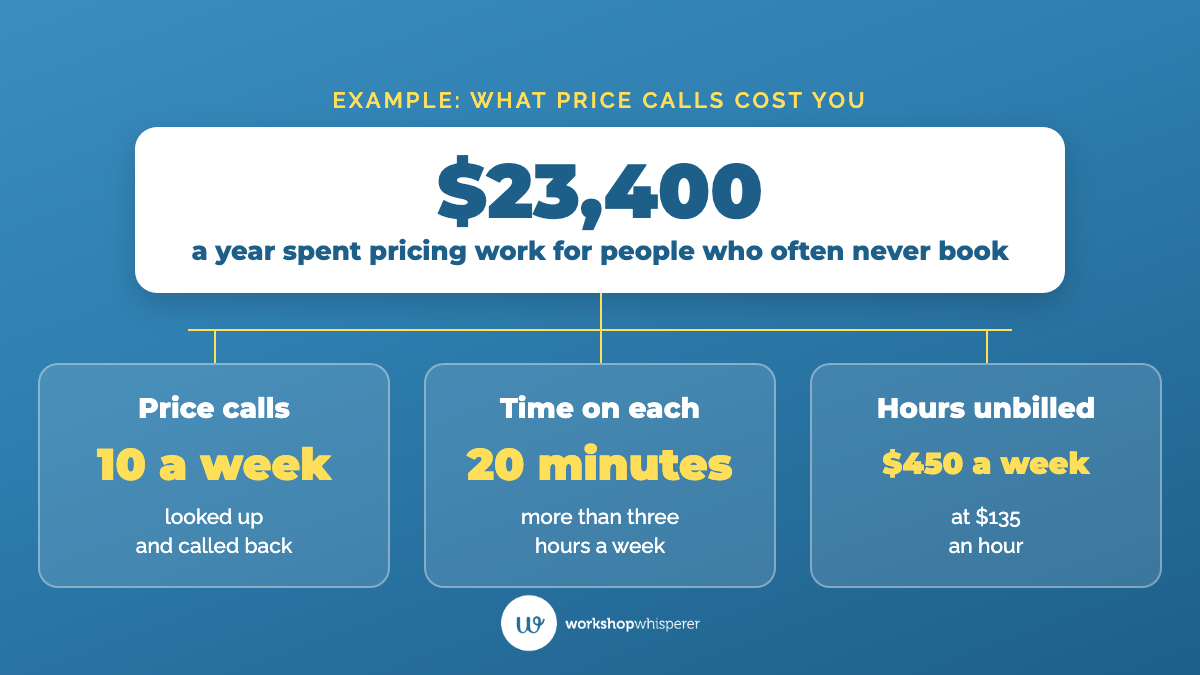
What the ringing around costs you. Here's an example, so you can run the maths on your own shop. Say you take 10 price calls a week, and each one means looking up parts, maybe ringing a supplier, working out the job and calling back. Call it 20 minutes each. That's 200 minutes, more than three hours a week. If it's you or a technician on the phone, those are hours you can't bill. At an advertised rate of $135 an hour, three and a third hours is $450 a week, or $23,400 a year, spent pricing work for people who often never book.
Dean asks owners how many of every 10 price calls turn into a booked job. Most have no idea, and as Dean says, you can't fix what you've never measured.
Won't I lose customers if I stop chasing price shoppers?
You'll lose a few, and they're the ones costing you the most time for the least margin. If you get rid of even the bottom 20% of your customers, the price shopping and the complaining ones, by raising your price, you won't lose the money. You recoup it through the customers who pay your price, and you start getting people who walk in the door because they like your work.
Ange, one of our Engine Room clients, had been in business 21 years when this clicked for her. Once you know who your ideal customer is, she said, the fear goes: "if we're too expensive, that's okay... you're not for us and we're not for you." I sent her a voice message asking whether she'd like an extra $100,000 on the bottom line each year, and told her to put her rate up that afternoon and send me a screenshot. She did it, hesitantly. The people who had been "essentially price shopping you without knowing" went to find someone else to hassle, and she had her record month ever that March.
Cody McKay runs Radical Mechanical in Newcastle from a busy corner where a lower-cost franchise used to trade, and he felt the flow-on from the customers that franchise had attracted. His answer: "We're not the cheapest people in town and we never will be, but we're not the most expensive." He won't do the cheap $80 service. When someone wants a job done at a price point he can't match, he tells them, "I'm sorry, we just can't help you." His car park is still full, and the cars in it are much nicer.
Hayden Kirk took over Kirk & Co Auto in Gulgong, NSW, when his boss retired. A drought and then COVID meant the business "made no money or went backwards" for its first three years. People kept telling him, "You can't say no to that." He started saying no anyway, including to some people who had been customers for 10 years. "We chase them for money, or they whinge about the price or whatever it is. And they're the people that leave me. It's not a loss for us. It's a win." Now he serves the customers who "don't mind waiting a week or two to get their car", and morale in his workshop is up.
We've watched this play out for more than 13 years, across more than 10,000 auto repair shops in 5 countries, and those shops have made more than $175 million in additional profit. If the odd customer arcs up, or you realise they've been price shopping you all along, let them go. As I said in our Shop Talk series: "There are enough customers that will come to you for the quality of your work, the reliability of your work, and see value in what you do, and they will pay your price without question."
Watch Dean's 15-minute walkthrough of the "how much?" call before your phone rings tomorrow morning. He walks through the "how much?" call, why winning on price leaves you renting price shoppers, and three questions that show you exactly where you're leaking jobs.
Questions auto repair shop owners ask about price shoppers
Should I give prices over the phone?
Not a number off the top of your head. Ask about the car first, then ask when they want the work done. If the first thing they ask is your hourly rate, the exact words for that call are in what to say when a customer asks your labour rate. If they're booking in, give them a considered estimate, a range built on what they've told you, with the diagnosis to confirm it. A number fired back down the phone only tells the caller which shop to beat.
What if a customer wants to supply their own parts?
We don't fit customer-supplied parts, and I'd encourage you not to either. Put some thought into the wording: your parts margin pays for the experience of the technicians fitting them and the wages you need to pay those technicians. Most customers want the job done right the first time. The ones who insist are usually the price shoppers, and the space they leave is better filled with a full-margin job.
Is it rude to send a customer to another shop?
No. Be polite, be clear and give them the number. You're telling them honestly that your shop isn't the right fit for what they want, and pointing them to one that might be. That's more respectful than an estimate you know will never turn into a booking.
What if it feels like every customer is price shopping me?
First, check whether it's true. Very few customers know what parts cost or what anyone's labour rate is. If every second customer really is like that, you may be in a price shopper market, possibly a low socioeconomic area. Moving the shop is an option, an expensive one. More often the fix is the wording at the counter and on the phone, and how you lay out your invoice.
Should I run a cheap service special to get people in the door?
No. A discount used as a sales tool only attracts price shoppers, and you can't resell the time you've given away. If you're tempted, read should I discount to win more customers? first.
Where to start tonight
Write the question down tonight, on a card that sits beside the phone where your calls get answered: "Are you looking to have this work done in the next seven days?"
Tomorrow, add a tally beside it. Every price call gets a mark, and every one that books gets a tick. By Friday you'll know your real conversion rate on price calls, which most owners have never seen, and you'll know how much of your week the ringing around is costing you.
Related questions:
- How Do I Keep Customers Coming Back to My Auto Repair Shop?
- How Do I Stand Out From Other Workshops Without Discounting?
See what changes for the people who do this work. On our Our Clients page, auto repair shop owners, named and on camera, tell you what actually changed in their shops and their numbers.
More on this topic: all Customer Experience articles.
Whenever you're ready, here's how we can help.
- Not ready to spend anything yet? Start free with Shop Talk, a 30-day reset for auto repair shop owners on our YouTube channel, and our free resources for auto repair shop owners.
- Want whoever answers your phone to turn "how much?" into a booking? Superstar Service Advisor trains the person at your front counter to present the work and hold the price, in 13 self-paced modules you keep for life.
- Running an auto repair shop under $50,000 a month? Auto Superstars Academy builds the foundations, with one-on-one coaching on demand from a business coach who is a current or former auto repair shop owner.
- Over $50,000 a month? The Engine Room changes how the whole business runs, from your numbers to your team, delivered online with one-on-one coaching on demand.