Should I Discount to Win More Customers?
No. A discount comes straight off your profit, because the parts, the wages and the rent cost you exactly the same whatever you charge. At a 45% gross profit, a 10% discount means your team has to do 29% more work to make the same money. And the customers a discount brings in are the ones most likely to leave for the next cheaper offer.
If you've been tempted on a quiet week, you're in good company. A full yard feels safe. The pressure to drop prices to win work never really goes away.
Whether you run an auto repair shop, a mechanics workshop or a garage, the maths below is the same, and so is the fix.
What does a discount really cost me?
Most owners think a 10% discount costs them 10%. It costs far more, because the whole discount comes out of the slice you keep. Your parts supplier still wants paying in full and so does your technician.
Dean from our team sets it out in three columns. Take a shop running at 45% gross profit, where one technician turns out four jobs a day.
| Discount | Extra work to make the same money | Four jobs a day becomes |
|---|---|---|
| 10% | 29% more | about five |
| 20% | 80% more | about seven |
| 30% | 200% more | twelve |
At 30% off, that's three days of work jammed into one day to stay exactly where you are. Dean picked 45% because it's where a lot of auto repair businesses sit, well short of the 58% to 62% gross profit we use as the benchmark at The Workshop Whisperer.
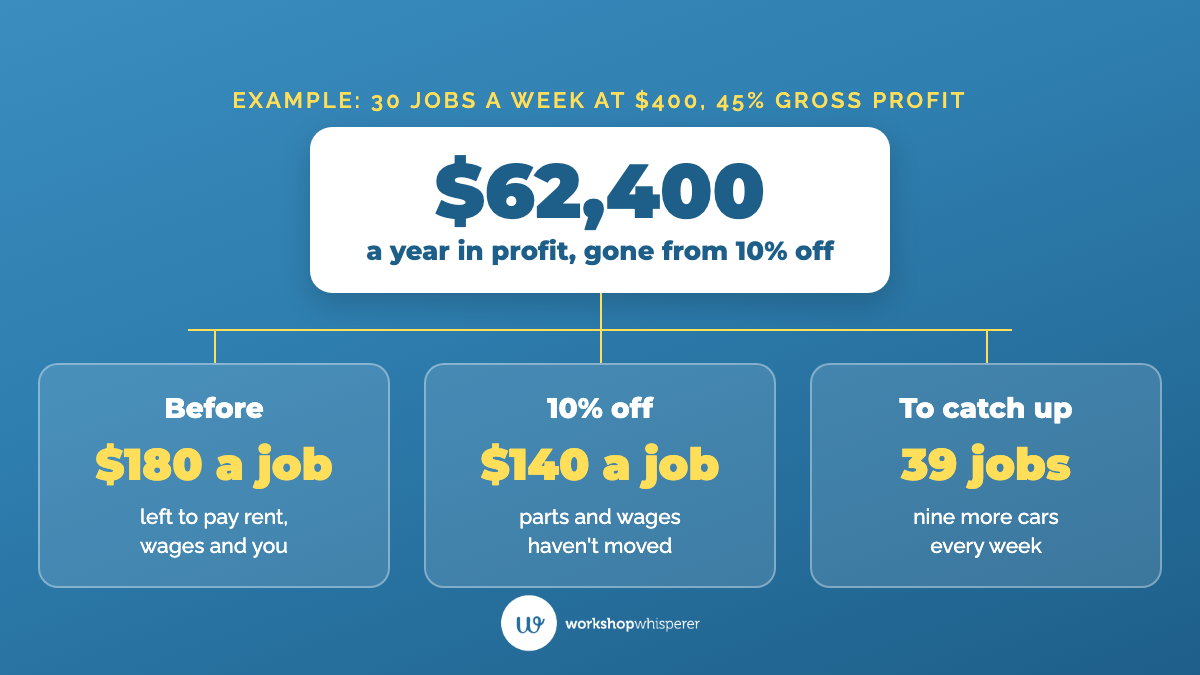
A worked example. Say your shop does 30 jobs a week at an average of $400, at 45% gross profit. Each job leaves you $180 to pay the rent, the wages and yourself. Put 10% off every job and each one drops to $360, but the parts and the wages haven't moved, so each job now leaves you $140. Across the week that's $1,200 gone, or $62,400 a year, in profit. To earn the same $5,400 a week back, you'd need 39 jobs instead of 30. That's nine more cars every week, through bays that are probably full already. These are example numbers, so run the sum with your own.
Dean tells the story of a client who came to us convinced that discounting was the only way to stay competitive. The bays were full and the team ran hard every day of the month, and at the end of each month there was nothing left in the bank account. When we mapped out every discount, the ad hoc ones, the ones for long-term loyal customers and the ones the service advisor handed out because they didn't know how to handle the pushback, they were averaging 12% to 15% right across the board. As Dean puts it, "Every discount you give is a job that you do not get paid for."
Most discounts never look like one. Dean describes an $800 job that reaches the customer at $650: the extra work never got offered, the parts margin got trimmed, and the hour the job ran over got written off. Nobody asked for any of it. That's the discount owners forget to count: money that never made it to the invoice to start with, which is the same as handing the customer their money back.
Won't a discount bring in customers who stay?
Usually it brings in the wrong ones.
There's nothing wrong with tyre shops, and plenty of them do good mechanical work too. What hurts you is the old-school tyre selling mentality: low margin, high volume. In a mechanic workshop you don't have the space, the hours in the day or the people to turn cars over at the rate that model needs. Large volume at low margin kills an auto repair shop. As Dean says, "It's really hard to offer three services and get the fourth one free."
If you sell your work at 25% or 30% gross profit week after week in general repair, heavy diesel or four-wheel drive, you will go broke, in five years or less. There's no question about it. That margin can't cover the running costs of your business.
The people a discount attracts are attracted to the cheapest price, whoever is offering it. Price shoppers are probably 5% to 10% of your customer base, and they give you about 80% of your headaches. They're also the first to leave. The loss leader idea, a cheap service now and the real work later, falls over for the same reason. You can't resell the time you discounted, and once those customers work out the cheap service was the hook, they don't come back.
Capped price and fixed price servicing work the same way. A minor service might take 0.8 to 1.2 hours. Advertise it at $99 with a $100 labour rate before GST and you're behind before the oil and filter even go in. Then the brakes need doing. The customer dropped the car off expecting $259 for their silver service. Now you're on the phone telling them it's another $500, and you start that conversation on the back foot. A fixed price teaches customers to watch the price instead of the work.
Discounting wears your team down as well. In the shop that discounts to fill the bays, motivation drops, pressure goes up, corners get cut, callbacks rise and the average repair order falls. In the shop that takes fewer jobs at the right price, the team has time to do the work properly and present what the car needs, and goes home in one piece. If you compete on price alone, it's a race to the bottom, and as Dean says, "that is a race you do not want to win."
What do I do instead of discounting?
Know your gross profit. A discount only feels harmless when you don't know your margin. Check yours against the 58% to 62% benchmark. If you're below it, every discount takes you further away.
Find out who is actually asking. When owners tell us customers pushed back on price, our next question is "How many?" The answer is almost always less than a handful. So shops end up discounting across their whole customer base to keep a few people happy, and often it's the service advisor offering it to avoid a hard conversation. As Dean puts it, "that's a training problem. It's not a market problem." That's exactly what Superstar Service Advisor fixes: the person at your front counter, whether you call them a service advisor or a service writer, learns to present the work and hold the price.
Sell the job, not the hourly number. If the shop down the road charges $80 an hour and quotes three hours for a job you know takes one, and you charge $110, the customer pays $240 there and $110 with you, and gets their car back sooner. Your customer doesn't want the cheapest price. They want bang for their buck. Dean uses a surgeon to make the point: nobody negotiates with their surgeon, and a surgeon who finishes early doesn't knock two hours off, because the speed came from skill. Show that skill on the invoice. A detailed story of what was done is worth more to the customer than a line of hours, and I cover how to set that up in how to raise your labour rate without losing customers.
Make the experience the reason they come back. "We think people buy on price, but they buy on experience," as Dean says. Think of the cheapest place you've ever eaten: if the staff were rude, you didn't go back. Be the most convenient option, under promise and over deliver, and make drop-off, pick-up and rebooking easy. Around 80% of your customers will pay your price when they know they're getting your best knowledge, your best workmanship and a team you keep investing in.
There's one more cost, and it never shows up on the P&L. When we give a discount, we give away a little piece of our soul. Every time you knock something off, even 5%, you're telling yourself your years of experience aren't worth it, your team isn't worth it and your business isn't worth it. Most of the time there was no need. "Both of those things come from fear, not from evidence," as I said on Talking Shop about the two reasons owners discount: an uncomfortable conversation, and the worry the customer won't come back.
Watch this before you knock another dollar off. In under ten minutes, Dean and I talk about the cost of discounting that never shows in your bank account, including what it does to the way you value your own work, and why a surgeon never writes off two hours.
Questions auto repair shop owners ask about discounting
Is it ever OK to give a discount?
Very rarely, and almost never as mates rates. Friends and family who promise to bring you more work hardly ever do, and you can't resell the time you gave away. Ask yourself whether you'd rather do that job at a discount or another job at full price. Your loyal customers don't need a discount to stay. They stay because of how you look after them.
Should I run a cheap service to get new customers in the door?
No. A cheap service, a coupon or a shopping docket offer attracts customers who chase the next cheap offer. At 45% gross profit, 20% off means 80% more work to make the same money.
What if the shop down the road is cheaper than me?
Let them be. A lower hourly rate doesn't mean a cheaper job, and quoting to undercut the shop down the road takes the profit out of everyone's work. If holding your price loses you the bottom 20% of your customers, the price shoppers and complainers, you won't lose the money. You'll recoup it from the customers who pay your price and like bringing their car to you.
My margins are already healthy. Can I afford a small discount?
It still costs more than it looks. Here's an example: at 60% gross profit, every $100 job leaves you $60. Take 10% off and it leaves you $50, so you need 20% more work to make the same money. Healthy margins are what pay for good technicians and good equipment. Don't give them away.
What do I say when a customer asks for a discount?
Always be polite. Then work out whether they're an ideal customer, because having your work and your value questioned every visit isn't an ideal situation. If you're confident your price reflects your experience, your team's experience and what you've invested in your shop, a customer who keeps pushing probably doesn't belong in your database.
Where to start tonight
Pull up last month's invoices, or the discount report from your workshop management software, and find every discount: the dollar amounts, the hours written off, the diagnostic fee you waived and the mates rates. Add them up and multiply by 12. Because none of your costs moved, that's roughly what discounting costs you a year, in profit.
Once you see that number written down, a discount stops looking like a favour and starts looking like what it is.
Related questions:
- How Should I Charge for Diagnostics?
- What Is Effective Labour Rate and How Do I Calculate It?
- Using Next Month's Money to Pay Last Month's Bills? How Sandy and Zac Got Out
See what changes for the people who do this work. On our Our Clients page, auto repair shop owners, named and on camera, tell you what actually changed in their shops and their numbers.
More on this topic: all Pricing articles.
Whenever you're ready, here's how we can help.
- Not ready to spend anything yet? Start free with Shop Talk, a 30-day reset for auto repair shop owners on our YouTube channel, and our free resources for auto repair shop owners.
- Want your service advisor to hold the price at the counter? Superstar Service Advisor trains the person at your front counter to present the work and hold the price, without more cars or more hours from you.
- Running an auto repair shop under $50,000 a month? Auto Superstars Academy builds the foundations, with one-on-one coaching on demand from a business coach who is a current or former auto repair shop owner.
- Over $50,000 a month? The Engine Room changes how the whole business runs, from your numbers to your team, delivered online with one-on-one coaching on demand.