
How Should I Charge for Diagnostics?
Charge diagnostic time at its own rate, between 25% and 50% above your advertised labour rate, because while your technician is finding the fault you can't sell a single part. Then set it up with the customer before the work starts: two hours of diagnosis at that rate, a check-in at the end of the two hours, and their permission before you go any further. Do both, and diagnostic hours stop being the hours you give away.
If you've been charging one hour for a fault that took three because it felt like the fair thing to do, you're in good company. Most owners do it out of decency.
Whether you run an auto repair shop, a mechanics workshop, a mechanical workshop or a garage, and whether you call it a diagnostic fee or a diagnostic labor rate, the maths and the conversation are the same.
Why should diagnostic time cost more than my normal labour rate?
Most owners have one labour rate. You can't run a profitable shop on one.
Start with your advertised rate. It's the number a price shopper is after when they ring and ask how much you charge an hour. In Australia that might be $135 an hour plus GST, and it's the rate you'd usually apply to servicing.
Diagnosis is different work. Finding an intermittent electrical fault takes years more experience than a logbook service, and there's a second problem underneath it. While your technician is diagnosing, the only thing you can charge for is labour. There are no parts going on the car yet, so there's no parts margin. Later in the job, once you've found the fault and you're fixing it, the parts go on and the margin comes with them. During the diagnosis itself, every dollar of gross profit has to come from the labour rate.
That's why your gross profit dollars per hour falls every time a car sits in diagnosis at your advertised rate. It's one of the key benchmarks we help our clients work towards at The Workshop Whisperer, and diagnostic time drags it down quietly, job after job.
The fix is a diagnostic rate that sits 25% to 50% above your advertised rate. Whenever diagnosing takes more than a few minutes, you switch to it. When you move on to the repair, you switch to your repair rate, which may be different again, and you sell the parts.
So you need at least two rates: advertised and diagnostic. I'd love you to have four, but two is where to start.
If you're not sure your advertised rate is right in the first place, fix that first, because nothing shows up an advertised rate that's too low faster than diagnostic work. And if the advertised rate needs to come up too, here's how to raise your labour rate without losing customers.
There's one more reason to charge properly for diagnosis, and it's the one that gives most owners the confidence to do it. As I said on Shop Talk, "If the customer knew how to diagnose their own repair, they wouldn't be bringing it to you." What they're paying for is the years it took you to know where to look, and that deserves its own rate.
Why do diagnostic hours get written off?
Diagnosing can take five minutes. In rare cases it takes hours and hours, and the fault still can't be found. And because diagnostic time usually isn't set up properly with the customer, those are the hours most likely to be wiped off the job.
Here's how it usually goes. The car comes in. You diagnose it. You come back to the customer and say, "It needs this, this and this, and it'll take this amount of time." Then you do the whole job, it takes longer than you said and it costs more, and you hand them the bill.
The customer now has bill shock, and you have an unhappy customer to deal with. Your first response is to give them a discount and wipe the time off.
Dean describes the same thing from the owner's side. A complex electrical fault might take two or three hours to find, and you only charge for one, because one felt like a reasonable amount to charge. The rest of that time disappears. It's one of the four labour leaks Dean talks about, and it never shows up in your accountant's reports, because they only see the revenue that came in.
Sometimes the problem starts before the car is even in the yard. A technician who moves to the front counter often wants to diagnose over the phone, because they know so much. The customer rings about a noise, gets a confident answer, and arrives expecting a certain fault and a certain price. When the inspection turns up something else, the customer is a bit miffed, and you're on the back foot before the job has started. Best practice is always to get the car to the workshop so a proper inspection can be done and the right diagnosis made.
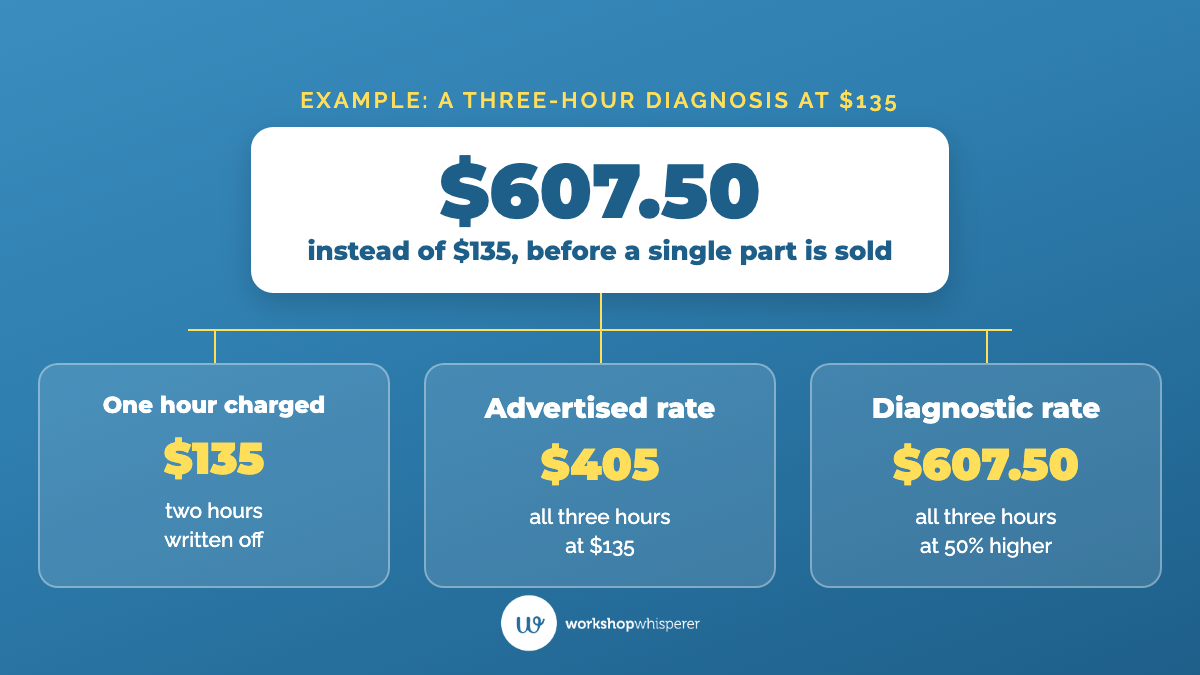
What it costs on one job. This is an example, so use your own numbers. Take an advertised rate of $135 an hour, and a fault that takes your technician three hours to find.
| How the three hours get charged | What you're paid |
|---|---|
| One hour at $135, two written off | $135 |
| All three hours at the $135 advertised rate | $405 |
| All three at a diagnostic rate 25% higher ($168.75) | $506.25 |
| All three at a diagnostic rate 50% higher ($202.50) | $607.50 |
The gap between the first line and the last two is $371.25 to $472.50, on one job, before a single part is sold. If four jobs like that come through your shop in a week, that's roughly $1,500 to $1,900 a week, or somewhere between $77,000 and $98,000 a year. Your technician's wages are paid either way, so almost every extra dollar you bill lands on your bottom line.
How do I set up diagnostic time with the customer?
The conversation matters as much as the rate. Set it up when the car first comes in, and keep it in two-hour blocks with a check-in at the end of each one.
When a vehicle needs an initial diagnosis, this is what your service advisor (or service writer, or service adviser, depending on where you are) says at the counter:
"Diagnosing attracts two hours of labour, and it'll be [your diagnostic rate]. At the end of that two hours, I'll update you, and if we need more time, I'll let you know and I'll get your permission to proceed. If we already have our fix, I'll let you know what the estimate is to move forward on the job, and we'll go from there. Does that sound okay with you?"
The customer will say yes. Rarely, they'll say no.
If two hours isn't enough, you ring them before the clock runs on:
"I'll get in touch with you again after we've done the next two hours. Hopefully we'll find the fix in that time. If not, I'll come back to you to get further permission."
That's the whole system. You tell the customer where the checkpoints are, and then you contact them at those checkpoints, every time. When the customer knows where you're up to, they're more than happy for you to continue, and the final bill holds no surprises. As I put it on Shop Talk, "No one will question your higher diagnosing rate."
Where this usually breaks down is the follow-through on a flat-out day, so train your service advisor and your technicians to make the call at the point they promised, and to never carry on into a third hour without the customer's okay. If the front counter is where your hours keep leaking, Superstar Service Advisor trains the person in that seat to run this conversation and hold the price.
One last habit to break. When you estimate a repair at five hours and your technician finishes it in three, don't knock the time off. In my words, "the customer is paying for your experience and knowledge of how to fix that thing, not how fast you can fix it." The precision that got it done faster is the same precision that means that car won't be back until its next service.
Watch this before you change your rates. In ten minutes I walk through why one labour rate isn't enough, where the 25% to 50% comes from, and the exact words to use at the counter so diagnostic hours stop disappearing.
Questions auto repair shop owners ask about charging for diagnostics
How much more should I charge for diagnostic work?
Between 25% and 50% more than your advertised labour rate. On an advertised rate of $135 an hour, that's a diagnostic rate between $168.75 and $202.50. The extra covers the parts margin you can't earn while the fault is still being found.
How much diagnostic time should I book in up front?
Two hours. Tell the customer that diagnosing attracts two hours of labour at your diagnostic rate, and that you'll update them at the end of the two hours. If you need more time, get their permission for the next block before you start it.
Will customers push back on a higher diagnostic rate?
Very rarely, when it's set up properly at the counter. Pushback tends to follow a surprise on the bill, and a customer who agreed to two hours at a known rate, and heard from you when you said they would, has nothing to be surprised about.
Should my service advisor diagnose over the phone?
No. Get the car into the workshop so a proper inspection can be done. A diagnosis given over the phone sets an expectation about the fault and the price, and when the inspection finds something else, the customer feels misled and the job starts under pressure.
Should I take time off the bill if we finish faster than estimated?
No. The customer is paying for your experience and knowledge of how to fix the car. If your team finishes early because they're good at it, that skill is what the customer came to you for.
Where to start tonight
Pull up five jobs from last month where your team had to find a fault. For each one, write down two numbers: the hours your technician spent diagnosing, and the hours you charged for it. The difference is your diagnostic leak, and most owners have never seen it written down.
Then take your advertised rate, multiply it by 1.25 and by 1.5, and choose your diagnostic rate from inside that range. Set it up in your system before the first car comes in tomorrow, and give your front counter the two-hour script.
Related questions:
- What Is Effective Labour Rate and How Do I Calculate It?
- Should I Discount to Win More Customers?
- How Do I Stop Working 70 Hours a Week in My Auto Repair Shop?
See what changes for the people who do this work. On our Our Clients page, auto repair shop owners, named and on camera, tell you what actually changed in their shops and their numbers.
More on this topic: all Pricing articles.
Whenever you're ready, here's how we can help.
- Not ready to spend anything yet? Start free with Shop Talk, a 30-day reset for auto repair shop owners on our YouTube channel, and our free resources for auto repair shop owners.
- Want your front counter to set up diagnostic time and hold the price? Superstar Service Advisor trains the person at your front counter to present the work and hold the price, without more cars or more hours from you.
- Over $50,000 a month and want every rate, margin and leak in your business working? The Engine Room changes how the whole business runs, from your numbers to your team, delivered online with one-on-one coaching on demand from a business coach who is a current or former auto repair shop owner.