
Will New Software Fix My Auto Repair Shop?
On its own, no. New software fixes your mechanics workshop only when the software itself is the problem, and most of the time it isn't. The system you already pay for can usually show you where your money is going. In a lot of shops it's only half set up, because nobody found the time to learn it or felt ready to ask the team to use it properly.
Changing is the right call when your software can't produce a productivity and efficiency report in a couple of clicks, can't track every minute of your technicians' day, or comes with a help desk that won't train you. If any of those is true, it's time to move, and moving is far less painful than most owners fear.
If you've been eyeing a new system in the hope it sorts everything out, that's understandable. When the money doesn't add up, a new program feels like progress. But software only reports what you put into it, so the first job is to look at how you're using the one you've got.
Why hasn't the software I already have fixed anything?
I see the same thing over and over. An owner buys the software, sets up the invoicing, and goes, "Great, I've got it. Tick, I've done that." Then they never go on to fully explore it.
Being time poor is a little part of it. Fear is the biggest part, mostly fear of how your technicians will feel about it.
The cost of that fear shows up in the numbers. When Capricorn ran their State of the Nation survey, 52% of all respondents said they measure their workshop's efficiency by whether they can pay their bills at the end of the month. More than half the owners who answered are guessing. I said at the time that it's a business plan called "she'll be right", and "that's not good management. That is just good luck."
And the reports you do pull are only as good as the information that goes in. If your technicians write their times on a paper job card, those times are wrong, and it's not because anyone's lying. A technician gets pulled off a job to talk to a customer, forgets how long the brake job took, and rounds it to something that looks about right.
Cindy Taylor at New Belgrave Motors in Ferntree Gully, Victoria, knows how it feels when the money doesn't add up. "We were broke and living day to day," she says. Part of the turnaround was "the improvements in our software and the way we use them. Stock, that sort of stuff." But she's clear about what did the heavy lifting: "Profit First has made the biggest difference to our business." Now "everything's under 30 days," the business is "almost debt-free," and "now we're planning for the future." Watch Cindy's story.
Then there's you. If you're involved in invoicing, you're often more price sensitive than your customers, because your head is in pricing and quoting all day. So you look at a job and think, "I'd better wipe off that half an hour, we shouldn't have taken that long." When you do that, it's discounting, and discounting destroys your bottom line.
The last piece is harder to hear. In Australia I'd estimate more than half of shops and garages still use paper job cards. Your younger team members aren't afraid of the technology. Very often the person holding the business back is the owner, because it feels like another thing to learn.
What should my workshop management software actually do for me?
Every automotive workshop needs mechanic-specific management software. An accounting package on its own, like Xero, MYOB or QuickBooks, doesn't cut the mustard. Your accountant needs that package on the back end, and you need the mechanic-specific system on the front, connected to it.
At a bare minimum, it has to do two things.
1. Produce a productivity and an efficiency report with a couple of clicks. Productivity is the hours sold against the hours available to sell. A technician with eight hours available who sells four is 50% productive. Efficiency is the time taken on a job against the time you set for it. Print both reports, for each technician and for the team, and ask what they're telling you. Maybe Mike is sitting at 105% efficiency and 85% productivity, and Sam is at 75% efficiency and 50% productivity. Those figures tell you which technician needs a conversation, and what it needs to be about.
2. Track continuous time, not only job time. Plenty of software lets a technician clock on and off a job. Continuous time clocking records the whole day. They clock into cleaning or admin first thing, onto a job, off it midway to start another, back on again, into five minutes of admin, into driving a customer home. Every movement is recorded, from the moment they pick up the keys to the moment those keys go back to the service advisor (your service writer, if you're in the US), including cleaning the bay afterwards. It's what dealerships use, and it's industry best practice we can borrow.
When you switch continuous time clocking on, you should expect an immediate lift of around 6% in recorded productivity, because now every minute is accounted for. Your team also becomes accountable for the whole day, not only the time on the hoist.
What 24 minutes a day is worth. I've said it many times: if you capture an extra three minutes per hour per technician, that's 24 minutes across an eight-hour day, and you'll bank around $10,000 a year in labour profit per technician. Here's an example of the maths. Twenty-four minutes is 0.4 of an hour. Over a five-day week that's 2 hours. Over 48 working weeks it's 96 hours. At a labour rate (labor rate, in the US) of $110 an hour, that's $10,560 for one technician. With four technicians, it's more than $42,000 a year in labour you've already paid wages for. That money goes to the bottom line. Run it with your own rate and your own team.
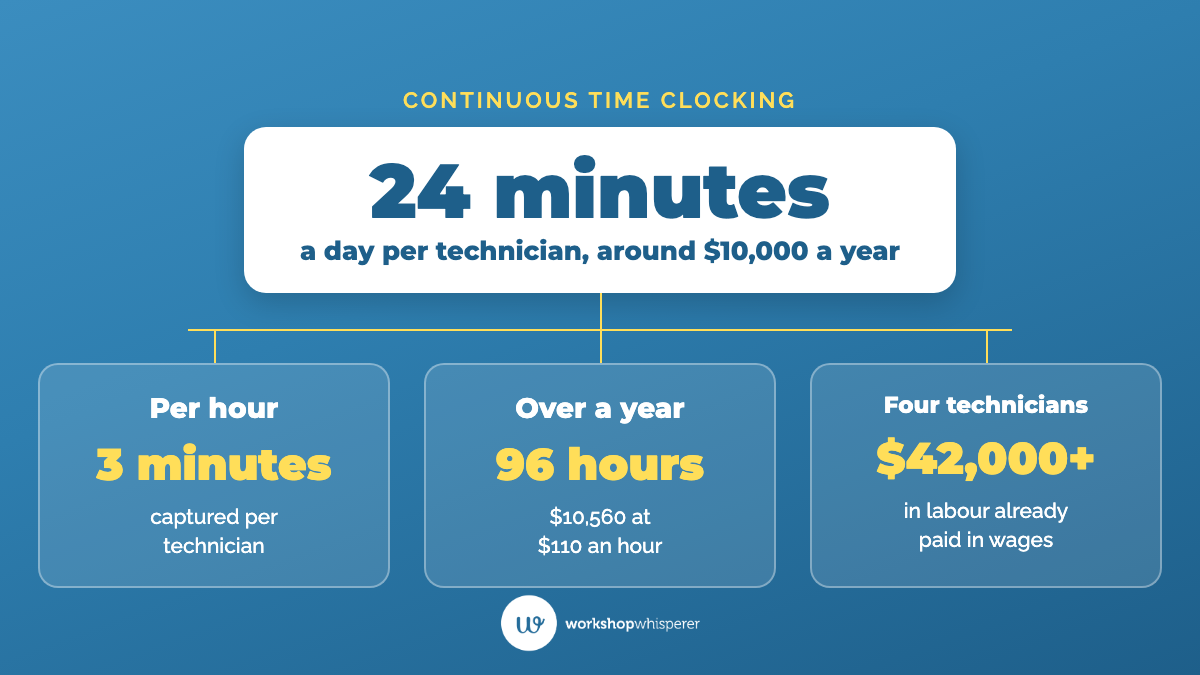
That's the money hiding in the gap between your advertised rate and what you actually collect.
Dean makes the point on the A-Grade Auto Repair Shop Show that finding your effective labour rate doesn't need new software. His version of the sum takes your total labour revenue from your P&L and divides it by the hours sold, from the workshop software you already have. Mine divides the same labour revenue by the hours your team had available to sell, so it also counts the hours you paid for and never sold. Both are in how to work out your effective labour rate.
When is it time to change, and how do I do it without chaos?
Ask three questions of your current system.
- Can it produce a productivity and efficiency report, by technician, at the touch of a couple of buttons?
- Can it continuously time clock, so your technicians can move through everything they do in a day?
- When you ring the help desk and ask for training, will they give it to you?
If the answer to all three is yes, you don't need new software. You need to use what you've got. If any answer is no, that program is no longer for you. A lot of software isn't cheap either, so if it isn't working for you, what's the point?
The biggest fear I hear is losing 20 years of car history. You need about three years, at most. Nobody cares what you did on a car that long ago. Good software providers will help you get your data out of the old system and do the legwork of moving it across.
Then the change itself:
- Get the training, and get it for your team. Use your new provider's help desk to train everyone, not only you.
- Give everyone a month's grace. When you start, people will remember to clock on and forget to clock off. You'll see a job that's 75 hours long. It takes a few weeks to settle.
- Lead from the front. Stand up, be confident and say, "This is the way we're doing it from now on." If a technician digs in and refuses, ask yourself whose business this is. As I've said before, "winners love to see their numbers, losers like to hide."
Kirsty Gardner, one of our Engine Room clients in central Queensland, named changing software as one of her three biggest wins of the year. Before the change, she said, "We didn't really know our numbers or where our staff were tracking." The first month was rocky. Once it was set up, they built quick invoice templates for the repetitive jobs, started tracking productivity and efficiency, and began sharing the figures with the team so everyone knew where they were sitting.
Look at what sat beside it, though. Her other two big wins were putting Profit First in place and writing standard operating procedures for the whole business, then training every team member in them. Kirsty and her husband Jason had grown from a husband and wife team to 13 staff in two and a half years. With the team trained in the systems, Jason works a four-day week while the business stays open five. The new software let them see their numbers, but it was the systems and the trained team that moved them. If your shop turns over more than $50,000 a month, that's what we do with owners in The Engine Room, where a business coach works with you on how the whole business runs, from your numbers to your team.
Watch this 13-minute episode before you shop for new software. On Whispering Loudly, I explain why so many owners never switch on continuous time clocking, what it captures that a paper job card can't, and how to bring your team with you.
Questions auto repair shop owners ask about new software
Can I run my auto repair shop on Xero, MYOB or QuickBooks alone?
Not if you want to know how your workshop is performing. Those are accounting packages, and your accountant needs one. You also need mechanic-specific management software alongside it, so you can see productivity, efficiency and the hours you're selling.
How much customer history do I need to bring across when I change software?
About three years, at most. Fear of losing decades of records keeps a lot of owners stuck on a system that isn't working. Ask your new provider to help migrate the data, then leave the rest behind.
Will my technicians hate continuous time clocking?
Some will worry you're spying on them. Explain why: you want the shop to be as professional as possible, and charging accurately for every minute means you can afford good equipment, good technicians and to pay yourself. The productive ones usually love it, because now the boss can see everything they do.
Should my auto repair shop go paperless?
Yes. Set a deadline and work to it. Paper job cards lose minutes, get lost, and have to be stored in a box somewhere. In your software, an old job is a few clicks away. If your program can't let you go paperless, you're probably not on one of the better programs designed for the industry.
What can I do if my software won't track time continuously yet?
Put a whiteboard in the workshop. At the close of every job card, each technician updates their sold hours for the day. It gives everyone a visual and holds them accountable while you sort out the software.
Where to start tonight
Open the software you already have and print last week's productivity and efficiency reports, for each technician and for the whole team. If you can find them, sit with them for ten minutes and ask what they're telling you about who needs a conversation. If you can't find them, ring your provider's help desk in the morning and ask them to show you. If they can show you, you don't need new software, you need to use what you've got. If they can't, or they won't train you, it's time to start looking.
Related questions:
- What Should I Look For in Workshop Management Software?
- What Reports Should I Pull From My Workshop Management System?
See what changes for the people who do this work. On our Our Clients page, auto repair shop owners, named and on camera, tell you what actually changed in their shops and their numbers.
More on this topic: all Software articles.
Whenever you're ready, here's how we can help.
- Not ready to spend anything yet? Start free with Shop Talk, a 30-day reset for auto repair shop owners on our YouTube channel, and our free resources for auto repair shop owners.
- Running an auto repair shop under $50,000 a month? Auto Superstars Academy builds the foundations, with one-on-one coaching on demand from a business coach who is a current or former auto repair shop owner.
- Over $50,000 a month? The Engine Room changes how the whole business runs, from your numbers to your team, delivered online with one-on-one coaching on demand.