
What Should a Service Advisor Say When a Customer Says It's Too Expensive?
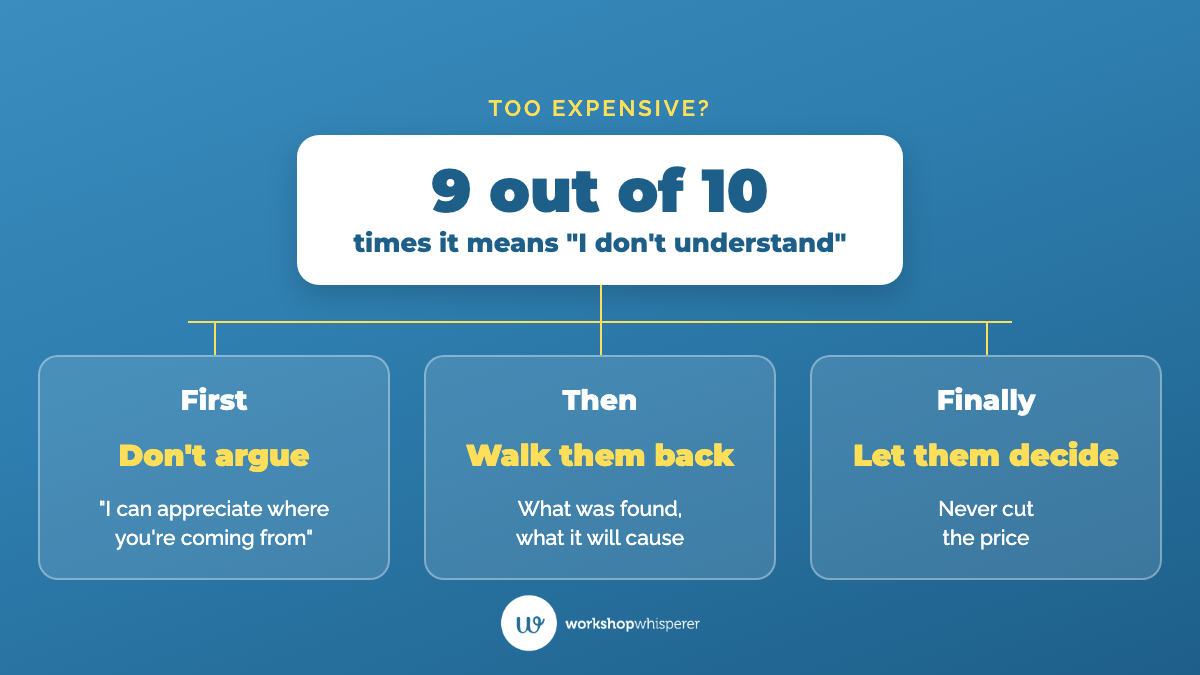
When a customer says "that's too expensive", your service advisor shouldn't cut the price and shouldn't argue for it. They acknowledge how the customer feels, then walk them back through what was found, what it will cause if it's left, and what it means for them. Then they let the customer decide. As Rachael says, when a customer says no and it's financial, nine times out of ten what they're actually saying is they don't understand.
If your front counter has been trimming prices to avoid that moment, it's not because they're soft. They're decent people who don't want the customer to feel stung.
The conversation is the same whether you run an auto repair shop, a mechanics workshop or an independent garage, and whether the person at your counter calls themselves a service advisor or a service writer.
Why does "too expensive" make us drop the price?
A car comes in for a service and your technician finds a worn control arm. It's a genuine safety issue. The work needs doing, it's a fair recommendation, and the total is sitting at $800.
By the time it reaches the customer, it's $650. The extra work got dropped, the margin on the parts came down a little, and an hour got written off because the job ran long. The customer never asked for any of that. Your service advisor, or you, did the negotiating on their behalf before they ever heard the number.
I call that the flinch. You're standing at the counter with a fair figure in your head, and before it comes out of your mouth you can hear yourself shrinking it. The conversation you imagine the customer is going to have is louder and harder than almost any real conversation with a real customer.
A shop owner told me once that his customers were too tight to pay full price. So I asked him how many of his customers had actually said no that month. He went quiet, then said, "None of them." He had never given them the chance to say no.
What the flinch costs. Here is an example you can redo with your own numbers. If the counter trims $150 off five jobs a week, the way that $800 job became $650, your average job value drops and you lose $750 a week. Across 52 weeks that's $39,000 a year, earned on work your team has already done, with the parts fitted and the wages paid, and never invoiced.
There's a cost that never shows up on a spreadsheet as well. Every time you discount, even if it's 5%, you're basically saying you're not worth it, your team's not worth it and your business isn't worth it. In most cases there was no need to write that money off in the first place.
Laura Moore, who runs M-Developments in Queenstown, New Zealand, found the answer to the flinch is certainty. It came from "really learning to know our numbers" and asking the hard questions: "Was our labour rate right?" and "Are we really really clear on who our target customer is? Cuz not everybody is our people and we're not everybody's perfect workshop." Once she was comfortable with that, the business had its "highest profit result ever". In her words, "It actually feels like an exciting place to be. And that's quite different from a few years ago." Watch Laura's story.
What should my service advisor actually say?
Conflict is a normal part of the job. Nobody sees the world the way you do, so almost every conversation at the counter carries a bit of it. A customer saying "that's too expensive" is someone who feels out of control of the situation. Your service advisor's job is to stay calm and lead the conversation to its natural end.
1. Let them say it. Say nothing at first. Whatever comes out, the customer is releasing tension about something they feel they can't control: the price, the part, how long the job took. Let it go past you. Cutting them off tells them you're not listening.
2. Acknowledge, don't argue. Everyone wants the same two things: to be validated and to be understood. One line does it:
"I can appreciate where you're coming from, and if I was in your position, I can understand how you might feel right now."
It's hard to fight someone who agrees with you. You stop standing toe to toe and start standing shoulder to shoulder, looking at a problem that needs solving.
3. Walk them through the situation, the problem and the impact. This is where most counters go wrong. Under pressure, people repeat the price louder or start to apologise for it. Instead, take the customer back through the facts. On a bill that's higher than they expected, it sounds like this:
"Yep, totally understand. This is more than you're expecting. Well, here's the situation. This is what we found. These are the problems that either it was causing or it was going to cause. This is the impact it would have had for you, your family, your vehicle, and this is what we needed to do to resolve it."
Asking someone to think through the facts moves them out of their emotions and into their logical brain. You can't be emotional and logical at the same time. Each step takes 30 seconds to a minute, and the customer never feels like they're being put through a process.
4. Then let them decide. Every customer has the freedom and the authority to say no to your recommendations. They should never say no without the full story, the full picture and the full consequences of what a no means for their car and their family. Your job is not to guess how they'll react, it's to know your number and present it with a straight face and clear certainty.
If it's a recommendation they're weighing up rather than a bill they're questioning, take a little extra time to explain why it needs doing now, in plain words. Plenty of customers won't say "I don't understand" out loud, so they say "it's too expensive" instead.
Holding a price under pressure is a skill your service advisor can learn. Superstar Service Advisor trains the person at your front counter to present the work, hold the price and convert the inspection, so the price your technician wrote down is the price the customer hears.
What if they still say it's too much?
Some customers will push back again, and that still doesn't mean you take money off.
Rachael's advice, when a customer says a job was a hundred dollars more than they could have got it done for down the road, is to say it plainly: "Well, you chose to get it done here. We discussed it before we went ahead." And when someone tells you they know someone who'll do it cheaper, she says it's okay to answer, "Well, I know someone who would pay more." You don't have to keep wearing it, and you don't have to feel bad about it.
The example I use is a surgeon. You've probably had an operation at some point. You never negotiated the cost with your surgeon, and if the operation finished early, they didn't wipe two hours off the bill. Their speed came from skill, knowledge and experience, and that has a value. Your technicians' speed comes from the same place.
Then look around for what caused the conversation in the first place, because in most cases it's a system failure, not a difficult customer. Two causes come up again and again:
- A quote instead of an estimate. A quote is a fixed price on a flexible process. You lock in a number before you've seen the car, and the moment you find something else, you've got no room to move. An estimate is a considered range, built on a conversation and a diagnosis.
- No phone call during the job. Bill shock happens when you estimated five hours, the job took ten, and nobody rang the customer. A phone call when the job changes keeps the customer in control of how much work gets done, and the argument at pick-up never happens.
And for the customer who argues every price, every time? Ask yourself whether they're an ideal customer. Constantly having your work and your value questioned isn't a normal part of business. You're welcome to keep your competitors busy with them.
Watch this 26-minute episode before your next tough conversation at the counter, because it shows who has really been setting the prices in your shop. I walk through the $800 job that leaves the counter at $650 and give you three questions to stop it happening this week.
Questions auto repair shop owners ask about customers saying it's too expensive
Should my service advisor offer a discount to save the job?
No. A discount teaches the customer that your first price wasn't your real price, and it attracts the people who only care about the cheapest shop in town. Those customers leave the day someone else is a dollar cheaper. Hold the price and explain the work.
What do I say when a customer asks "how much?" on the phone?
Answer with a question, not a number. Ask what the car is doing, what they're hearing and feeling, and what job they want done. You won't know the price until you know what you're looking at. As Rachael says, in any conversation, questions are the answers.
What if the customer genuinely can't afford the work?
Tell them the full story anyway, including what happens if it's left, then let them choose what to do today and what to book in for later. It's not your job to decide what a customer can afford based on the car they drive or how they're dressed. It's your job to make the recommendation and educate them on why it matters.
How do I stop the bill shock in the first place?
Give an estimate, not a quote, and ring the customer the moment the job changes. When the customer has approved every step, there's nothing to be shocked about at the counter.
Is it ever okay to let a customer walk?
Yes. If a customer questions your price every single visit, they're probably not your ideal customer. Stay polite, and feel free to refer them to another shop.
Where to start tonight
Look back over last month and count how many customers actually said no to a price your counter presented in full. Then count how many jobs went out lower than the number your technician first wrote down. If the second number is bigger than the first, the price is being cut at your counter before your customers get a say.
Related questions:
See what changes for the people who do this work. On our Our Clients page, auto repair shop owners, named and on camera, tell you what actually changed in their shops and their numbers.
More on this topic: all Sales articles.
Whenever you're ready, here's how we can help.
- Not ready to spend anything yet? Start free with Shop Talk, a 30-day reset for auto repair shop owners on our YouTube channel, and our free resources for auto repair shop owners.
- Want your service advisor to hold the price at the counter? Superstar Service Advisor trains the person at your front counter to present the work, hold the price and convert the inspection, without more cars, more marketing or more hours from you.
- Running an auto repair shop under $50,000 a month? Auto Superstars Academy builds the foundations, with one-on-one coaching on demand from a business coach who is a current or former auto repair shop owner.
- Over $50,000 a month? The Engine Room changes how the whole business runs, from your numbers to your team, delivered online with one-on-one coaching on demand.