Do I Need More Cars, or More From the Cars I Already Have?
If you've been in business for a while, you almost certainly need more from the cars you already have. Pour more cars into the shop you're running now and you get the same profit result you're getting today, and sometimes a worse one. More cars become the answer once you're selling all the work on every car, your technicians still have hours left to sell, and the bookings aren't there to fill them.
It makes sense that more customers feels like the fix. An empty hoist is easy to see. The work left on a car that has already driven out the gate is much harder to see.
That holds whether you run an auto repair shop, a mechanics workshop or a garage, and whether you call the number your average repair order or your average job value. Below is how to tell which problem your shop has, and where to start on it tonight.
Why won't more customers fix my cash flow?
Finding more customers looks like the magic pill. In reality you're tipping more people into "an already inefficient and unproductive system which achieves the exact same profit result" you're getting now. More cars does not equal more profit. As I've worked through with our Engine Room clients, more cars can actually make the profit result worse.
When we were coaching shops in Perth, I watched owner after owner look at their shed and decide there was nowhere left to grow. Some were out hunting for bigger premises, at the risk of more rent and bigger mortgages. As I wrote in Poor to Profit, "many of them were confusing more car spaces with bigger profits." They weren't at capacity. They didn't know how to get the most profit out of each customer, and a bigger shed would have meant more rent, more staff and more marketing on top of the same leaks.
Dean describes every business as a bucket with holes in it, and in his words, "very rarely is the answer get more cars." When the bucket won't fill, most owners go and get a bigger hose instead of fixing the holes. There's more activity, the team looks busier and more jobs get booked in, and at the end of the month there's still not much left in the bucket.
There's a second reason, and it catches owners who are already busy. Squeeze two or three extra cars into a shop that's already flat out and everyone focuses on getting the jobs out before close. The inspection gets rushed, the recommendation never gets made, and gross profit per invoice drops. The challenge I set owners is simple. "Track the correlation between the number of cars you do in a day and the gross profit on each invoice." Do it for 14 days. The more cars you put through over and above your ideal number, the lower your gross profit per invoice, every time.
How do I know which one my shop needs?
Start with your technicians. Our benchmark is a minimum of 80 to 85% productivity across the whole team, meaning they sell 80 to 85% of the hours you pay them for. Dean will tell you that most shops start between 50 and 60%, and we've seen some as low as 30 to 40%.
If your team is sitting down there, it's only ever one of two reasons. Either you don't have the work to give them, or they're taking longer than the job should take. Losing 40 to 50% of your paid hours is a lot of capacity, so before you spend a dollar on marketing, find out which of the two it is.
Then clean up your customer database. Most hold people who haven't been in for 12 months, two years, even three. We work on roughly 18% of customers dropping away every year, because they've moved, they've died or they've gone to someone else. Contact the lapsed ones, remove the ones who are gone, and you'll know how many cars you can actually expect in a year.
Now look at two numbers side by side: your daily car count and your average repair order. Dean's point is that every shop has a sweet spot, a number of cars a day that suits your team and your floor. Too many and profitability drops in almost every case. Too few and there isn't the cash flow to keep the doors open. "Bigger isn't better. Better is always best."
Dean tells the story of one of our Engine Room members, a shop turning over around $800,000 a year. The owner came to us convinced he needed more customers. Gross profit was soft, his average repair order felt flat and cash was tight at the end of every month. His plan was to spend more on ads. When we went through his numbers, the fault was his labour rate. He was charging $30 an hour below where a shop his size should sit, so every job was underpriced. More volume at that rate would only have made the cash flow worse. We didn't get him more customers. He put his labour rate up to where it should be, and the next quarter he made more money on the same number of jobs.
Tanya and Godfrey Nardone run GTN Services in remote Western Australia, a two and a half hour drive from Kalgoorlie. They'd gone about two months without being able to pay wages. As Tanya put it, "We are at a point where we have no money. We can't pay our bills. We can't pay our wages." They didn't go hunting for more customers. They lifted their labour rate from $120 an hour to $150. "Everyone's fear is oh my god we'll lose all our customers." They didn't. "We're actually doing less work and more money. But the workshop's happier." Read Tanya and Godfrey's story.
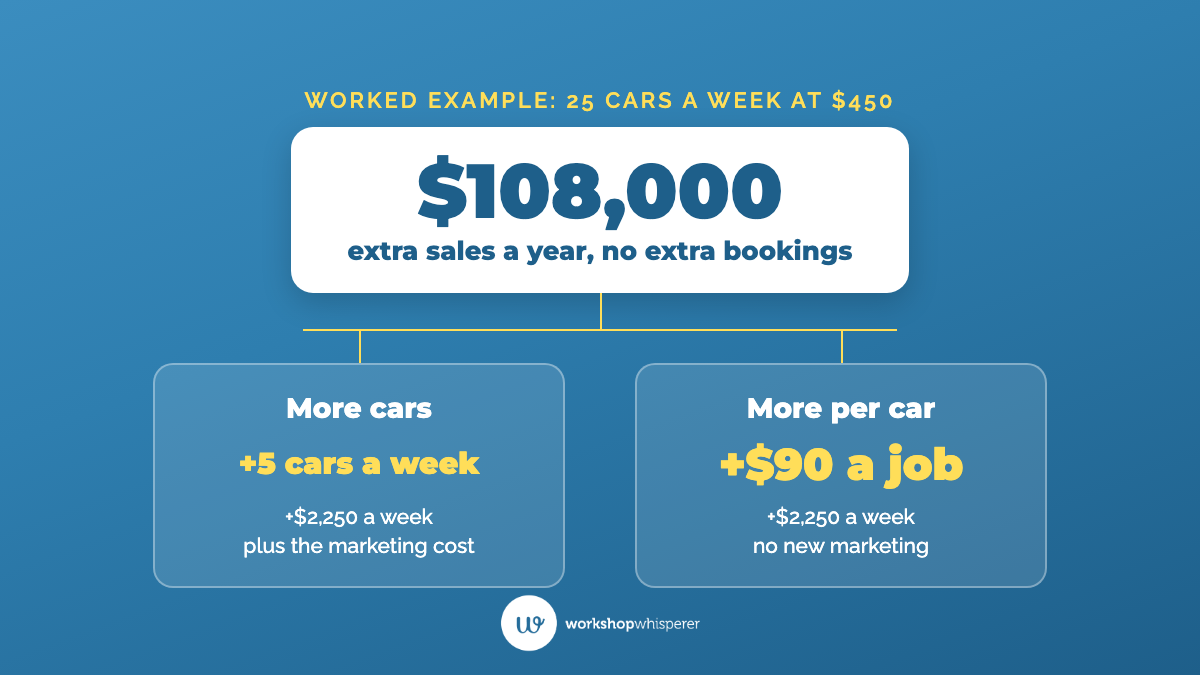
A worked example. These are round numbers I've chosen to show the maths, so swap in your own. Say your shop sees 25 cars a week at an average of $450 a job. That's $11,250 a week in sales.
- Path one: five more cars a week. At the same average, that's another $2,250 in sales. To get it you pay for the marketing, you need five cars' worth of technician hours free, and if the shop is already busy, your gross profit per invoice starts to slide.
- Path two: the same 25 cars, $90 more on each. That might be one recommended job worth around $270 agreed on one car in every three. It's the same $2,250 a week, with no new marketing, on cars that are already on the hoist, using technician hours you're already paying for.
Across a 48-week year, path two is $108,000 in extra sales without one extra booking.
How do I get more from the cars already in my shop?
Write down how you want every car inspected. Ask yourself how much of it is on paper. Most owners expect their technicians to know what to look for and how to write it up. Without it written down, your recommendations depend on who had the car.
Write down what your service advisor says. Your service advisor (service writer in the US, service adviser in the UK) is where extra work gets agreed or quietly lost. If the conversation isn't written down and trained, it changes every time.
Stop deciding what the customer can afford. It's one of the most common misconceptions I see. An owner looks at the car, the state it's in, the way the customer is dressed or a bill they were slow to pay last year, and decides not to put the recommendation forward. Maybe 85% of the time you'd be right about them. It's still not for you to decide. Your job is to make the recommendation and explain why it needs doing, and the customer's job is to say yes or no. And when a customer says no for financial reasons, "nine times out of ten what they're actually saying is they don't understand." So take the extra minute. Explain it in plain words, show them a visual of what you found, and tell them what happens if it isn't done.
There's a safety side too. If you knew about a problem, said nothing and something happens on the road, you carry the guilt and you could be in serious legal trouble. Put your big boy or big girl pants on and have the conversation. That's what you're there for.
Dean puts the limit plainly. This isn't about squeezing a customer for every dollar, and "it is certainly not about selling work that is not required."
Protect the time it takes. When the board is full, don't fix it by saying yes to two or three more cars and rushing them all. Give your front counter a line that books them in properly instead: "We can definitely take care of that for you. Due to the work already booked in, we'll be able to start that tomorrow afternoon or on Thursday. Which suits you better?"
If the front counter is where your shop leaks, that's what Superstar Service Advisor is built for: training the person at your counter to find, present and hold the work on every car.
Once all of that is humming, and your techs still have hours left to sell, go and find more customers, because every new car will land in a shop that knows how to look after it.
Watch this two-minute video before you spend another dollar on ads: why more cars don't equal more profit, and what to fix first.
Questions auto repair shop owners ask about more cars
Will upselling make my customers feel ripped off?
Not if you recommend only what the car needs and explain why. Customers come to you to be safe on the road, and a clear recommendation they can say yes or no to is good service.
When should I spend money on marketing?
Once your database is clean, your inspection and front-counter process is written down and working, and your technicians still have hours left to sell. A new shop may need more cars sooner. Either way, spend on marketing you can measure the result from.
How many cars a day should my shop be doing?
There's no single number. It depends on your team, your floor and the type of work you do. Find yours by tracking cars per day against gross profit per invoice. The point where the gross profit starts to fall is past your sweet spot.
Should I hire another technician so I can take more cars?
Not until your whole team is selling at least 80% of the hours you pay them for. Below that, you've got workflow problems to fix first. Fixing them frees up capacity to take more cars, or gives your team more time to sell the work on the cars you already have.
What if a customer says they can't afford the work?
Most of the time they don't understand it yet. Explain it again in plain language, show them what you found, and tell them what happens if it waits. If they still say no, that's their decision to make, and they've made it with everything in front of them.
Where to start tonight
Open your workshop management system and pull the last 14 working days. For each day, write down two figures: how many cars you invoiced, and the average gross profit on those invoices. Put them side by side on one page and see whether your best gross profit came on the busiest days or the calmer ones. That page will tell you more about whether you need more cars than any marketing quote will.
Related questions:
See what changes for the people who do this work. On our Our Clients page, auto repair shop owners, named and on camera, tell you what actually changed in their shops and their numbers.
More on this topic: all Sales articles.
Whenever you're ready, here's how we can help.
- Not ready to spend anything yet? Start free with Shop Talk, a 30-day reset for auto repair shop owners on our YouTube channel, and our free resources for auto repair shop owners.
- Want your front counter to find and sell the work on every car? Superstar Service Advisor trains the person at your front counter to present the work and hold the price, without more cars or more hours from you.
- Running an auto repair shop under $50,000 a month? Auto Superstars Academy builds the foundations, with one-on-one coaching on demand from a business coach who is a current or former auto repair shop owner.
- Over $50,000 a month? The Engine Room changes how the whole business runs, from your numbers to your team, delivered online with one-on-one coaching on demand.