
How Do I Follow Up on Declined Work?
You follow up on declined work by writing every "no" on the job card, with the reason and how long the part has left. Before the customer leaves, ask their permission to get in touch. Close to that date, send a text offering two specific times to bring the car back in, and pick up the phone if a couple of texts go unanswered. When one person on your front counter does this every time, work your technician has already found becomes booked work.
If declined work has been sliding in your shop, it's rarely because you don't care. Chasing a customer who said no can feel like pestering them, and most of us got into this trade to fix cars, not to sell.
It works the same whether you run a mechanics workshop or an independent garage. Whatever you call the person on your front counter, service advisor, service writer or service adviser, this is their job.
Why does declined work matter so much?
Think about what has already happened by the time a customer says no. Your technician has done the inspection and found the work. Someone has priced the parts and written the estimate. As I said in one of our live trainings, it's even more disheartening when you get a no, "because you realise the time that both your technician team and your service team have used to prepare that estimate for the customer." Then the customer drives away, and in a lot of shops that work is never mentioned again.
Then there's safety. Plenty of declined work is brake pads and tyres, flagged because they won't make it to the next service. If you don't follow up, nobody will. If something then happens on the road, you carry the guilt of it, and you could find yourself in serious legal hot water.
What changes how owners feel about following up is understanding what a no usually means. When a customer says no and it sounds like money, it often isn't. As I put it on our podcast, "nine times out of ten what they're actually saying is they don't understand." Maybe they didn't see the worn pad, or nobody explained what happens when the tread runs out. A no at the counter is very often "not yet" or "I didn't get it", and you can follow up on both.
One of our A-Grade Auto Repair Shop Show episodes describes a customer every shop has: the one "who keeps putting off the work that you flagged for them 6 months ago." That customer already trusts you and is already in your system. Getting the work booked takes a conversation with someone you know, not a new customer.
What should we record when a customer says no?
You can't follow up on work nobody wrote down, so the system starts on the job card.
Write a decline line for every item the customer turns down. Each piece of recommended work the customer says no to goes on the job card as what we call a decline line. Without decline lines, "it's anyone's guess whether the service advisor actually put that work to them," as I said in our Cash Flow Rescue Kit training. You can't tell if the work was offered, what the customer said, or why they said no.
Record the reason and the timeframe. Listen more than you talk, and take notes. You'll often hear something like, "I'll get the tyres done today, but I'm probably going to need to wait a month for those new brake pads." That sentence is your follow-up date. Write it on the decline line.
Ask permission to call. Before they leave, ask if you can give them a quick call when that month is up. Your follow-up then becomes a call they have agreed to, and the customer knows you're still looking after them.
Review the decline lines regularly. Once they're filled out on every job, they become a coaching tool. If the same item gets the same no for the same reason every time it's offered, that points to a training conversation with your service advisor. You may find the person who's brilliant at building rapport isn't great at putting the work forward, or that your technicians are too busy to do a proper inspection. How your front counter presents work and converts estimates is the core of Superstar Service Advisor.
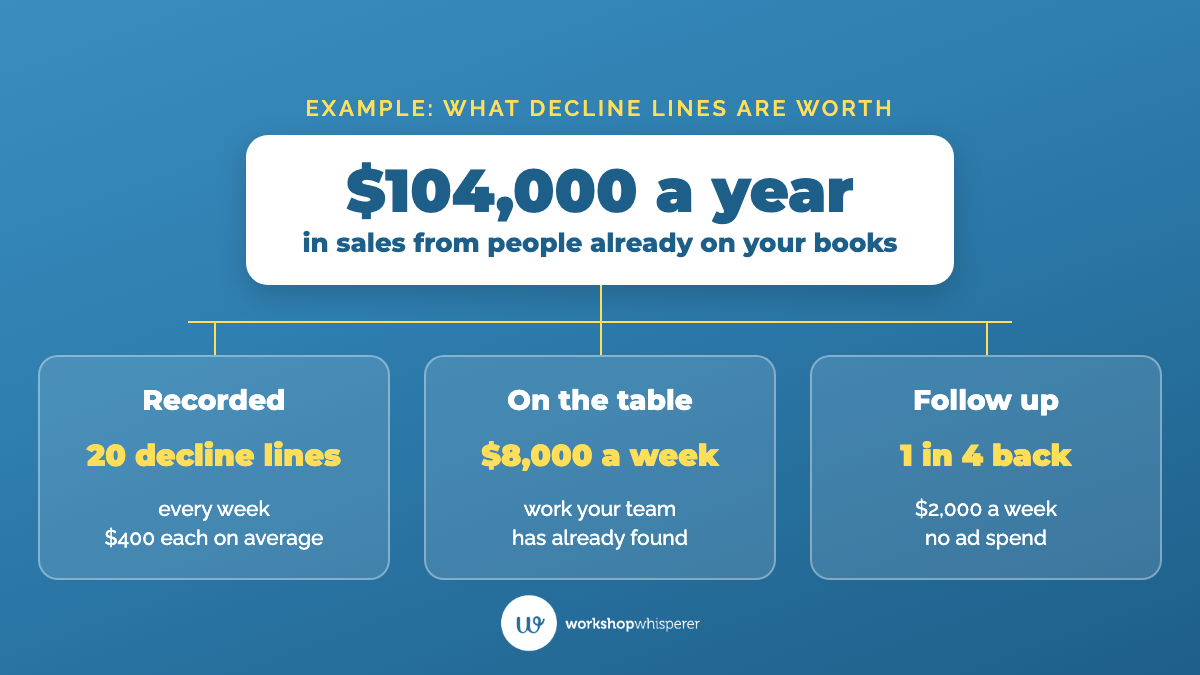
Example: what a week of decline lines can be worth. These figures are an example to show the maths, not a benchmark. Say your service advisor records 20 decline lines a week, and the average one is worth $400. That's $8,000 of work every week that your team has already found and your customers have already been told about. If your follow-up brings back one job in four, that's $2,000 a week, or $104,000 a year in sales, from people already on your books. There's no ad spend in that, and no new customers. Run it for your own shop: count last month's decline lines, add up their value, and work out what one in four would have added to your average repair order (or average job value, depending on what you call it).
How do I follow up without being pushy?
Change how you see the call. It's okay to let your customers know that even if their safety isn't top of mind for them, it's top of mind for you. In my words, "you're not bothering them you're not spamming them you're doing them a favour." Think of it as a duty of care. If their tyre tread or brake pads were getting low and they've let it go, you should be following them up so they understand the consequences of continuing to delay.
Send a text first. Texts may go unanswered, but they rarely go unread. Keep it plain and specific, and offer two times instead of an open question. Something like:
"Hi, at your last service we noted your tyres weren't going to make it through to the next one. They're probably worn down to where we don't want them to be. We've got a spot open tomorrow afternoon at 1, or the following day at 9am. Would either of those suit?"
Pick up the phone after a couple of tries. People get busy. If two texts haven't landed, call. That bit of personal contact is often what gets you over the line. Don't leave it to your customers to do the legwork.
Explain the problem again, in plain words. When you get them on the phone, don't read the quote back. Tell them what the problem is, what happens if it isn't fixed, and that you can solve it for them. Customers are often reluctant to admit they don't understand, especially about their car. When the work is put as a problem you can solve, instead of extra money on the job, it doesn't feel like pushy sales.
Don't decide for them. Don't skip a follow-up because of the car they drive, how they were dressed or how they paid last time. You might be right about some of them, but it's still not your decision to make. Your job is to put the recommendation forward and educate. The customer decides.
Make one person responsible. If following up relies on whoever remembers, it won't get done. Your service advisor works from the decline lines, and the reports in your management software show who hasn't come back on time for a service. If your front counter doesn't work from clear written processes (SOPs), following people up won't be as routine as you think it is.
Daniel Barry from Danbar Automotive in New Norfolk, Tasmania, saw what changed when the owner stepped back from the counter. Before, his shop was flat out and "we're billing so much, but we're not making any money, we're going backwards." He's honest about why: "I'm very customer-orientated, which is good. But yeah, as for the financial part, I am a sucker." Putting a service advisor on the front counter felt like "a bit of a double down", because "we're paying for a service advisor and I was going to lose a tech off the floor as well." It paid off. "Having an SA has been huge, one of the biggest game changers for the workshop," Daniel says. It kept him away from the invoices and what he calls "the old emotional discounting".
Watch this before you send your first follow-up text. In about seven minutes, Dean and I talk through the money sitting in your customer database, including the message I'd send to a customer whose tyres weren't going to last to their next service.
Questions auto repair shop owners ask about following up on declined work
How soon should I follow up on declined work?
At the time the customer gave you. If they said "in a month", call in a month. If the part won't last to the next service, follow up well before that service is due rather than waiting for the reminder to go out. If they didn't give you a time, ask for one before they leave the counter.
Should I follow up by text or by phone?
Start with a text, because texts rarely go unread. Offer two specific times to bring the car in. If a couple of texts go unanswered, pick up the phone.
What if the customer said no because of money?
Often it isn't money. Nine times out of ten, a no means they didn't understand what you found or why it matters. Explain the problem and what happens if it's left. If money really is the issue, ask when would suit them, note it on the decline line, and call them then.
How do I know if my service advisor is offering the work at all?
Decline lines. When every item that's turned down is recorded on the job card with the reason, you can see what was offered and why it was refused. If your job cards have none, you have no way of knowing.
Isn't following up on declined work pushy?
Not when the work is about safety and the customer agreed to hear from you. You found a problem, told them about it, and you're checking in before it becomes dangerous. Customers expect that from the people they trust with their car.
Where to start tonight
Pull up your last 20 job cards and count how many have a decline line. If the answer is none, or close to it, that's your first finding: right now you can't see what's being offered or why it's being turned down. If the decline lines are there, pick the three oldest brake or tyre items and text each of those customers tomorrow morning with two times they could bring the car in.
Related questions:
- How Do I Get Customers to Say Yes to the Work We Recommend?
- How Do I Increase My Average Repair Order?
See what changes for the people who do this work. On our Our Clients page, auto repair shop owners, named and on camera, tell you what actually changed in their shops and their numbers.
More on this topic: all Sales articles.
Whenever you're ready, here's how we can help.
- Not ready to spend anything yet? Start free with Shop Talk, a 30-day reset for auto repair shop owners on our YouTube channel, and our free resources for auto repair shop owners.
- Want your service advisor turning more of those noes into booked work? Superstar Service Advisor trains the person at your front counter to present the work, convert estimates and hold the price, without more cars or more hours from you.
- Running an auto repair shop under $50,000 a month? Auto Superstars Academy builds the foundations, with one-on-one coaching on demand from a business coach who is a current or former auto repair shop owner.
- Over $50,000 a month? The Engine Room changes how the whole business runs, from your numbers to your team, delivered online with one-on-one coaching on demand.