

How to Work Out What Your Labour Rate Should Be
You work out your labour rate from your own numbers, in two steps. First, find what your shop costs to run every hour the doors are open, add the profit you want to make, and build the rate backwards from there. Then test it. Across your labour and parts together, your invoices should return between 58% and 62% gross profit on average. If they do, your rate is doing its job. If they don't, the numbers will tell you whether the rate is the problem.
If you picked yours out of thin air, you're in good company. Nobody sits a new auto repair shop owner down and explains break-even, and if you bought a shop, you most likely kept the rate that was on the books.
Whether you run an auto repair shop, a mechanics workshop, a mechanical workshop or a garage, and whether you write labour rate or labor rate, the maths is the same.
Is there a right labour rate for my area?
No. There's no specific benchmark for a labour rate, because different markets and different types of repair need a different baseline, and every business is different again. A heavy diesel shop, a four-wheel drive specialist and a light vehicle workshop in the same street will each have their own number.
It's rare to find two shops in the same area with the same break-even point. Your technicians are on different wages. Your rent or mortgage is different. Your fixed costs are different. So the rate that keeps one business alive can send the next one broke.
Say you're in Australia, charging $130 an hour plus GST, which is probably a bit low these days, and the shop down the road charges $115. It's easy to believe you're too expensive. In reality, your rate could be what pays the wages of four more technicians than they have, or a shed mortgage twice the size of theirs.
From time to time in our free Facebook group, Your Profitable Auto Repair Shop, we ask the 4,000 or so owners in there to share their labour charge-out rates. You can see rates from Australia, New Zealand, the USA and Canada side by side, and every time the comments fill up with "Looks like it's time to raise our labour rate." It might be. But do the maths on your own numbers first. Looking around can prompt the question, but as I've said on Shop Talk, "always base your labour rate decisions on the maths alone."
Why copying the shop down the road costs you, and how to make a rise stick, are covered in how to raise your labour rate without losing customers. This article is about finding the number.
How do I work out my labour rate from my own numbers?
Start with the question most owners have never answered. What does your business need, every hour, to break even, before you even open the roller door in the morning?
Step 1: Find your break-even per hour. We built a free break-even calculator to do this. Put in your actual costs from the last 12 months: your team's wages (not your own), rent or mortgage, power, software, insurance, equipment finance, marketing and accounting. Leave out parts, sublet work and anything tied directly to a job. Choose your trading week and it breaks the total down to the hour. That hourly figure is what it costs to keep your business running, every hour the doors are open, before you make a cent.
When you see that number, you start to get real about how undervalued your advertised labour rate is.
Step 2: Decide the profit you want, and add it. Profit is a decision you make at the start of the year, not something you find out at the end. As I've put it in one of our live trainings, "you must decide how much profit you want to make and then we go about reverse engineering it all the way back down to your labour rate and your parts gross profit amount."
Step 3: Spread it across the hours you sell. You pay your technicians for every hour they're on the clock, but not every one of those hours makes it onto an invoice. Your rate has to be earned on the hours you sell.
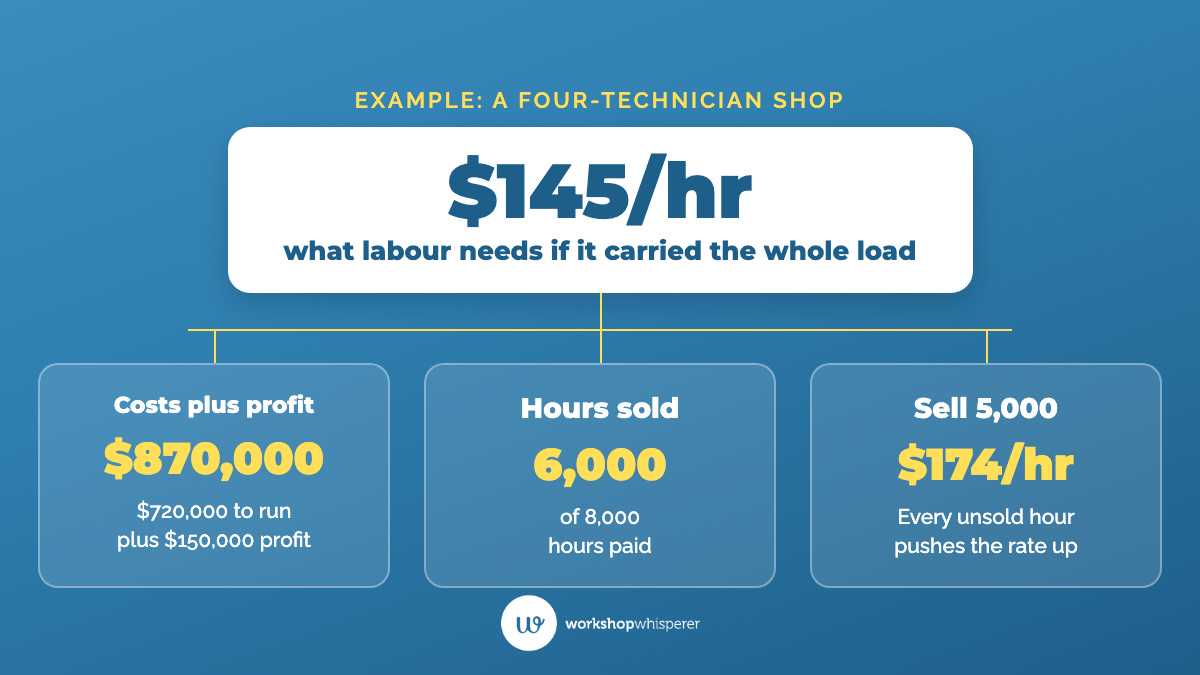
A worked example. These are made-up numbers for a four-technician shop, there to show the steps. Use your own.
- Operating costs for the last 12 months, team wages included: $720,000
- Trading 50 weeks, 5 days, 8 hours a day: 2,000 hours. Break-even is $360 for every hour the doors are open
- Profit you want before tax: $150,000. The business now needs $870,000, or $435 an hour
- Four technicians at 2,000 hours each: 8,000 hours paid. Say 6,000 of them get sold
- $870,000 divided by 6,000 hours sold: $145 an hour
That $145 is what labour would have to earn if it carried the whole load by itself. It doesn't, because the gross profit on your parts pays part of that bill, so your rate can land below it. How far below depends on how well your parts are priced, which is what the second check is for.
Look at what happens if those four technicians sell 5,000 hours instead of 6,000. The same bill now needs $174 for every hour sold. Every hour written off or left unsold pushes the rate you need up.
How do I know if the rate I've worked out is right?
Check it against gross profit. On average, across every invoice, your gross profit should sit between 58% and 62%. That figure is made of two parts, labour gross profit and parts gross profit. Parts should return between 48% and 52%, so labour has to sit well above that or the two can never add up to 58%.
Here's one job, again with made-up numbers. Four hours of labour, $400 of parts priced at 50% gross profit, and a technician who costs you $50 an hour with wages and on-costs in.
| At $150 an hour | At $120 an hour | |
|---|---|---|
| Labour charged | $600 | $480 |
| Labour cost | $200 | $200 |
| Labour gross profit | $400 | $280 |
| Parts gross profit | $200 | $200 |
| Total gross profit | $600 on a $1,000 invoice: 60% | $480 on an $880 invoice: 54.5% |
Same job, same parts, same technician. The only thing that changed is the rate, and it cost $120 in gross profit on one job.
Now run the check across a month of invoices. If your overall gross profit is low, there are only two places to look. If labour gross profit is low, it's your rate that has to change. If labour is fine and parts gross profit is low, the rate isn't your problem, and raising it won't fix it.
And if both are where they should be, leave the rate alone. Don't drop a rate that's already on benchmark because you look like the most expensive in town. Dropping it only hurts your performance further. Inside The Engine Room, our clients report labour gross profit, parts gross profit and overall gross profit against our benchmarks every week, so this check becomes a habit.
Some of the biggest turnarounds we see come from heavy vehicle and performance shops. They arrive with gross profit on their jobs sitting somewhere in the 20s, a long way from 58% to 62%, convinced their part of the industry can't charge more. Then they look at the numbers, make the changes scared, and they're often the ones who go on to the biggest profit transformations.
One rate isn't enough. Once you've found your number, it becomes your advertised rate. That's the one a price shopper asks about on the phone, and the one you'd usually apply to servicing. Say it's $135 an hour plus GST.
Diagnostic work needs its own rate. While your technician is finding the fault, you can't sell a part, so your gross profit dollars for every hour fall unless the labour carries more. Your diagnostic rate should sit 25% to 50% above your advertised rate. On a $135 advertised rate, that's roughly $169 to $203 an hour. Your repair rate, for the fix itself, can be different again. As I've said on Shop Talk, "I'd love you to have four, but that's a conversation for another day."
Make sure your service advisor, or service writer, knows which rate applies to which part of the job and tells the customer before diagnosis starts.
Watch this before you set your number. In seven minutes, Dean asks me why so many owners pull their labour rate out of thin air, and I walk through break-even, the gross profit your rate has to deliver, and why diagnostic work needs a rate of its own.
Questions auto repair shop owners ask about working out their labour rate
What labour rate should I charge if I'm starting a new shop?
Work out your break-even before you set anything. Most owners who started from scratch never knew break-even existed, so there was no maths in the rate at all. Use your best estimate of a year's costs, add the profit you want, and build the rate from there. Don't start cheap to win customers. Only breaking even, or spending a few years making a loss, will put you out of business, and then there are no customers anyway.
I bought my shop. Should I keep the labour rate that came with it?
Not without checking it. The previous owner's rate was built on the previous owner's costs, if it was built on anything. Your wages, your rent and your loan repayments are your own. Run the break-even calculator on your own last 12 months and test the rate against the gross profit benchmark before you decide.
Should I lower my labour rate if I'm the most expensive in town?
Only if your numbers say so, and they rarely do. If your labour gross profit is on benchmark, your rate is right, and dropping it will hurt you. The shops charging much less are usually not analysing their financial performance at all.
Can I charge more because my work is better?
Yes, once the maths is done. Get your rate to where your numbers say first, then think about the quality of the work you deliver, because shops that are booked out on the strength of their work and their reputation get to add a bit extra onto their labour rate.
How often should I work out my labour rate again?
Every time your costs change in a real way: when you add or lose a team member, change wages, move premises, buy equipment or change how the business runs. Your break-even isn't fixed, so your rate can't be either. Review it at least every six months, because wages and rent move every year.
Where to start tonight
Open our free break-even calculator and put in your last 12 months of costs. It takes about ten minutes. Divide the hourly figure by the number of technicians on your floor and write it next to your current labour rate. That's what every paid technician hour costs you, before profit and before a single hour gets written off. Seeing those two numbers side by side is where working out your rate starts.
Sales will outrun most problems, and sales with good margins will outrun them all.
Related questions:
- What Is Effective Labour Rate and How Do I Calculate It?
- How Should I Charge for Diagnostics?
- Using Next Month's Money to Pay Last Month's Bills? How Sandy and Zac Got Out
See what changes for the people who do this work. On our Our Clients page, auto repair shop owners, named and on camera, tell you what actually changed in their shops and their numbers.
More on this topic: all Pricing articles.
Whenever you're ready, here's how we can help.
- Not ready to spend anything yet? Start free with Shop Talk, a 30-day reset for auto repair shop owners on our YouTube channel, and our free resources for auto repair shop owners.
- Running an auto repair shop under $50,000 a month? Auto Superstars Academy builds the foundations, with one-on-one coaching on demand from a business coach who is a current or former auto repair shop owner.
- Over $50,000 a month? The Engine Room changes how the whole business runs, from your numbers to your team, delivered online with one-on-one coaching on demand.