
Is My Best Customer Actually Costing Me Money?
Quite possibly, and the warmer the relationship the more likely it is. The customer you would never let go is often draining more margin than the bloke who haggles over every dollar and whom you cannot stand the sight of.
It does not feel like a leak. It feels like good service. That's exactly why it runs for years.
This is not a customer problem. It's a measurement problem. You are grading your customers with your heart instead of your numbers.
You know the one. He's in every few weeks, asks for you by name, has referred half his street, and never argues about the bill. So every time his car is in you look after him. A bit knocked off the invoice. No charge for the half hour you spent ringing around for his part. Squeezed in ahead of the job that was actually booked for that morning.
Why does this happen in almost every shop?
Ask an owner who their best customers are and watch what they do. They don't reach for a report. They start listing names: the loyal ones, the friendly ones, the easy ones.
Every one of those is a feeling. Not a number, and certainly not a fact.
Here's the part nobody says out loud. Loyalty gets bought. Think about how you actually earn it. "Don't worry about that, mate." The small discount you never mention. The half hour here and there that doesn't make the invoice. "Yeah, bring it in, I'll fit you in somewhere."
Every one of those is you paying for the relationship. So the warmer it gets, the more you give away, and the nicer the customer, the harder you find it to charge them properly.
That's the loyalty trap. Your feeling about a customer is highest exactly where your margin is lowest, and the warmth hides it the whole way.
One owner who was certain
I sat with an owner not long ago who swore his best customer was a local fellow with a handful of cars. One vehicle in every week. Referred his mates for years. Knew everyone at the counter by first name.
Then we pulled the account apart. The discount on every job. The times he was booked in ahead of work already locked in for someone else. And the killer: his hours were quietly getting written down at invoicing every time, so the bill looked fair.
His best customer was his lowest margin account in the whole shop. Not by a little. By a long way.
He wasn't being loyal to that customer. He was subsidising him, lopping the price off and calling it friendship.
Watch: I draw the grid out and walk through all four boxes in 18 minutes. Once you have seen it you cannot unsee it.
Rank them on two things at once
Not one. Two. Put profit along the bottom, low on the left and high on the right. That's the margin the customer actually leaves behind. Put priority up the side, low at the bottom and high at the top. That's how much care they get: how fast you accommodate them, how readily you discount, how quickly they get into the diary.
Four boxes come out of it.
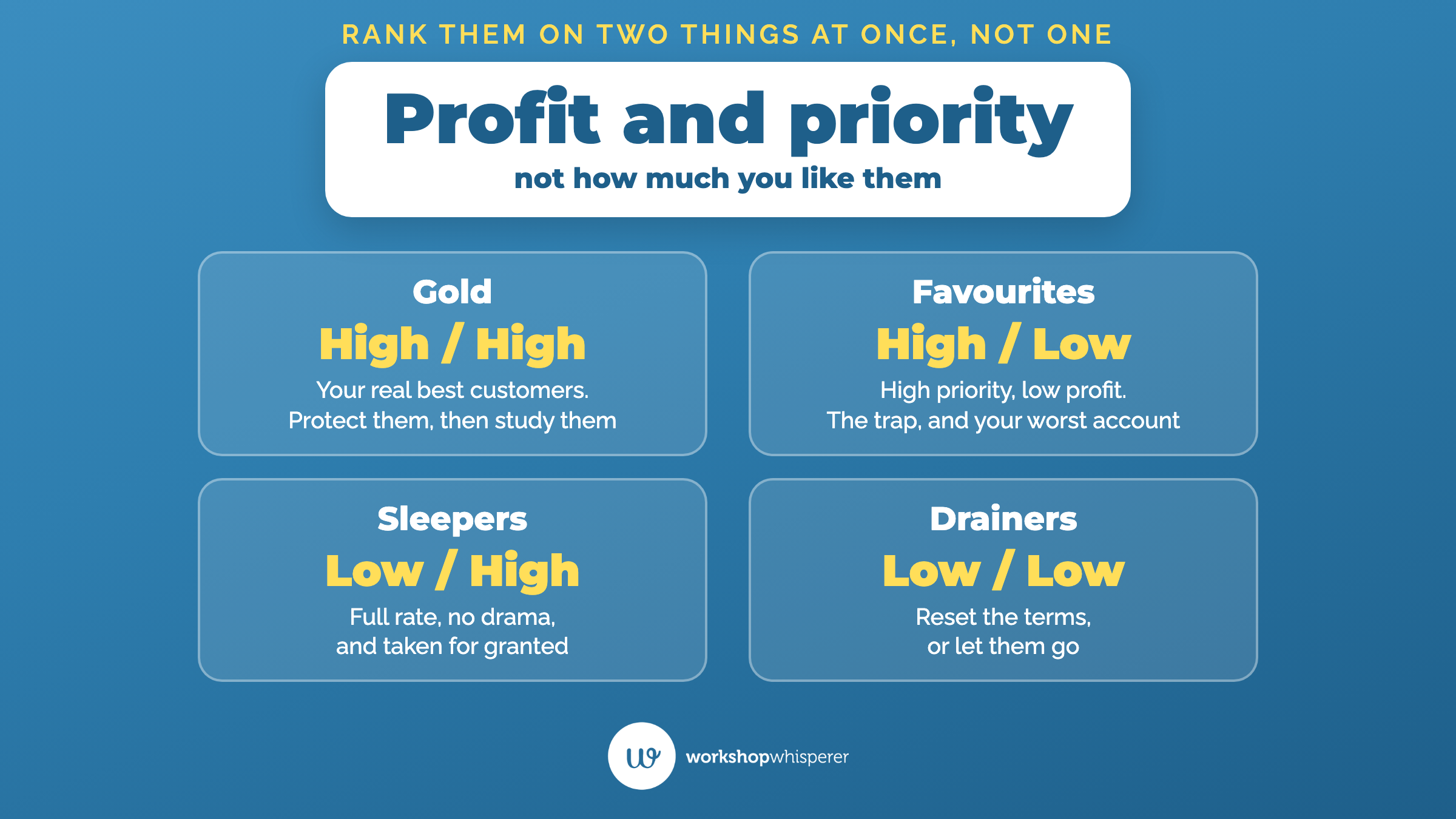
Gold. High profit, high priority. You make good money and you work to get them in. These are the genuine best customers in any automotive workshop. Protect them, and more importantly study them, because the entire job of your marketing is finding more people like these. They pay full price and they get your fullest care, and both sides are happy with the deal.
Sleepers. High profit, low priority. They pay full rate, they're no drama, and you barely give them a second thought. These are the ones you have been taking for granted while you were busy looking after someone else.
Drainers. Low profit, low priority. They haggle, and you don't enjoy the work. This one is easy: reset the terms, or let them go. There's a good saying for it. Keep your competitors busy with the customers you don't want.
Favourites. High priority, low profit. The best mate from the top of this article. Your worst account, sitting in a box where you can finally see it.
What changes once you can see it
You stop managing every customer the same way. You stop pouring your best service into the box that pays you least. And you stop confusing a warm relationship with a profitable one.
Your gold customers are still a warm relationship. The difference is it's profitable for both of you. They get high priority, you get high profit, and nobody is quietly subsidising anybody.
It won't be huge amounts on any single job. That's what makes it survive. But the more loyal that customer is, the more often the car comes in, the more often the discount gets applied, and across a lifetime of loyalty it's a considerable number.
Questions owners ask
Doesn't this mean treating good people badly?
No. It means charging them properly. Your favourites are not getting better work, they're getting cheaper work, and you are funding it. Most of them have no idea it's happening and would be mortified if they did. Charging full rate to someone you like is not a betrayal of the relationship.
How do I work out the margin per customer?
Start with your top twenty by invoice count rather than the whole list. Every mechanics workshop has a manageable number at the top. For each one, pull the discounts given, the hours written down at invoicing, and the jobs bumped to fit them in. Your workshop management software will give you the first two. The third you'll remember.
What do I do with a favourite once I've found one?
Stop the bleeding before you have any difficult conversation. Charge the full hours on the next job. Don't discount it. Most of the time nothing happens at all, because the discount was never why they came.
Aren't my favourites the ones referring people?
Sometimes, and that's worth real money, so check it rather than assume it. If the referrals are genuinely coming, that's a reason to keep the relationship warm. It is not a reason to write their hours down every single visit, and the two things are easy to tangle.
What about the drainers, should I sack them?
Reset the terms first and see what happens. Full rate, normal booking priority, no squeezing in. Some become sleepers overnight. The ones who leave were costing you money and a bay, and your competitor is welcome to them.
The shift
You're treating your best customers well and it's costing you money. The fix is not caring less. It's measuring before you decide who gets the care.
Tonight, write down the five customers you would call your best. Next to each, write what you discounted on their last job, and whether you charged every hour you worked. If you cannot remember, that is the answer, and those names belong in the top left box.
Want to see what a shop looks like once the gold customers are the ones getting the gold treatment? Our clients are named auto repair shop owners, and garage owners across five countries, on camera, telling you what changed.
More on this topic: all Money & Profit articles.
Whenever you're ready, here's how we can help.
- Free. Shop Talk, a 30 day reset for auto repair shop owners, and our free resources.
- Front counter the problem? Superstar Service Advisor turns whoever answers your phone into the best salesperson in the business. $197, yours for life. Your service advisor, service writer or service adviser is where most of the discounting gets handed out.
- Over $50,000 a month? The Engine Room, where we pull the accounts apart with you, with one on one coaching on demand from a business coach who is a current or former auto repair shop owner.