
What Systems Does a Mechanic Workshop Need First?
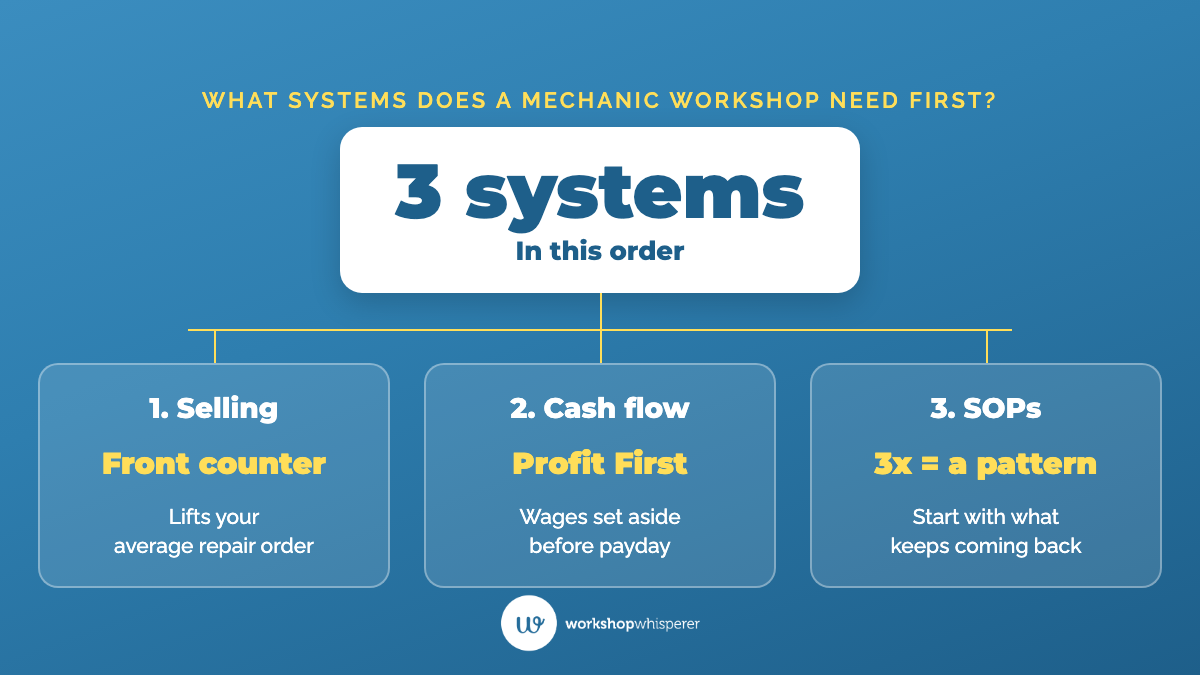
Build the system that brings money in first: how your front counter recommends and prices the work on the cars already in your yard. Then build the system that looks after that money, so wages and bills are covered before you spend a cent. After that, write down the jobs that keep landing on you, one at a time, starting with the problem you've fixed more than three times this month. It's the order we take every new Engine Room client through, and it works the same in a two-bay mechanics workshop as in a ten-bay automotive workshop, or a garage if you're in the UK.
If "get some systems in" has been on your list for years, that's not because you're lazy. You're booked out, and every hour you might spend writing things down is an hour someone needs you on the floor.
How do I know my shop is short of systems?
You already know the signs. You're first in every morning and last to lock up. Your phone goes on your day off. The same questions come to you, from the same people, about the same jobs.
Say a brake job goes out without a road test, and the car comes back. You catch it, have a word with the technician, and in your mind it's sorted. Dean calls that working at the height of the spanner: you fix the problem in front of you, for today, and move on.
Then ask whether it was the first time. Usually it's the third time this quarter. As Dean puts it, "once is an event, twice is a coincidence, but three times is a pattern." Underneath every pattern is a system you haven't built yet. In this case there's nothing written down that says every car gets road tested before it goes back to the customer. The standard lives in your head, and your head isn't in the bay every time a car goes out.
Timing matters too. By the three to five year mark, with a few people on the team, you should be moving out of the dawn-till-dark years. If you're still working that shift by then, it's a systems problem, and it's what we mean when we say a business without systems owns you, while a business with systems sets you free.
Which system should I build first?
Most owners expect the answer to be a manual, a checklist or new software. Start where the money comes in instead.
1. A selling system at the front counter. Technicians are rarely trained to sell, and they rarely enjoy it. But as Dean says, "you're not in the business of fixing cars. You're actually in the business of selling repair work." When you don't trust your own ability to sell, you need to put your trust in a system that does the selling for you.
Inside The Engine Room we call ours the Expert Selling System, and it's the first thing every new client installs. It's a six-step system for recommending additional work in a way that makes the customer more likely to say yes, at your prices, with no need to discount. It works on vehicles already up on the hoist. You're not spending more on marketing, and your labour is already assigned to those jobs. What it lifts is your average repair order, or your average job value if that's what you call it.
It also gives you something you can teach. Somewhere around $40,000 to $50,000 of turnover a month, you're going to need another pair of hands. When you hire that next technician, or your first service advisor (service adviser in the UK, service writer in the US), a written selling system means everyone uses the same language and talks to customers in the same way. Your service advisor still brings their own flair, but they're working from the same page as you, in black and white.
2. A cash flow system that looks after the money. It's module two in The Engine Room, straight after selling, because more money on every invoice doesn't help if it all lands in one account and you run the business on whatever's left over each day.
Dean describes the Thursday scramble. The wages come out tomorrow, the account looks thin, and you start shuffling money from savings or ringing customers about unpaid invoices. Look back and it wasn't the first time. The end of each month is always tight, and it happens on a rhythm. The missing system is a way of allocating money into the right places the day it comes in, before you get the chance to spend it. We use Profit First with every Engine Room client, so the wages are already set aside before payday arrives.
3. SOPs for the problems that keep coming back. Only now do you start writing standard operating procedures, and you don't start with a binder of everything. You start with the one problem you're sick of solving.
What getting the order right is worth (an example, not a benchmark). Say your mechanic workshop sees 40 cars a week at an average job value of $400. If a consistent way of recommending work lifted that average by $40, that's an extra $1,600 a week, or $83,200 a year, from cars that were already booked in. That comes with no extra marketing and no extra hours. Run the same sum on your own numbers, then think about where that money goes without a cash flow system. It lands in the same account as everything else and gets spent before you keep any of it.
Watch this to see why the selling system comes first. In six and a half minutes, Dean and I explain why it's the first system we install in every Engine Room client's shop, and why "my customers are different" doesn't hold up.
How do I write SOPs that my team will actually follow?
An SOP is a written or filmed set of steps for how a job is done in your shop. Keep it plain. Dean breaks every one into three Ts:
- Task. What has to happen, described clearly. It can be as small as changing the toilet roll.
- Team. Who is responsible for it. Without responsibility there's no accountability.
- Time. When it's done: daily, weekly or monthly, and by what time.
Don't write them all yourself. Do a brain dump of everything that happens in the shop, from how to use the coffee machine to how to quote, invoice and follow up a customer. Then explain to the team why you're doing it and how it will benefit them. Hand the writing of each SOP to the person who already does that job, and have them film it while they do it. A video they can pause and rewind will teach far more than a page of instructions.
Know what good looks like before you hand it over. You can't expect anyone to hit a standard you haven't defined. That's especially true at the service desk. You learnt to sell by osmosis over years in the trade, and none of that is easy to explain to someone starting from scratch. The same goes for your apprentices. When the process is written down, they know what's expected of them, even when you haven't been on the floor for a while.
Store them where everyone can find them. A written document in a shared drive works, with videos of jobs in the workshop and screen recordings of how things are done in your management software. Put a review date at the bottom of every SOP and check them once a year. You'll change suppliers and software, and the SOP has to change with them.
Then hold the standard yourself. This is where most systems fail. You can document how to greet a customer, price a job or inspect a vehicle until the cows come home. If you're not following the system yourself, and you're not the one holding the team accountable to it, it means nothing. The owner sets the standard. When you hand SOPs to the team, tell them why they matter: they make the shop more efficient, and hopefully more profitable, and they keep people safe.
As Dean puts it, most owners are short of structure rather than motivation. When everyone knows what step one, two and three look like, the work doesn't depend on anyone feeling like it that day. It gets done because the day is designed to run that way.
Bronwyn and Bodie Geck run BB Garage in Ipswich, Queensland. Before The Engine Room, they described the business as "a hot mess. It was month-to-month, it was chaos, it was pray, hope for the best." They'd "find out at the end of each month if it worked out or not," with "a lot of sleepless nights." The change came from "following all the systems that we created to achieve those goals and following them to a T," and "holding our team accountable and holding ourselves accountable." Today they run a four-day work week with the whole team. Watch Bronwyn and Bodie's story.
If your shop is turning over less than $50,000 a month and you'd rather not build these foundations on your own, Auto Superstars Academy builds them with you, with one-on-one coaching on demand from a business coach who is a current or former auto repair shop owner.
Questions auto repair shop owners ask about systems
What is the most important system in an auto repair shop?
Your selling system, the way your front counter recommends and prices work. It brings in more money from cars already in your workshop, without spending more on marketing. It's the first system every Engine Room client installs, and the cash flow system comes straight after it.
How many SOPs does an auto repair shop need?
More than you'd think. Most owners expect to find ten or fifteen things to document, and it's usually closer to 50 or 100. If you finish one a week, you'll have around 50 by the end of the year. Two a week gets you close to 100.
Do I need systems if it's only me, or me and one other person?
Yes. You might close the shop to take a planned break, and that's fine. Injury, illness and accidents don't wait for a planned break, and that's when a written list of steps keeps things running. And one day you'll want to sell. A business with documented systems is worth more at sale than the one down the road that has none.
Why won't my team follow the SOPs I've written?
Usually because you aren't following them either, or you aren't holding anyone to them. An SOP only comes to life when the owner leads by example and holds the team accountable. Check that each one is easy to find and up to date, then hold the standard every day.
Will new workshop software give me systems?
Software helps you run a system. It doesn't decide how your shop sells, looks after its cash or does a road test. Work out the process first, then use your software to make it easier to follow.
Where to start tonight
Grab a sheet of paper and write down one problem you've personally fixed more than three times this month. Don't pick the dramatic one. Pick the boring one that keeps coming back, the one where you've thought, "I can't believe they're asking me about that again." That's almost always where the missing system is hiding.
Underneath it, write three lines: the task, who owns it, and when it has to be done by. Tomorrow, hand it to the person who does that job and ask them to film themselves doing it. That's your first SOP, and one less problem coming back to you.
Related questions:
- How Do I Delegate When My Team Keeps Making Mistakes?
- How Do I Take a Holiday Without the Shop Falling Apart?
- Working Every Day and Getting Nowhere? How James Got His Shop Running Without Him
See what changes for the people who do this work. On our Our Clients page, auto repair shop owners, named and on camera, tell you what actually changed in their shops and their numbers.
More on this topic: all Systems articles.
Whenever you're ready, here's how we can help.
- Not ready to spend anything yet? Start free with Shop Talk, a 30-day reset for auto repair shop owners on our YouTube channel, and our free resources for auto repair shop owners.
- Running an auto repair shop under $50,000 a month? Auto Superstars Academy builds the foundations, with one-on-one coaching on demand from a business coach who is a current or former auto repair shop owner.
- Over $50,000 a month? The Engine Room changes how the whole business runs, from your numbers to your team, delivered online with one-on-one coaching on demand.