
How Do I Delegate When My Team Keeps Making Mistakes?
Stop correcting the result after the job and start checking the thinking before it. Agree what done looks like, ask your team member how they plan to get there before they pick up a tool, and let them make a new mistake once. When the same mistake turns up three times, treat it as a missing system rather than a bad technician, and write the system.
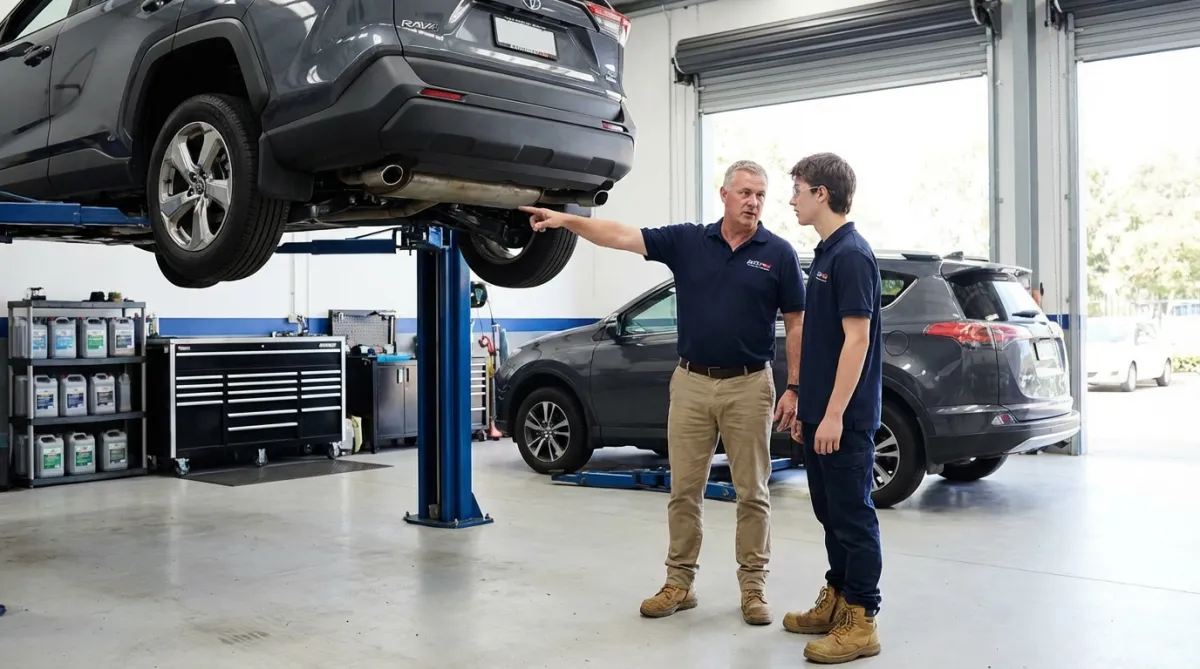
If you've been taking jobs back because it's quicker to do them yourself, that comes from caring about the customer, and it's understandable. The trouble is it keeps you on the floor for good, and it works the same way in any mechanics workshop or garage, whether the job is in the bay or with your service advisor or service writer at the front counter.
Why does my team keep making the same mistakes?
Dean tells the story of one of our Engine Room members who runs a four-bay shop with a solid team and capable technicians. He was still spending his afternoons redoing work and dealing with customer complaints about jobs that had already gone out. He'd fix it, have a word with the team member and make the standard clear again. Three days later he'd see the same result.
He had replaced his technician team twice, and each time the same problems came back with new faces.
After 11 years of running that shop, he had never once had a conversation to find out how his team were thinking about a job before they started it. Every correction was aimed at the outcome, and the thinking behind the outcome was never touched, so it kept producing the same result.
Another new Engine Room member put it plainly: "I don't know what they're thinking until something goes wrong."
That space between what you expect and what your team member understands is what Dean calls the thinking gap. You have a clear picture of what the job looks like when it's done. Your technician has a picture too, and it might be different. A team member can follow every step, tick every box and still have no real idea what the work is meant to achieve. On routine jobs that gets by. On complex repair work it breaks down fast, and the phone call comes to you.
There's a second gap, and it sits with the owner. If you don't know what good looks like in a role, nobody you put in that role can get there. I see this most at the service desk. You've been selling work for years, so you know the small things that make it work, like saying the customer's name back to them when you take a booking. You picked all of that up by osmosis, so it never gets explained to a new starter unless you sit down and spell it out.
And there's the trap of handing a task over and walking away. Dean draws the line like this. Delegation is asking someone else to do a role while you keep watching the results. Abdication is when you dish off tasks with the expectation they're being done, without ever coming back to check what's actually happening. When the mistakes start piling up, it's worth asking which one you've been doing.
How do I stop the same mistake coming back?
We draw three circles for this. The big outer one is the problem, the job in front of you today. Inside that is the pattern, the same problem seen across time. Right in the middle, the smallest circle, is the system that is missing.
The example is one most owners will know. A brake job goes out without the technician road testing the car. You catch it, you have a word, the road test gets done, and in your mind that's sorted.
Then you ask whether it was the first time, and it turns out it was the third time this quarter. That's a pattern, and the reason for it is that nothing written down says every vehicle gets road tested before it goes back to the customer. The standard lives in your head, or it was explained to the technician once, maybe twice, and you can't be in the bay every time a car goes out.
So the fix was never another word with the technician. It's a written procedure that gets followed on every job, whether you're standing in the shop or not. The rule of thumb we use is that once is an event, twice is a coincidence and three times is a pattern, and a pattern tells you a system is missing.
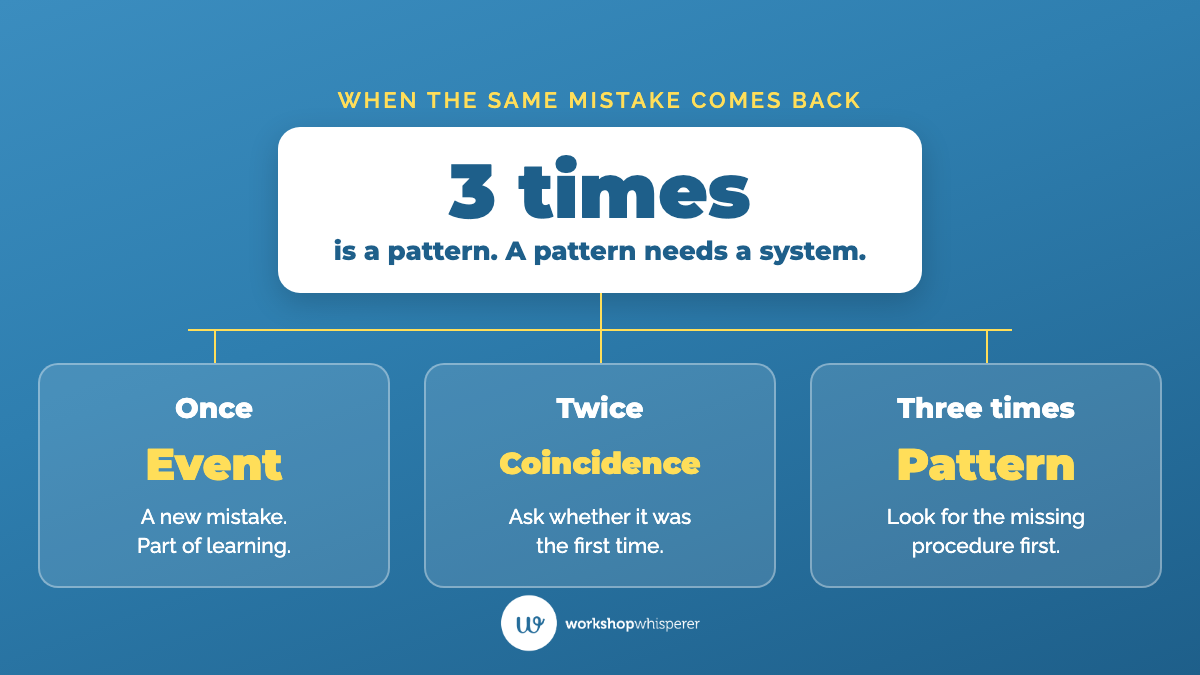
There's a reason the word with the technician doesn't hold. Under pressure, people don't retain much of what they've been told, and Dean puts it at around 90% forgotten within ten minutes. Write the procedure down, or better still, film it while the job is being done. Then you teach the task once and train every team member after that from the same procedure.
What a repeated mistake is costing you. Here's an example to work through with your own numbers. Say a missed step sends one car back three times a quarter, the same as the brake job above. Each comeback takes an hour and a half to put right, and you can't charge for it. At a labour rate of $150 an hour, that's $675 a quarter, or $2,700 a year, in labour you've already paid for and can't bill, on one missed step. Put your own labour rate and your own comebacks into that sum, then compare it with the afternoon it takes to write the procedure down.
How do I hand work over without doing all the thinking for them?
This is the hard part for a good mechanic, because you're good at fixing things. Every time a team member asks you a question and you hand over the answer, you fix today's problem and leave the thinking that caused it exactly where it was. As Dean says, a team that needs the owner to catch their mistakes will always need the owner.
Dean teaches a conversation for this called the Why Loop. It happens before the work starts, it doesn't take long, and you can have it on the workshop floor or at the front counter without booking a meeting.
First, find out how they're thinking.
- "What's the aim?" Ask what the finished job looks like. What does done mean here? Their answer tells you straight away whether they understand the standard.
- "How do you intend to get there?" You're asking for their plan, not a list of steps. Then listen. Don't correct anything yet. The gaps in their plan show you the gaps in their understanding.
- Agree one clear next step they can nail down.
Then, pressure test the plan.
- "Will that get you closer to the result?" This makes the gaps visible to them, not only to you. If the plan follows the procedure and makes sense, tell them so and get out of the way.
- "How else could you do it?" If there's a gap, ask this and wait. Don't rush in to fix it or rescue them. Believe they have another answer.
- "What's your next step?" Now you've agreed how the work will be done, and they did the thinking.
The one exception is risk. If the plan puts someone's life or limb at risk, costs an uncomfortable amount of money or would hand the customer back an unsafe vehicle, you step in before the work starts.
For the questions that come to you mid-job, use the 1:3:1 Method. Your team member brings you one problem, three possible solutions and the one they favour. An apprentice might only manage one solution, and that's fine, because they're still having a go. The hardest part is on you. When you're flat out, the urge is to walk over to the car and do it yourself because you're faster and you know it'll be done right, and every time you give in to it, your team learns to bring the problem back to you.
Steve and Leonie Black run Black's Machinery Repairs in Kingaroy, Queensland. Before they joined us, they were, in their words, "basically just flying by the seat of our pants", with no set processes for anything. Steve never got to the kids' sports days because he was "too busy trying to run the business, micromanage doing everything". With processes in place, he says he's "been a lot more free to delegate work out to other workers that wanted to step up into higher roles". His lesson: "There's a lot of them there that they really want to grow and you've got to help them and let them do that." Not long ago Steve took a day off midweek to take their son fishing, and Leonie says that never would have happened before. Watch Steve and Leonie's story.
Then decide how you'll treat mistakes, and say it out loud. This is how I put it to teams:
"As long as they learn from the mistakes, we are allowed to make mistakes. That's how we learn. But you must learn from them. We can't make the same mistake over and over again. That's not okay."
That only works if you go first. When you get something wrong, put your hand up in front of the team. It shows them it's safe to own a mistake. Then hold the standard, because writing the procedure down is only half the job and the other half is holding people to it. If you'd rather the standard came from someone outside the business, Ultimate Team Advantage is a low-cost program that trains your whole team, from self-leadership to leadership, and leaves you to coach it.
Watch this before your next handover: Dean walks through all six Why Loop questions with the exact wording to use with your technicians (about 45 minutes).
Questions auto repair shop owners ask about delegating when the team makes mistakes
Isn't it quicker to do it myself?
For today's job, yes, but not for next week's. Every time you take the job back or hand over the answer, you teach your team that problems go to you. You stay the bottleneck, and the same question comes back tomorrow.
How many mistakes should I allow?
A new mistake is part of learning, and your team needs room to make one. The same mistake three times is a pattern. At that point, look for the missing procedure before you look at the person.
Should I replace the team member who keeps getting it wrong?
Not until you've closed the thinking gap and given them the training. The Engine Room member who replaced his technician team twice got the same problems with new faces. Some people will show you they're not cut out for the role once you hold the standard. Your job is to make sure they had every chance first.
What if the mistake could be dangerous?
That's where you step in, and you step in before the work starts. When you ask how they intend to do the job, you'll hear any plan that risks someone's safety, a large amount of money or an unsafe vehicle going back to the customer. Correct it then, not after.
Do I need to know the role myself before I delegate it?
Yes. If you don't know what good looks like at the service desk or in the bay, you can't describe it, and your team member can't hit it. Where there's training for the role, do it alongside them so you're both working from the same playbook.
Where to start tonight
Think of one mistake you've fixed more than three times this month. Pick a boring one, the kind that makes you think "I can't believe that's happened again". Write down, in a few lines, what done looks like for that job.
Tomorrow, before that job starts, ask the person doing it one question: "What's the aim?" Then listen to the whole answer before you say anything. You'll learn more about why the mistake keeps happening from that answer than from any job you've redone.
Related questions:
- Why Do I Have to Do Everything Myself?
- What Systems Does a Mechanic Workshop Need First?
- How Do I Save My Mechanic Shop From Closing? Marcus's Turnaround
See what changes for the people who do this work. On our Our Clients page, auto repair shop owners, named and on camera, tell you what actually changed in their shops and their numbers.
More on this topic: all Systems articles.
Whenever you're ready, here's how we can help.
- Not ready to spend anything yet? Start free with Shop Talk, a 30-day reset for auto repair shop owners on our YouTube channel, and our free resources for auto repair shop owners.
- Tired of fixing the same mistakes and repeating yourself? Ultimate Team Advantage is a low-cost program that trains your whole team, from self-leadership to leadership, so the standard comes from someone outside the business and you get to coach it.
- Running an auto repair shop under $50,000 a month? Auto Superstars Academy builds the foundations, with one-on-one coaching on demand from a business coach who is a current or former auto repair shop owner.
- Over $50,000 a month? The Engine Room changes how the whole business runs, from your numbers to your team, delivered online with one-on-one coaching on demand.