
How Do I Take a Holiday Without the Shop Falling Apart?
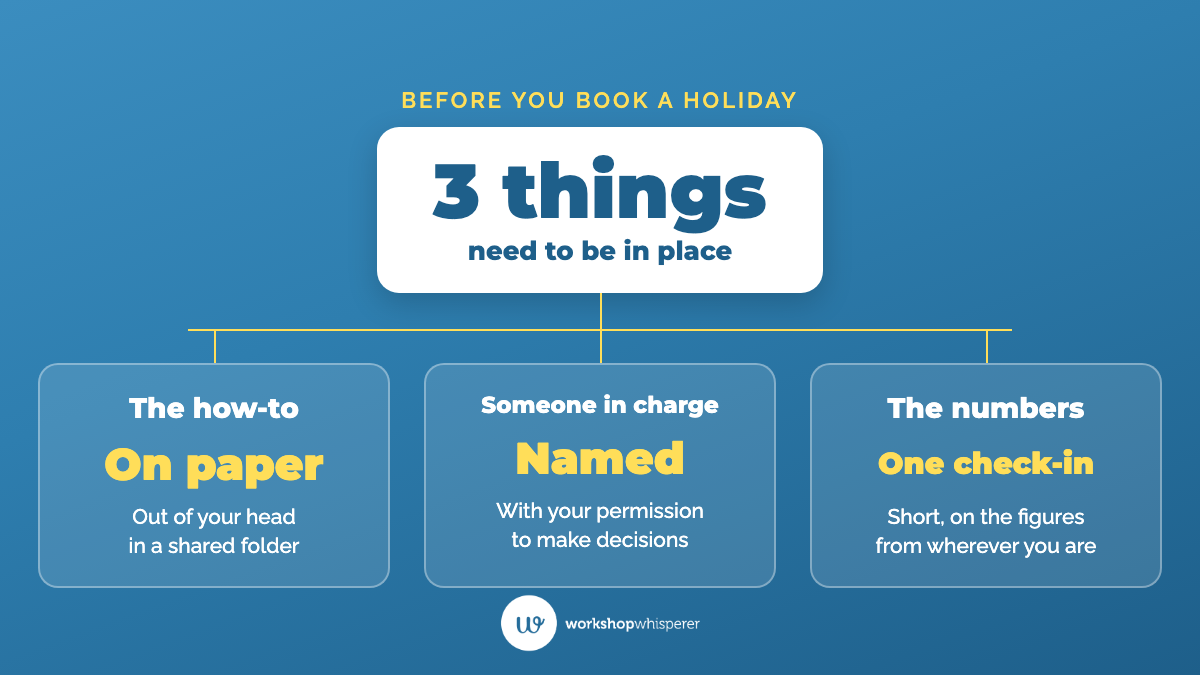
You take a holiday without the shop falling apart by getting the business ready before you book, rather than hoping the phone stays quiet once you've gone. The how-to for every job has to be written down or filmed where your team can find it, not kept in your head. Someone has to be in charge, with your permission to make decisions. You need one short check-in on the numbers while you're away. Then you build up to it, starting with a day off, then a long weekend, then a proper break.
If your last holiday was spent on the phone, it isn't because you're bad at switching off. The business was set up to need you, and that can change.
It works the same whether you run a mechanics workshop in a country town, an automotive workshop in the city, an auto repair shop in the US or an independent garage in the UK.
Why does everything go wrong the moment I leave?
Mick, from Lismore in northern New South Wales, wrote in to our podcast after what was meant to be a few weeks away with his family. Instead he got "around a dozen phone calls per day from team members with all sorts of issues." His words: "Our billable hours fell through the floor." Several cars came back afterwards with shoddy workmanship from while he was away.
I hear this story all the time, and most of the owners who join us in the Engine Room come to us with this very problem. When Mick was in the shop, he was the Oracle and everything ran smoothly. When he walked away, he took the knowledge with him. If you haven't started passing your skills on to your team, they'll still need you when you're not there.
Dean, who hosts Talking Shop with me, puts it plainly: if you don't have a documented how-to guide for your business, then you are the how-to guide, and you can never take a break.
Sometimes it isn't the phone that tells you. Nathan, from Jervis Bay, had been in business for over 15 years and had hardly ever taken a break. His wife was pregnant, a close family member was seriously ill, and they wanted some time together. "Whenever we've done this for even just a day we come back to camera recordings of staff slacking off and everything in shambles."
I know how that feels, and I still told him the truth, which is that if your team behaves like that when you're not there, it's on you. Something is missing in the culture, in the systems, or in the consequences. When I ask owners what happens to someone who slacks off while the cat's away, the answer is usually nothing. Be firm about it, even though it's hard when you want to be friends with your team.
If you're three to five years in, with a few people on the team, and you're still the first one there at dawn and the last to lock up, that tells you something too. You've got a systems problem, and it's a phase we want you moving through.
What has to be in place before I book?
Get the how-to out of your head. For a week, keep a sheet of paper on you. Write down every time you change task and every time you're called over to solve a problem. At the end of the week, look back over it. Plenty of it will be work you have skilled people paid to do, and you're doing it out of habit rather than necessity. Then document one procedure a week, starting with the questions that come up most. You don't need to type it all out. Film yourself doing the job on your phone and talk through each step, then save it in a shared folder your team can reach.
Cover the people who hold the keys. Your key person risk might sit with your best diagnostic technician or with your service advisor (service writer in the US, service adviser in the UK). In a small shop, if the person on the front counter isn't there, a technician comes in off the floor to do the invoicing. That's like taking a fish out of water and expecting it to walk on land. I've seen businesses where someone went on holidays without a handover and it hit the fan, because nobody knew their procedures. When you're the one who goes, it works exactly the same way.
Teach your team to bring you answers. Your team comes to you because you answer, and you answer because it feels faster than letting them work it out. Turn that around now, while you're still there. For the next couple of months, anyone who brings you a problem brings a suggested solution with it. Ask them how they'd handle it if they couldn't reach you. Set times when you're available, even when you're in the building, so they get used to deciding without you. It will be frustrating at first, and it eases as their confidence grows.
Name who's in charge, and how you'll check in. Before you go, your team needs to know who makes the call when something goes wrong, and what they're allowed to decide. Agree one check-in on the figures and keep it short.
A worked example. These are illustrative numbers, so put your own in. Say you're away for two weeks, ten working days, and like Mick you get a dozen calls a day. At ten minutes a call, that's two hours a day on the phone, or twenty hours of your holiday. Now say your four technicians each lose one billable hour a day while they wait for answers. That's 40 hours over the fortnight. At a labour rate (labor rate in the US) of $150 an hour, that's $6,000 in labour you didn't sell, before you count a single comeback. Put your own call count, team size and rate in, and you'll see what the time spent documenting before you go is worth.
How do I build up to a real holiday?
Start smaller than you think. Chad and Sarah own a general repair shop in Western Australia. When they started, it was the two of them and an apprentice. They came through our online Auto Superstars Academy and systemised the business, one piece at a time, until they had four technicians and the shop no longer leaned on them. Then they packed their three young girls into the camper and drove across the country for six weeks.
Chad reckoned he'd had three phone calls the whole time. They touched base most days to go over the figures, and the business made money while they were gone. Sarah summed up what had changed: "Everything's got directions. I suppose everything's kind of out of your head and on paper."
When I asked Chad what he'd say to an owner who doesn't think their shop would survive without them, he was honest that it took them years. His advice was to start with a long weekend, or a day off during the week. "The business will be there when you get back. It's not going to fall apart in one day or two days." Theirs didn't fall apart in six weeks.
Ange and Alan Wall run Accelerate Automotive in Coopers Plains, Brisbane, with Carl Millward. For years their only real break was the Christmas shutdown. "We've always been lucky that we closed for two weeks at Christmas, but that was your holidays." Once they joined the Engine Room, they added one extra week. Then came a week at our Hamilton Island event, and after that Ange and Alan took another two weeks at the start of the year. "So, we're nearly having, you know, five, six weeks off a year." They put it down to "the work on the system, the work with the team." Watch Ange, Alan and Carl's story.
Laura, who owns a business in Queenstown, New Zealand with her husband Barry and now coaches with us, told me about the day Barry came in and said they were going on holiday the following week. They told the team on the Monday, and the team said, great, go for it, enjoy yourselves. The systems were in place for that to happen.
Decide what the time off is for. Most of us move away from pain instead of towards something we want. Write down how many holiday days a year you want, whether you'd like a big family trip each year, and what time you want to be home at night. Once it's on paper, you can work backwards to the profit and the team that will pay for it.
Use the breaks you already have. If you're a small team, take every public holiday and the Christmas shutdown as actual rest, not catch-up time. If you're a one or two person shop that closes up when you go away, that's a planned break, and it's fine. Dean's caution is about the unplanned ones. Injury, illness and accidents don't book ahead, and a written how-to is what keeps the doors open when one of them arrives.
Most people go into business for themselves for the chance at freedom, not for a job they happen to own. I started our destination event on Hamilton Island because I could see how many auto repair shop owners weren't getting away at all. Getting a business systemised is one of the first things we work on in The Engine Room, and for a lot of owners that trip is their first holiday in years.
Watch this before you book your next break. In five minutes, Dean and I talk through why you can never take a break while the how-to guide for your shop lives in your head, and what changes once it's written down.
Questions auto repair shop owners ask about taking a holiday
How long before I can take a proper holiday from my shop?
When owners join the Engine Room, we tell them to expect 12 to 15 months to systemise the business properly, because most come to us with no written systems at all. You don't have to wait for the end of that. Take a day off as soon as a few key procedures are written down, then stretch it as your team proves they can handle it.
What if my team slacks off while I'm away?
Look at what's missing before you look at who to blame. It will be something in your culture, your systems or your consequences. Make the standard clear, make it clear what happens when it isn't met, and follow through when you get back.
Should my team be able to call me while I'm on holiday?
Agree one short check-in on the figures, and send everything else to the person you've left in charge. If the phone does ring, write down what it was about. Each call is a procedure you haven't documented yet.
Will my work dry up while I'm away?
It shouldn't, if the basics keep running. On average, 18% of your customers won't come back to you this year, so your service reminders, your follow-up calls and some marketing need to keep going whether you're there or not. Check they will before you leave.
I'm a one-person shop. Do I need any of this?
If you close up when you take a holiday and that suits you, that's a fair choice. Document the essentials anyway. A holiday can be planned, but an injury or an illness won't wait for a quiet week.
Where to start tonight
Open your diary and book one weekday off in the next month. Tomorrow, tell your team the date and who's in charge that day. Between now and then, keep a sheet of paper in your pocket and write down every question you're asked. The day before you go, sit down with the person in charge and work through that list together. When you come back, whatever went wrong becomes your next procedure.
Related questions:
- What Systems Does a Mechanic Workshop Need First?
- How Do I Delegate When My Team Keeps Making Mistakes?
- How Do I Save My Mechanic Shop From Closing? Marcus's Turnaround
See what changes for the people who do this work. On our Our Clients page, auto repair shop owners, named and on camera, tell you what actually changed in their shops and their numbers.
More on this topic: all Systems articles.
Whenever you're ready, here's how we can help.
- Not ready to spend anything yet? Start free with Shop Talk, a 30-day reset for auto repair shop owners on our YouTube channel, and our free resources for auto repair shop owners.
- Over $50,000 a month and ready to step back? The Engine Room changes how the whole business runs, from your numbers to your team, delivered online with one-on-one coaching on demand.
- Running an auto repair shop under $50,000 a month? Auto Superstars Academy builds the foundations, with one-on-one coaching on demand from a business coach who is a current or former auto repair shop owner.