

How Do I Hold My Team Accountable Without Micromanaging?
You hold your team accountable by doing three things well. Make the standard clear, make the score visible to everyone, and deal with any gap quickly and calmly. Get those right and you can stop watching over shoulders, because the standard and the scoreboard do the checking for you. When those three things are missing, micromanaging is what fills the gap.
If you've slipped into hovering over your team in the mechanics workshop, it's rarely because you're a control freak. More often you've been burnt. You were short-staffed for too long, or you carried people who needed talking through every step.
The method below is the same whether you run a mechanical workshop, an automotive workshop or a garage.
Why do I end up hovering over my team?
Darren, from Toowoomba in Queensland, wrote in to our podcast with a problem plenty of owners would love to have. He'd finally filled every seat on his team, and had no clue how to manage the workload without it turning into chaos.
What I told Darren is what I'd tell you. The need to micromanage is a stress response. For a stretch of time you didn't have enough people, or the people you had weren't skilled enough, so you were always watching over them and talking them through every step. Then the seats fill up and the habit stays.
Dean breaks control down into three needs: certainty that nothing will blow up, significance (the feeling that the business still needs you), and safety (if I stay involved, nothing goes wrong). Wanting all three is normal. The trouble is that every time you check someone's work, fix their problem or rescue them, you strengthen the wiring in their head that says problems go to the boss, and the wiring in yours that says you have to fix them. As Dean puts it, "if every problem has to come to you for a solution, if no decisions can be made without first going through you, then you become the biggest bottleneck to your auto repair shop's growth."
Hovering also costs you the time you delegated to get back. Hand a technician the vehicle inspection, then hang over their shoulder, and you haven't bought back any time to do something else that makes money. So keep the standard high, and let a clear standard and a visible score do the checking instead of you.
What does real accountability look like in my shop?
Accountability has three parts.
1. A standard everyone can see. Delegation fails when an owner hands a job over without the framework to do it well. Before you step back, make it clear what done looks like and what quality you expect, then ask your team member to tell you how they'll deliver it. Your inspection checklist is a standard, whether it has 44 points or fewer. So are your KPIs. Dean calls these the goalposts: "a clear standard, a clear target, a clear goal". Picture a technician who thinks billing 50% of their available hours is a good day. The benchmark Dean uses sits around 80%, so the gap isn't laziness. Nobody has told them the target.
2. A score your team keeps themselves. Put a whiteboard on the workshop floor, somewhere every team member can see it. Give each technician a section for each day, with the hours they have available to sell. When a job is ready for invoicing, the technician walks up and updates their own total. If they've already got two hours up and that job was 1.5 hours, they change it to 3.5 out of 8. Your service advisor doesn't do it for them, and neither do you.
No one wants to be the lowest number on the board, so you get some healthy competition. It has to stay ethical: the goal is selling every hour the work genuinely took.
Then the board feeds two seven-minute huddles, one in the morning and one after lunch. That's where you acknowledge the people doing well and the ones stuck on a two-day job, and ask the person who's slipping what got in the way. Those two short conversations mean you're not looking over shoulders for the rest of the day.
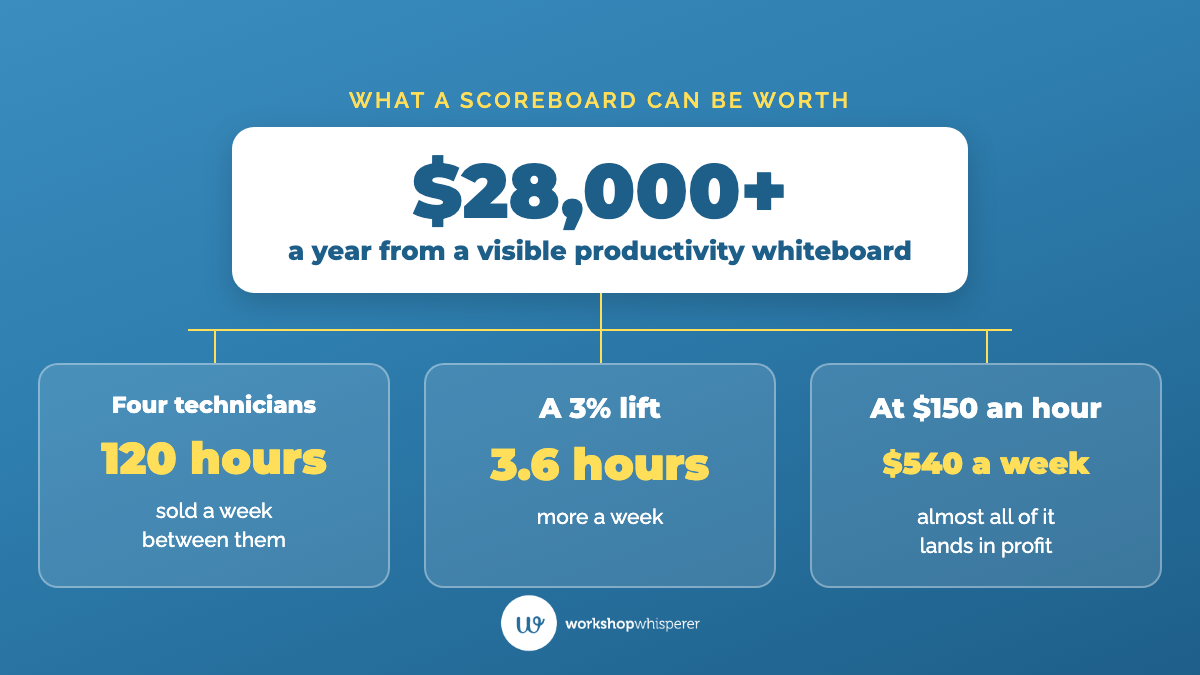
What a scoreboard can be worth (an example). In my experience, a visible productivity whiteboard gives you at least a 3% lift in productivity, because the team knows the hours are seen. Take four technicians selling 120 hours a week between them. A 3% lift is another 3.6 hours a week. At a labour rate of $150 an hour, that's $540 a week, or more than $28,000 over a year. Your wages haven't changed and the hours are already being worked, so almost all of it lands in profit. That's an example shop, not a client result, so run it with your own hours and labour rate (labor rate, if you're in the US).
3. A response that's the same every time. This is the part that's easiest to let slide when you're flat out. Your good team members will watch what you tolerate rather than listen to what you preach. A scoreboard brings the coasters out into the open. Winners love KPIs and love showing they can hit them. The people who coast along for a pay cheque won't like a public score, and that's worth knowing early.
Dean describes what happens when you let it slide. Your best technician starts thinking: "Why am I busting my backside here to produce better or to deliver better quality work when I can see Dave on the hoist next to me that's only working half as hard, but he's making the same amount that I am." First your A players drop to the lower standard, then they leave. In Dean's words, "the standard you accept is the standard you set."
The same goes for every new system. Stop enforcing it the moment you get busy and your team gets change fatigue. Next time you bring in something good, they won't pay attention, because they know it'll only last a few days.
If you've said the same things so often you feel like a broken record, it can help to have someone from outside say it. That's why I built Ultimate Team Advantage. You hire them, I train them, and you coach them.
How do I step back without the standards slipping?
Make them bring a solution with the problem. We call it the 1:3:1 Method. When a team member comes to you unsure of their next move, they bring their one problem, three potential solutions, and the one they favour. You counsel them through it. An apprentice might only manage one solution at first, and that's fine, because they're still having a crack at it. The discipline is on you: when it's flat out, don't override it and walk over and do the job yourself because it's faster. Over time they learn to trust their own judgement and stop coming to you for every fix. Let them make minor errors, and correct them through the 1:3:1.
Give decisions away inside a boundary. Dean calls these decision rights. Your service advisor, or service writer as the role is called in the United States, might be cleared to fix any customer complaint up to $250 without coming to you for permission. If they need to use it on every customer, you have a quality problem.
Check in at agreed moments. Agree up front when you'll look at progress, and don't watch in between. Rather than fixing mistakes at the end, ask your team how they'll avoid them along the way.
Know the difference between performance management and micromanaging. If someone hasn't yet shown you they can follow the process to the standard, following them more closely is performance management, and it's your job. Once they've proven they can, staying involved is micromanaging.
Make sure you aren't the one breaking the system. One of our Engine Room members ran a quick finance check and found that the biggest discounts in his business were coming from him. His service advisor was invoicing exactly to the agreement. He was walking back in and discounting over the top. Owners are the number one culprit for unnecessary discounting, and that's micromanaging that costs you money.
Follow through on repeat behaviour. If you've got repeat offenders who waste time, and you're not holding them accountable, then that's on you, not on them. When the huddle conversation doesn't change anything, it moves to a one-on-one in your office, and if it keeps happening, to a more formal process. The ultimate consequence of repeat behaviour is their job. That's hard to say out loud when good technicians are scarce, but a passenger on your bus with a poor work ethic costs you more than an empty seat.
Done well, this ends with your leaders holding the standard for you. One of our Million Dollar Mechanics Boardroom members messaged me about a win. A written warning had been given in his business, and the win was that he didn't give it. His leaders, the middle managers we'd spent a couple of years growing into the role, ran the whole performance process themselves. No one likes a written warning, but it's a bloody great win when a plan comes together and your leaders are firing. It took a couple of years, and it started with close supervision before his leaders could run it without him.
James Walker owns Ballarat Roadworthy Centre in Ballarat, Victoria, with a team of seven. When he took over, "I had no business experience. I didn't know how to treat my team." Asked what he took most from The Engine Room, he said accountability "for myself", and he's honest about why: "you sort of have a high turnover rate and you wonder why people don't like to be working for you and it's usually yourself in the end." With systems in place, he started to "pass on a bit more accountability to everyone else in the team", and they stepped up. Now, in his words, "I can go away and the business still runs." Read James's story.
Watch this if you've ever handed a job over and then hovered. In under nine minutes, Dean and I walk through why delegation fails, how to agree what done looks like, and where performance management ends and micromanaging begins.
Questions auto repair shop owners ask about holding their team accountable
What's the difference between accountability and micromanaging?
Accountability is a clear standard, a visible score and a consistent response when someone falls short. Micromanaging is staying involved in a job you've delegated to someone who has already shown they can do it.
How often should I check in on my team?
At agreed moments, not all day. A seven-minute huddle in the morning and another after lunch covers most of it. Bigger or repeated problems go to a one-on-one, rather than waiting for a quarterly review.
What if my technicians push back on a scoreboard?
It's your business, and if you decide this is how it's done, the team plays by the rules. Your best people usually love it. Someone who fights a public score hard is often hiding something worth knowing.
My team brings me every problem. How do I stop it?
Use the 1:3:1 Method: one problem, three potential solutions and the one they favour. Hold to it on busy days too, because every answer you hand over trains them to come straight back.
What do I do when someone keeps missing the standard?
Make sure they've had the training and know the standard first. Mistakes are how people learn, but they have to learn from them. If the same mistake keeps happening after that, take it out of the huddle and into a formal conversation, and be willing to follow it through.
Where to start tonight
Order a whiteboard. A mobile one on wheels works well, and it costs a few hundred dollars. Draw up a section for each technician with the hours they have available each day, and tomorrow morning take ten minutes to show the team how it works: job finished, card finalised, walk up and update your own number. Then run your first seven-minute huddle off it.
Related questions:
- How Do I Deal With an Underperforming Technician?
- Do I Need a Business Coach for My Mechanic Workshop?
- How Do I Stop Winging It in My Auto Repair Shop?
See what changes for the people who do this work. On our Our Clients page, auto repair shop owners, named and on camera, tell you what actually changed in their shops and their numbers.
More on this topic: all Performance articles.
Whenever you're ready, here's how we can help.
- Not ready to spend anything yet? Start free with Shop Talk, a 30-day reset for auto repair shop owners on our YouTube channel, and our free resources for auto repair shop owners.
- Tired of sounding like a broken record with your team? Ultimate Team Advantage is a low-cost program that trains your whole team, from self-leadership to leadership, so the standard comes from someone outside the business and you get to coach it.
- Running an auto repair shop under $50,000 a month? Auto Superstars Academy builds the foundations, with one-on-one coaching on demand from a business coach who is a current or former auto repair shop owner.
- Over $50,000 a month? The Engine Room changes how the whole business runs, from your numbers to your team, delivered online with one-on-one coaching on demand.