Do I Need a Business Coach for My Mechanic Workshop?
Your mechanics workshop needs a business coach when what you're doing has stopped working and you can't see why from where you stand. If you're busy but the money isn't there, if your plan is sitting in a drawer, or if you're lying awake working out how to pay the team, a good coach will get you out faster than you'll get out alone. A good coach has run an auto repair shop, can show you results from shops like yours, and will hold you to the work.
If you've been weighing it up for a while, you're in good company. Most of us went into business on our own because we didn't want to answer to anyone, so asking for help doesn't come naturally.
You may well work it out on your own in the end. What a coach changes is how long it takes, and when the money is tight, every month you wait costs you.
How do I know if my auto repair shop needs a business coach?
Dean puts it this way. If we could watch you while you slept, you wouldn't be sleeping. You'd be lying awake worrying about how you're going to pay the bills, the team and the suppliers, and whether you'll make it to next month. On the outside you're putting on a brave face. On the inside you feel like a fraud, and you're scared someone's going to find out.
That's the far end. Most owners who need help aren't there yet, and the signs are quieter:
- You're flat out and there's nothing left over. The turnover looks strong at the end of the year, there's no money in the bank, and you can't answer the question "where's all that money gone?"
- You keep trying new things and nothing sticks. Another marketing campaign, another way of selling, another job ad on another platform. Dean calls this desperation, and if it goes on long enough it turns into agitation that your team and your customers can feel.
- Your plan lives in a drawer. Plenty of owners write a business plan once. It sits on the desk for a week, then something gets put on top of it, then it goes in the drawer, and that's the death of it.
- You're working it out from scratch. Nicola Van Heunen at Coastal Autos in New Zealand built every system in her business herself. "I had no idea what KPIs I should be tracking or what targets I should be aiming for," she told me. "I was really like the blind leading the blind."
- You're getting through one day at a time. Brett and Ruth Gillard at Sherson Automotive said that before they started with us they were "coping financially and strategically day-to-day, literally just going from day to day."
If two or three of those sound like your week, Dean's first step applies, and it costs nothing. Admit that what you're doing isn't working. Dean and I have both had to say "I think we're the problem" more than once.
What should I look for in a business coach for an auto repair shop?
You already have coaches. Dean's point is that every one of us does, and most of them are what he calls "friend-tors". They're well-meaning people who tell you what they'd do in your position: a good friend who runs a removalist business, or someone on a salary who has never had to make payroll. They mean well, but they're the wrong people to ask, and most of us have gone to the wrong person for the right advice at some point.
A mentor is different, and here is what to look for:
They know your industry. Your accountant matters, and you should have a good one. But as Dean says, accountants are specialists in looking backwards, at work you've already done. A coach looks forward, at the strategies and systems that will move the numbers next quarter. Ange Wall put it in mechanic's terms when she was asked what she'd say to someone thinking about getting a coach: "Your customers don't know how to look after cars." They come to you for that, and running the business at a high level works the same way. You go to someone who works with automotive workshops every day.
They can show you results. Dean learned this early: "Find the person who's got the results you want and pay them to teach you how they did it." Ask any coach to show you shops like yours that they've helped, with real names and real numbers.
They won't pat you on the shoulder. A good coach is empathetic to the situation you're in. Then, in Dean's words, instead of saying "there there, it'll be okay", they lay out the strategies, systems and processes that move you from where you are to where you want to go.
They'll come and find you when you hide. This is the part people don't expect. Plenty of owners say they want accountability, then go quiet the moment the conversations get difficult. When our clients go missing, we go and find them, and we remind them why they joined.
Dean and I have lived both sides of this. We were once part of a generalist business coaching program, and we learned a lot there. When we switched to a mentor who works only in our industry, the results were night and day. That mentorship became the single biggest investment we made in our business every year.
It's why every coach at The Workshop Whisperer is a current or former auto repair shop owner. In 13+ years we've helped more than 10,000 auto repair shops across five countries, and our clients have generated over $175 million in additional profit.
What does it cost to keep waiting?
When someone asks us what a program costs, we ask a different question back. What's it costing you not to do it? As Dean says, ignorance and knowledge both have a cost. Ignorance usually costs far more, personally and financially, and some of it lands on your family.
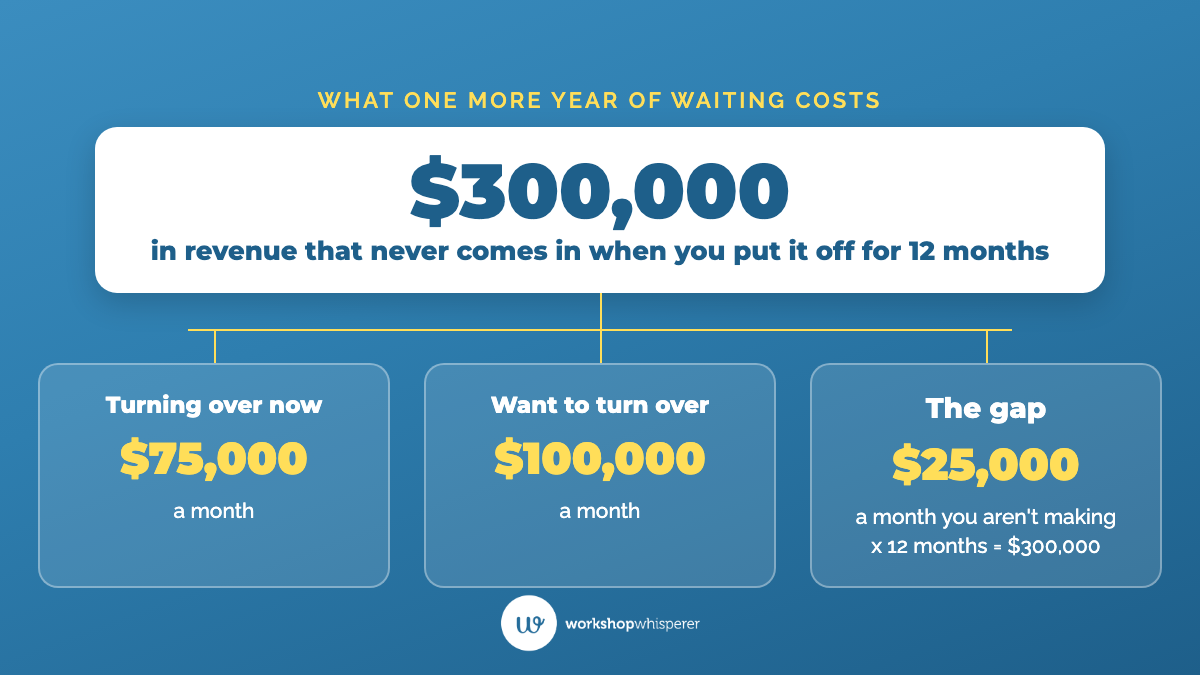
What waiting costs, as an example. Owners often come to us with a number in mind: "We're turning over $75,000 a month, and we want to be turning over $100,000." That's $25,000 a month you want to make and aren't making. Put it off for 12 months and that's $300,000 in revenue that never comes in. That's revenue, not profit, but it shows you how big the gap gets when you leave it another year.
I'll be honest about the other side too. If everyone knew how to get themselves from $75,000 to $100,000 on their own, and do it profitably, we wouldn't exist. Some people take years to decide, and that's okay, because the decision is always yours to make. What I'd point out is that "I'll do it once this happens" is rarely only about coaching. The way you do one thing is the way you do everything.
Brad Lyons at Lyons Mechanical, in Mansfield on the south side of Brisbane, watched what we were doing for years before he joined. "Like all mechanics, I probably thought I knew better," he said. "I used to think that I was a pretty bit of a smart ass that we survived for 20 years and we're doing okay." He did our 8-week course and came to events, and when it came to The Engine Room, "I fought it for as long as I could." About 12 months in, he said, "I've gone from working every day, working back at night, doing stuff" to having "trouble filling in a couple of the questionnaires on what I actually did during the day." Watch Brad's story.
At Coastal Autos, Nicola's husband had come home saying "I'm done, I'm selling." They turned it around once the owners stopped waiting and asked for help.
One of our first clients was two weeks away from shutting his doors. Five years on, Dean told the story of him moving into a purpose-built facility three to four times bigger than the one he started in. That's what a good coach gives you. As Dean says, their long road can become your shortcut.
Whether the fee pays for itself comes down to the work you do between sessions. I've covered that, with named client results, in whether business coaching is worth it for an auto repair shop.
If you're weighing it up, watch this first. In about 15 minutes Dean walks through the four people every auto repair shop owner needs in their corner, from the accountant to the coach, and why a friend-tor isn't one of them.
Questions auto repair shop owners ask about business coaching
What's the difference between a business coach and my accountant?
Your accountant looks backwards. They work with the numbers from work you've already done, and they keep you compliant. A business coach for an auto repair shop looks forward: the pricing, the team and the systems that will change next quarter's numbers. You need both, and the best accountants work alongside a coach rather than instead of one.
Can I work it out on my own?
Some of it, yes. You can block out half a day every 90 days to redraw your business plan, and you should. What's hard on your own is seeing your blind spots and holding yourself to the plan when you're busy. A coach who has run a shop has already made the mistakes you're about to make.
Should my business coach have owned an auto repair shop?
It helps enormously. A generalist coach can teach you good business habits. A coach who has run a garage of their own knows what a fair labour rate looks like, why technicians push back on time clocking, and what to say to a customer about diagnostics.
How much time does business coaching take each week?
Plan on two to four hours a week working on your business, plus the coaching sessions themselves. That's the figure Nicola Van Heunen gives owners from her own experience. If you can't find that time yet, finding it is your first job.
I've been thinking about it for years. Is it too late?
No. Wayde Simpson at Simpson Automotive in Mackay decided he needed a coach after almost 20 years in business. Another owner took 11 years to go from downloading one of our ebooks to joining. Earlier is always better, but what matters most is that you're ready to do the work when you start.
Where to start tonight
Write down two numbers: what your shop turns over in a month now, and what you'd like it to turn over. Take the gap and multiply it by 12. That's what one more year of working it out alone costs you.
Related questions:
- What Does an Auto Repair Business Coach Actually Do?
- How Do I Hold My Team Accountable Without Micromanaging?
- How Do I Stop Winging It in My Auto Repair Shop?
See what changes for the people who do this work. On our Our Clients page, auto repair shop owners, named and on camera, tell you what actually changed in their shops and their numbers.
More on this topic: all Performance articles.
Whenever you're ready, here's how we can help.
- Not ready to spend anything yet? Start free with Shop Talk, a 30-day reset for auto repair shop owners on our YouTube channel, and our free resources for auto repair shop owners.
- Running an auto repair shop under $50,000 a month? Auto Superstars Academy builds the foundations, delivered online, with one-on-one coaching on demand from a business coach who is a current or former auto repair shop owner.
- Over $50,000 a month? The Engine Room changes how the whole business runs, with one-on-one coaching on demand, group sessions over Zoom and three two-day intensives a year.