Who Is the Best Business Coach for Auto Repair Shops?
The best business coach for an auto repair shop is one who has owned an auto repair shop, works from financial benchmarks built for this industry, gives you one-on-one help when you need it, and can name clients whose shops changed because of it. If a coach can't show you all four, keep looking.
If you've been burnt by advice before, being careful is the right instinct. I'm biased, of course, because I run The Workshop Whisperer. So rather than tell you we're the answer, I'll give you the four tests and hold us up against each one, and you can use the same tests on any other coach you're talking to.
Why does it matter whether my coach has owned an auto repair shop?
Because the problems in a mechanics workshop don't look like the problems in a café or a plumbing business, and a coach who has never lived them won't recognise them when you describe them.
I learned that the hard way. When my husband and I took over our shop, GS Mechanical, it was a rundown business. We were struggling as business owners and we were struggling as a married couple. When I went looking for help in the business mentoring space, there wasn't really anybody out there that understood the nature of the industry, or the problems we were experiencing, or had any real experience of getting out of them. So after a lot of trial and error, we coached ourselves out of that struggle street position.
That's why The Workshop Whisperer exists, and it's why every coach on our team today is a current or former auto repair shop owner.
That doesn't mean your coach has to be a mechanic. What matters is that they understand the business side of a shop. Jeff Hazzeldine, who owns SCS 4WD Centre in Melbourne, was the very first client of The Workshop Whisperer, and he's one of our longest-serving Engine Room clients. When he first saw our ad, he assumed I was a spokesperson and he'd end up dealing with someone else. Then we talked. He told me later that he was blown away that I understood an industry I'd never worked in on the tools.
Jeff had been a mechanic by trade, then a service advisor and service manager in a dealership. He thought owning a shop would be more of the same. It wasn't. "There was so much more behind the scenes I didn't know," he said. Creditors, quoting, what it actually cost him an hour to run the shop. Before he found us, he'd had to sell a house to keep the business going.
The way he put it, the mechanics take care of the cars. It's "the backside of our businesses," he said, where they all suffer.
What should a good business coach give me?
Two things above everything else: numbers you can measure your shop against, and someone to talk to when you're stuck.
Benchmarks built for auto repair. A generic business coach can tell you to grow your revenue and cut your costs. A coach who knows this industry can tell you what your numbers should be, and which one is out.
Cassie and Josh run a shop together, and they have five kids at home. Before they joined The Engine Room, they sat down with a generic business coach while they made up their minds. I asked Josh what made the difference. It was "having those industry specific metrics to know where my target should be," he said. A generalist, he reckoned, would give them "generic basic indexes" to follow. He'd been in business for ten years and only found out after joining that he'd "been winging it."
Bill owns Ron Hill Automatics in Maroochydore, Queensland. It's been going for 43 years, with about five techs, three in admin and seven hoists, and it's won many business awards. Even so, "over the years we have had the odd business coach, but nothing industry-specific," he said. He'd ask business coaches and accountants where his gross profit percentage should sit for a shop like his. After working through one of our courses, his words were: "Now I've got some really good tools. I've got some really good line in the sand." Watch Bill's story.
At The Workshop Whisperer we work our clients towards 15 benchmarks of our own, financial metrics built only for auto repair shop owners. I'll share one of them here, because it shows why industry numbers matter.
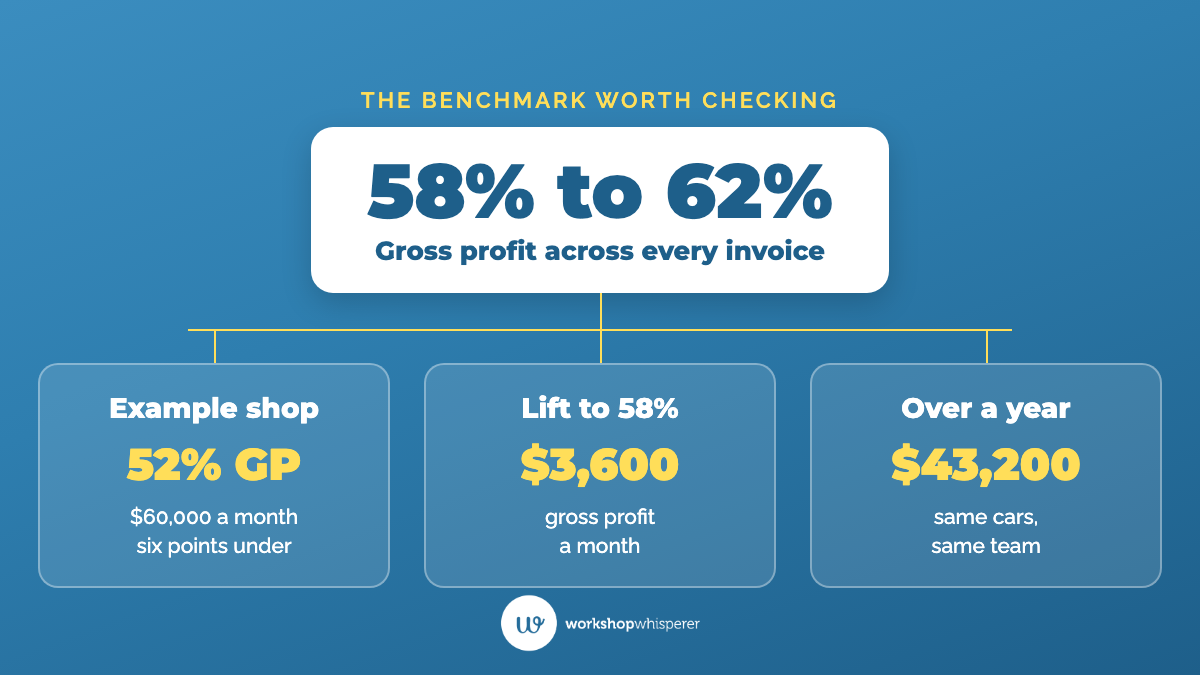
Across every invoice in your business, your gross profit should sit between 58% and 62%. If it's lower, there are only two places to look: your labour rate (labor rate, if you're in the United States) or your parts margin.
What that one benchmark is worth. This is an example, using my own arithmetic. Take a shop turning over $60,000 a month with gross profit sitting at 52%. Lifting that to the bottom of the range, 58%, is six percentage points. Six percent of $60,000 is $3,600 a month, or $43,200 a year in gross profit, from the same cars and the same team. A coach without the benchmark wouldn't know to look. Run the same sum with your own turnover and your own gross profit.
One-on-one help, when you need it. A webinar or a course on its own can't see your shop. Plenty of our clients are still on the tools, so for some of them coaching means 30 minutes, three times a week. They log into our online university and book a 20-minute tune-up call on demand, where we work on the one next thing that will move the needle for them. Others make our Wednesday webinar the priority, and watch the replay when a tech is off sick and they end up back on the tools.
If your shop turns over more than $50,000 a month, The Engine Room gives you all of that in one place, with one-on-one coaching on demand, group sessions over Zoom and three two-day intensives a year.
Watch how a coach handles your problems, too. Cassie told me what she valued most. When she brought me personal issues, "instead of your judgement back to me you ask me questions to make me think for myself." That's worth looking for, because a coach who helps you work it out yourself leaves you able to handle the next problem without them.
How do I check a coach's results before I sign up?
Ask for names, and ask for the before and the after.
A result with no name on it is hard to trust, and so is a result with no starting point. You want to hear from owners who sat where you're sitting, and you want to know how far they travelled.
Cassie and Josh's bottom line went up roughly 50% in their first six months with us, and then by about another 75% on top of that over the following 12 months. Josh's words: "by amounts that I didn't even know were possible." Cassie's measure was different. Josh, she said, "has become a different person." Less stress at work meant less stress coming home to the family.
Jeff went from selling a house to save the business to sharing his own mistakes with other members, so they don't have to go through what he did. He started with the eight-week online program we ran at the time, and said it had paid for itself by week four, once he knew how to mark up his parts, set his labour rate and work out his break-even. Later, inside The Engine Room, his team hit 110% productivity, one technician down, and came within about $2,000 in gross of a normal month with two people on the floor instead of three.
Another of our clients, four years in when she recorded her story, had looked at other coaches and generic business models before she came to us. Her verdict was that this was "so specific to our industry and it just breaks through the mumbo jumbo. I don't have to go to someone else and then work out what I need from their program."
Then look at the track record behind the coach. We're the #1 business coaches for auto repair shops. In 13+ years we've helped more than 10,000 auto repair shops across 5 countries, and generated $175 million in additional profit for our clients. We work in auto repair and nothing else.
Every one of these results came from the owner making changes in their own shop. So when a coach shows you a result, ask what the owner had to do to get it.
Watch this to hear it from two owners who looked elsewhere first. In about five and a half minutes, Cassie and Josh explain why they chose an industry coach over a generic one, what happened to their bottom line, and what they'd say to anyone sitting on the fence.
Questions auto repair shop owners ask about choosing a business coach
Does my business coach need to be a mechanic?
No. They need to understand the business of an auto repair shop, ideally because they've owned one. Most owners already know how to fix the car. What they've never been taught is pricing, cash flow, leading a team and reading a profit and loss.
Is a generic business coach good enough for an auto repair shop?
A good generic coach can help with goals and accountability. What they usually can't give you is benchmarks for labour, parts and productivity in this industry, so they can't tell you which number is costing you money. That was the deciding point for Cassie and Josh.
Is online coaching as good as face to face?
For most owners it's better, because you can fit it around the shop. Everything we do is delivered online, so you can join from anywhere, and The Engine Room adds three two-day intensives a year.
Do you coach auto repair shops outside Australia?
Yes. Whether you call it a garage, an automotive workshop or an auto repair shop, we coach auto repair shop owners across Australia, New Zealand, the United Kingdom, the United States and Canada.
How quickly will I see results from a business coach?
It depends on how quickly you act. Jeff said his first eight-week program had paid for itself by week four. Cassie and Josh saw their bottom line rise about 50% in six months. In both cases the result came from the changes they made, not from signing up.
Where to start tonight
Before you talk to any coach, write down four questions on one page. Have you owned an auto repair shop? What benchmarks will you measure my shop against? How do I get one-on-one help when I'm stuck? Can you name three clients and tell me where they started and where they are now?
Then pull up last month's profit and loss and work out your gross profit as a percentage of sales. Take that number into every conversation. A coach who knows this industry will tell you straight away what it means. Ask us the same four questions too.
Related questions:
- Is Business Coaching Worth It for an Auto Repair Shop?
- What Results Do Auto Repair Shops Get From Business Coaching?
- How Do I Stop Winging It in My Auto Repair Shop?
See what changes for the people who do this work. On our Our Clients page, auto repair shop owners, named and on camera, tell you what actually changed in their shops and their numbers.
More on this topic: all Performance articles.
Whenever you're ready, here's how we can help.
- Not ready to spend anything yet? Start free with Shop Talk, a 30-day reset for auto repair shop owners on our YouTube channel, and our free resources for auto repair shop owners.
- Running an auto repair shop under $50,000 a month? Auto Superstars Academy builds the foundations, delivered online so you can join from anywhere, with one-on-one coaching on demand from a business coach who is a current or former auto repair shop owner.
- Over $50,000 a month? The Engine Room changes how the whole business runs, with one-on-one coaching on demand, group sessions over Zoom and three two-day intensives a year.