

How Do I Increase My Average Repair Order?
You increase your average repair order by getting more of the right work approved on the cars already in your yard. Inspect every vehicle properly, put every recommendation to the customer, report it in a clear order of priority, and explain it in plain words so they can say yes. You don't need more cars to do it, and you don't need to become a pushy salesperson.
If your average job value has gone flat, it's rarely because you're bad at your trade. As Dean puts it, you probably started your own shop because you liked fixing cars, not because you liked selling. Nobody told you that the day you opened the doors, you went into the business of selling repairs.
Whether you call it your average repair order (ARO), your average job value or your average invoice, and whether you run an auto repair shop, a mechanics workshop, an automotive workshop or a garage, the number means the same thing: the total you invoice divided by the number of jobs. The way to lift it is the same everywhere.
Why is my average repair order lower than it should be?
I still see it happen. The car comes in for a log book service. The technician finds worn brake pads and a weeping hose, and writes it up. Then somebody at the front counter looks at the car, looks at the customer, remembers that this customer was slow to pay last time, and decides they won't be able to afford it. So the recommendation never reaches the customer.
We make these calls on the car someone drives, the state it comes in, how they're dressed, or trouble with payment in the past. Maybe 85% of the time you're right in your assumptions. It's still not for you to decide. Your job is to put the recommendation to the customer and explain why it needs doing. Whether they say yes or no is up to them.
Getting that wrong costs more than the sale. If you don't mention a safety concern and something happens to that vehicle, you carry the guilt of it, and you could find yourself in serious legal hot water. And when the brake pads fail a month later, the customer doesn't think "they knew I couldn't afford it". They think you didn't do your job, and they go to another mechanic for work they would have paid you for in the first place.
The other reason is time. When the diary is jammed, nobody has time to look properly or have the conversation. Dean describes the pattern: the team are exhausted, rushing to finish everything booked for the day, and "they're not taking the time to upsell, so they're not maximising the repair order on every job." I've taught the same thing for years: the more cars you try to fit in, the lower your average sale goes.
That's why chasing more customers so rarely fixes it. For most owners who have been in business a while, the opportunity is on the vehicles already in the shop. Tipping more cars into the same system makes you busier without fixing anything, and it can even reduce your profit.
What is a higher average repair order worth?
Dean puts it plainly: one of the fastest levers any owner has to improve cash flow is increasing the average repair order. It's revenue on work you already have, on vehicles already up on the hoist. You haven't spent a cent on marketing to get it, and your labour is already assigned to those jobs.
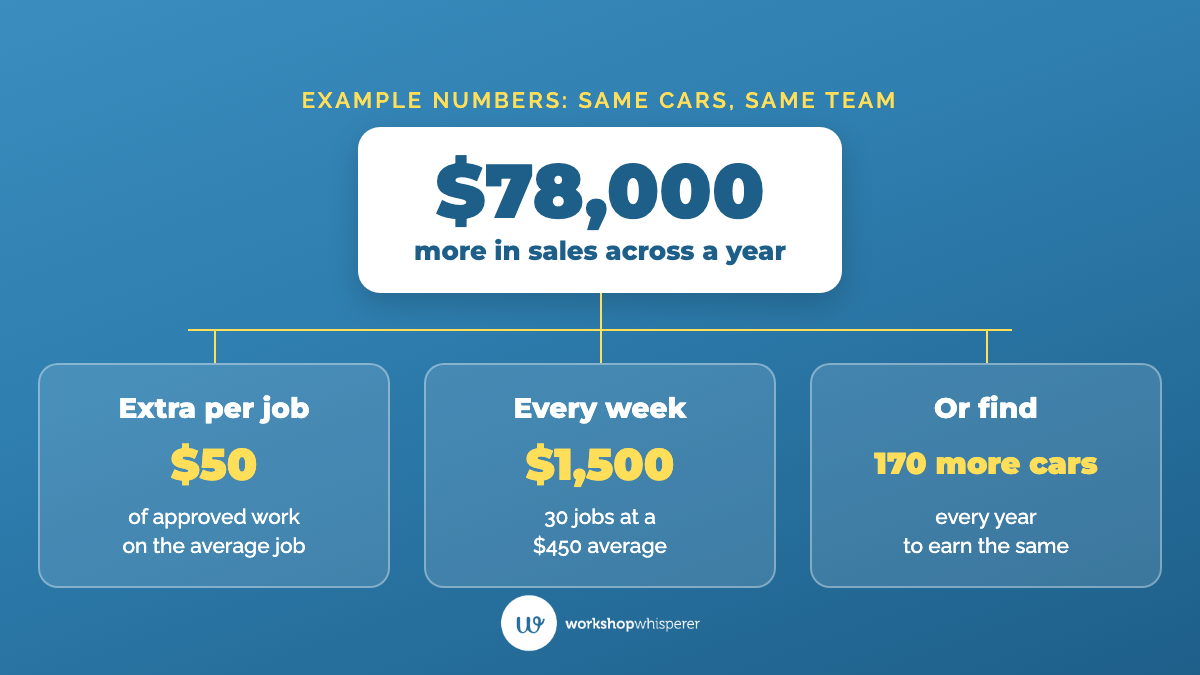
A worked example. These are example numbers, so run your own. Take a shop doing 30 jobs a week at an average repair order of $450. If the front counter gets an extra $50 of approved work on the average job, that's $1,500 more a week, or $78,000 more in sales across a year, from the same cars, customers and team.
To earn that same $1,500 by finding new customers at $450 a job, you'd need more than three extra cars every week, around 170 more a year. Every one has to be marketed for, booked in and worked on by a technician who's already flat out.
It works in the other direction too. When I list the red flags that tell an owner the business is in trouble, one of them is noticing that your average sale has dropped by $200. Across 30 jobs a week, that's $6,000 a week you're no longer invoicing. It usually creeps in alongside other warning signs, so it's easy not to add it up until the bills don't clear at the end of the month.
That's why your average repair order belongs on the list of numbers you look at every week, alongside your daily car count. Dean calls them lead measures. Watch them every week and your cash flow becomes predictable, your team stops drowning, and you get to decide which cars you work on rather than the customer deciding for you.
How do I get more work approved on the cars already in my workshop?
This is the part owners dread, because it sounds like selling. Done properly, it's looking after the customer. We're not trying to sell people things their vehicles don't need. We're trying to be the most convenient option for them, so they can have everything done on the one visit instead of coming back two or three more times.
1. Inspect every car, every time. A thorough walkaround outside, then a thorough inspection once the vehicle is inside and up on the hoist. You can't recommend work nobody looked for.
2. Put every recommendation forward. No pre-qualifying, no deciding on the customer's behalf. Put the problem to them and let them decide if they want to solve it today.
3. Report it in order of priority. Start with the work the vehicle came in for. Then the safety concerns. Then the work that makes sense to do while the car is already on the hoist, so the customer doesn't have to come back for it. Finally, any elective work the customer asked about.
4. Frame it as a problem you can solve today. "We've identified that your brake pads are really low... we can do that for you today." You're telling the customer what the problem is and showing them you can fix it. That's educating the customer, not being sleazy, and they can see the value in it.
5. Explain it until they understand. When a customer says no and it sounds like money, nine times out of ten what they're actually saying is they don't understand. Plenty of customers won't admit that, so explain the consequence in plain words, and show them where you can. When we started using visual software in our own shop to show customers what was wrong, our average sale went up and the program paid for itself after two jobs.
6. Leave room in the diary for it. Dean's rule here is a good one. Don't book every last hour. Hold back around 15% of the day for the extra work your technicians find, so there's time to do it on the day.
7. When it's a no, make a note. If the customer says "I'll do the tyres today, but the brake pads will have to wait a month," write it down. Ask permission to give them a call when that month is up, so they know you're looking after them.
8. Put the right person on the counter. A receptionist won't lift your average repair order, because the role needs different skills. Your service advisor (your service writer in the United States, your service adviser in the UK) is the advocate for the customer's car and the go-between for the customer and the technician. Growing the average repair order, and growing it over time, is one of their three main responsibilities.
Bill owns Ron Hill Automatics in Maroochydore, Queensland. It's a big shop, about five techs, three in admin and seven hoists, and it's been established 43 years. Over the years he'd had "the odd business coach, but nothing industry-specific," so when he came to us he was in the market for a good service advisor and wanted "a position description, some sort of guidelines there, and some measurable targets." Now, in his words, "I've got some really good tools. I've got some really good line in the sand." And he's clear on the bit most owners avoid: "We might be mechanics out the back, but we're all selling. We're all part of that sales team." Watch Bill's story.
Your own story about money gets picked up by your team. If you're nervous about asking, your service advisor will be too. So put your big boy or big girl pants on and have the conversations with your customers. That's what you're there for.
If that person needs help presenting the work and getting a yes at your prices, that's exactly what Superstar Service Advisor is built for. Inside The Engine Room, the first system every new member puts in place is our Expert Selling System, because it lifts the average repair order without a single extra car.
Watch this five-minute video before your next busy morning: Dean and I talk through why you're in the business of selling repairs, and why the opportunity starts the moment a car is booked in.
Questions auto repair shop owners ask about average repair order
How do I calculate my average repair order?
Take your total sales for a period and divide by the number of jobs (invoices) in that same period. $45,000 in sales across 100 jobs is an average repair order of $450. Most shop management systems will report it for you.
What is a good average repair order for an auto repair shop?
It depends on your shop. Your size, the type of work you do, your revenue level and how many technicians you have all change what a healthy figure looks like, which is why we benchmark it shop by shop rather than quoting one number for everyone. The most useful comparison to start with is your own: is it higher or lower than last month, and than the same month last year?
Isn't upselling pushy?
Only if you sell things the car doesn't need. Recommending work the vehicle genuinely needs, explained clearly, keeps the customer safe on the road and saves them coming back two or three more times. Framed as a problem you can solve today, it doesn't sound like a sales pitch.
Should I get more customers or increase my average repair order first?
If you're brand new and the diary is empty, more customers will make the bigger difference. For most owners who have been trading a while, the bigger opportunity is on the cars you already have. More cars through an unchanged system often lowers your average sale and can even reduce your profit.
What should I do when a customer says no to recommended work?
Assume they don't understand yet, and explain the consequence of leaving it in plain words. If it's still a no, respect it, note the work and the time frame they mentioned, and ask permission to call when it's due.
Where to start tonight
Pull last month's total sales and the number of jobs from your management system, and divide one by the other. That's your average repair order, and it's your starting line.
Then pull five invoices from yesterday. For each one, ask a single question: did the technician find anything extra, and was it put to the customer? Between them, they'll show you whether your technicians are finding the work and whether it's reaching the customer.
Related questions:
See what changes for the people who do this work. On our Our Clients page, auto repair shop owners, named and on camera, tell you what actually changed in their shops and their numbers.
More on this topic: all Sales articles.
Whenever you're ready, here's how we can help.
- Not ready to spend anything yet? Start free with Shop Talk, a 30-day reset for auto repair shop owners on our YouTube channel, and our free resources for auto repair shop owners.
- Want your front counter getting more yeses at your prices? Superstar Service Advisor trains the person at your front counter to present the work and hold the price, without more cars or more hours from you.
- Running an auto repair shop under $50,000 a month? Auto Superstars Academy builds the foundations, with one-on-one coaching on demand from a business coach who is a current or former auto repair shop owner.
- Over $50,000 a month? The Engine Room changes how the whole business runs, from your numbers to your team, delivered online with one-on-one coaching on demand.