
How Do I Get Customers to Say Yes to the Work We Recommend?
Put every recommendation to the customer, every time, in the right order. Frame each one as a problem you can solve for them today, explain it until they understand it, and say the total as one simple number. Then let them decide. Most of the no's you hear at the front counter come from customers who didn't understand what they were being asked to pay for.
If you've been holding work back, it's usually because you're decent. You look at the car, or the customer, and decide they can't afford it before anyone has asked them.
This conversation at the front counter of your mechanics workshop decides your average repair order, or average job value as most of us say in Australia. It doesn't matter whether you call the person having it a service advisor or a service writer, or whether your sign says garage. The same few changes lift the number.
Why do customers say no to work they need?
Dean Evans puts it plainly: you're not in the business of fixing cars. You're in the business of selling repair work. Most of us got into this because we liked fixing cars, and nobody taught us to sell. So the selling happens badly, or it doesn't happen at all.
The first place it goes wrong is in your own head. I still see it in shops we work with. An owner looks at the car the customer drives, the state it's in, how the customer is dressed, or a bill they were slow to pay last year, and decides what that person can afford. The recommendation never leaves their mouth.
"Maybe 85 percent of the time you're right in your assumptions, but it's still not for you to decide." Your job is to put the work to the customer and explain why it needs doing. Whether they say yes or no is their call.
And when the work you held back is a safety item, the cost goes beyond money. If something happens to that vehicle because you never had the conversation, you live with the guilt, and you could find yourself in serious legal trouble. The customer who would have happily paid for the brakes goes to another mechanic, because they now think you didn't do your job.
The second place it goes wrong is the owner standing at the front counter. When you're the one presenting the invoice, you get emotionally attached to the value of it. You wipe off labour time and trim the margin before the customer has said a word. Many of our clients who were working the front counter themselves have told me the same thing: "I should have removed myself from the service desk sooner. I'm getting in the way. I'm the one pricing with my own wallet."
Bek and Trent Jackson run Busselton Automotive Repairs in Busselton, WA. They were three years into business before they hired a service advisor. "I guess we both had the mentality that we needed to be at the front of our business for it to work because our customers would only want us." Their pricing came from the same place: "charging with our heart, not our head ... being too emotionally invested in it." Trent worked out he isn't a service advisor, and Bek says the role wasn't really for her either. Handing the front counter to someone who isn't the owner "completely changed not only our business but our life," Bek says. "It's made a massive difference and enabled us to grow." Watch Bek and Trent's story.
The third is how the customer feels walking in. Dean teaches that every customer, new or long-standing, arrives carrying two fears. They're afraid of you, because they don't know how much you know about what their car needs. And they're afraid of making a bad choice and feeling ripped off. Your first job in any sales conversation is to bring that fear down and build their confidence to say yes.
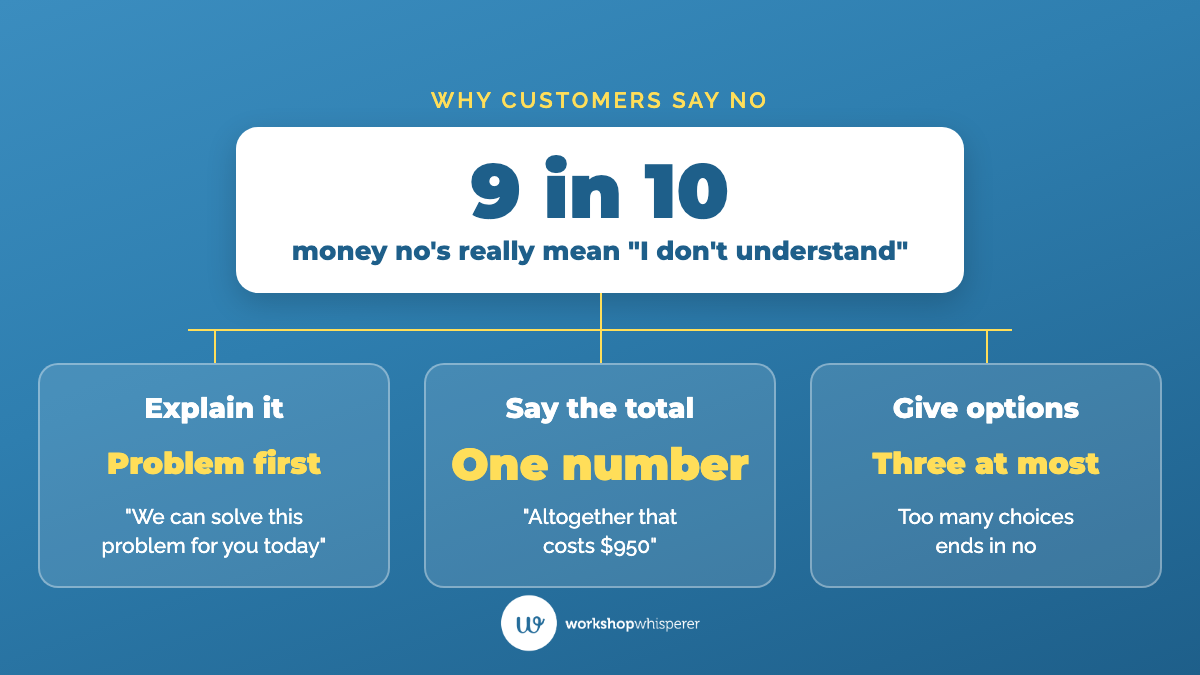
All three lead to the same place. "When a customer says no and it's financial, nine times out of ten what they're actually saying is they don't understand."
What a few more yeses are worth. Here's an example, using numbers I've made up so the maths is easy to follow. Say your technicians find extra work on 20 cars a week, and the average recommendation is worth $400. If 5 of those 20 customers say yes, that's $2,000 a week. Get it to 10 out of 20 and it's $4,000. That's an extra $2,000 a week, or $104,000 a year in extra sales, from cars already on your hoist, worked on by technicians you're already paying. Run the same sum with your own numbers.
How should my service advisor present the work?
Report it in the right order. In Poor to Profit I set out the order a good service advisor presents their findings in. First, the work the vehicle came in for. Then any safety concerns. Then work that should be done while the car is up on the hoist. Last, any elective work the customer asked about. That way the customer hears what they came in for before anything new, and the safety work never gets lost at the bottom of the list.
Put it as a problem you can solve today. Selling feels sleazy when it looks like you're chasing extra money on the job. So don't put it that way. Tell the customer what the problem is, then show them you can fix it: "We've identified that your brake pads are really low. We can solve this problem for you today." The customer learns something about their car and doesn't feel pushed.
Don't assume they know what you know. Break it down for them. What the problem is, what happens if it isn't fixed, whether you can do it today or need to order the part, and what else could be done at the same time to save them time and money. Plenty of men won't admit they don't understand their car, and plenty of women are never given the chance to ask. Visual software that shows the customer what you're talking about does a lot of the explaining for an advisor who's still learning. Your customers come to you the way they'd go to a specialist doctor. They're paying for your expertise, so give it to them.
Say the number the right way. This sounds too small to matter, so try it before you write it off. Instead of "Item A costs $450 and item B costs $500, in total that makes $950", say "Altogether that costs $950." And instead of "I can discount that", say "I'm also happy to add" a car wash or roadside assist as an inclusion. You keep your price and the customer gets something extra.
Those come from a table in our expert selling system that we call "instead of saying this, say this". When auto repair shop owners and their service advisors change how they report the invoice, the first thing they tell us about is more estimates converting and fewer complaints at the service desk. The full system is inside Superstar Service Advisor. As I said in the video below, "if you're doing it the long-winded way, you're often talking your customer out of saying yes."
Watch this before your service advisor presents another estimate. In under eight minutes I walk through how your service advisor should report the estimate back to the customer, and why the way you say the total changes the answer.
What do I do when the customer says "I can't afford it"?
Treat it as the start of the conversation, not the end of it. Dean calls this the ladder of commitment, and the customer tells you where they're standing on it through the words they use.
- Can't. "I can't afford it." "I can't leave the car." In Dean's words, "When we hear the word can't, that is code for don't want to." What it really signals is that the customer doesn't have enough information to say yes yet.
- Could. Answer with possibility. "Here's what we could do for you today." That word puts choice, and control, back in the customer's hands. Keep it to three options at most. As Dean says, the brain counts "one, two, three, four, lots", and faced with too many choices it picks the simplest one, which is no.
- Can. From those options, agree what can be done today, how long the car can stay, and what fits.
- Will. Get the authorisation: "Based on what I'm hearing, this is what we will do on your car today."
- Reinforce. Run back through it. What you will do, what you can do today if they'd like, and what you could do if there's time. Then finish with "Would that be okay?"
If you ask what budget they're working to, remember the figure they give you is the lowest number they'll start at, and it's rarely all they have to spend.
When the answer is still no to part of it, write it down. "I'll get the tyres done today, but the brake pads will have to wait a month." Ask their permission to give them a quick call when that month is up. That's how a no today becomes a booking next month, and the customer knows you're looking after them.
None of this is a licence to sell work the car doesn't need. If there's no additional work that needs doing, don't suggest it. You'll earn as much trust from that customer as from the ones who say yes to a safety concern you found. Where the work is needed, put your big boy or big girl pants on and have the conversation, because that's what you're there for.
Questions auto repair shop owners ask about getting customers to say yes
Is upselling unethical?
Only when you sell work the car doesn't need. Recommending work your technician has found, explaining why it matters and letting the customer decide is doing your job properly. Holding back a safety item because you've decided the customer can't afford it is the bigger risk, to them and to you.
How do I stop my service advisor discounting?
Start by getting yourself off the front counter, because owners are often the ones wiping off labour time. Then give your service advisor a different line to reach for. Instead of "I can discount that", they say "I'm also happy to add" a car wash or roadside assist. The price holds and the customer still feels looked after.
Should the owner present the work, or the service advisor?
As soon as you can, a trained service advisor. Owners get emotionally attached to the invoice and price with their own wallet. A service advisor's job is to put every recommendation to the customer and let the customer decide, and your customers will get used to dealing with them faster than you expect.
How many options should I give a customer?
Three at most. Give more than that and most people choose the easiest option, which is to say no to all of it.
What's the quickest change I can make at the front counter?
Say the total as one figure. "Altogether that costs $950" lands far better than reading out each line and adding it up in front of the customer.
Where to start tonight
Pull last week's job cards. Count how many cars had extra work recommended, and how many of those customers said yes. That's your conversion rate on recommended work. Write it on a sticky note and put it on the front counter.
Then tomorrow morning, before the first car comes in, teach whoever is at the counter one line: "Altogether that costs..." Count again at the end of next week and compare the two numbers.
Related questions:
See what changes for the people who do this work. On our Our Clients page, auto repair shop owners, named and on camera, tell you what actually changed in their shops and their numbers.
More on this topic: all Sales articles.
Whenever you're ready, here's how we can help.
- Not ready to spend anything yet? Start free with Shop Talk, a 30-day reset for auto repair shop owners on our YouTube channel, and our free resources for auto repair shop owners.
- Want more customers saying yes at your front counter? Superstar Service Advisor trains the person at your front counter to present the work, hold the price and convert the inspection, without more cars, more marketing or more hours from you.
- Running an auto repair shop under $50,000 a month? Auto Superstars Academy builds the foundations, with one-on-one coaching on demand from a business coach who is a current or former auto repair shop owner.
- Over $50,000 a month? The Engine Room changes how the whole business runs, from your numbers to your team, delivered online with one-on-one coaching on demand.