
How Do I Handle a Customer Who Is Angry About the Bill?
When a customer is angry about the bill, don't argue and don't reach for a discount. Ask questions. Get them to tell you what happened, what the problems are and what it has done to their day, then ask what they think would make it right. Agree on what you can do, put a time on it and follow through. Then fix the reason it happened, which is almost always a phone call nobody made while the job was running over.
If your first instinct is to wipe a few hours off and get them out the door, you're in good company. As Rachael puts it, "if there's one thing we know about you guys... you don't like confrontation."
Whether you run an auto repair shop, a mechanics workshop, an automotive workshop or a garage, the conversation at the counter is the same, and so is the fix behind it.
Why is the customer angry about the bill?
Nearly every conversation you have, with a customer, a team member or your partner at home, is a conflict conversation, because nobody sees the world the way you do. The customer walking up to your counter is already looking at that invoice from a different place.
It usually plays out like this. The job was under-estimated. There were unexpected findings, or the repair was harder than you thought. The invoice total went up. The customer comes in to pick up the car, looks at the number and says, "What the heck is this?"
Rachael puts it more bluntly. You quoted five hours, you took ten, and now they're jumping up and down because nobody contacted them.
At that moment most people do one of two things. They repeat the same explanation louder, getting more aggressive by the second, which is pouring fuel on the fire. Or they go the other way. As Rachael says, "Your first response is going to be give them a discount, wipe the time off."
Neither one deals with what's going on. The customer feels surprised and unheard, and a discount tells them the bill was wrong in the first place.
What do I say when they're standing at the counter?
Follow the road rules and you get from A to B safely. Conflict works the same way: until you trust yourself to manage your own emotions and someone else's, follow a framework you know works.
The simplest and most effective one I've found is called SPIN: situation, problem, impact, need. Rather than walking in with the solution, you walk in to understand how they see it.
Situation. "Can you tell me, from your perspective, what happened?" Then listen. Offer no solutions and ask nothing else yet. When people have to think their way through a problem, they can't feel their way through it. We can't be logical and emotional at the same time, so the moment they start explaining, they start managing their own emotion.
Problem. "What were the problems, as you saw them?" Get every one of them out on the table. Every problem they name is a bullet taken out of the gun and laid on the table, where you can deal with it. The human condition is that we want to be heard, we want to be validated, and we want to be understood.
Impact. "What impact has this had on you?" Maybe the delay mucked up their plans for the night. They're airing their frustration, and you're letting them.
Need. "What do you think needs to be done to make this right?" Some will make unreasonable demands. That's fine. Let every idea come out and you've got a menu. You know what can and can't be done, so agree on what's reasonably achievable.
Then put a timeframe on it, confirm it in a text or an email, and follow through. Each step takes 30 seconds to a minute. Nobody on the other side of the counter knows you're using a framework, they feel listened to.
You can flip it to explain the bill, too. When the issue is pure bill shock, use the same four steps yourself:
"Yep, totally understand. This is more than you were expecting. Here's the situation, here's what we found. These are the problems it was causing, or was going to cause. This is the impact it would have had on you, your family and your vehicle. And this is what we needed to do to resolve it."
As Rachael teaches it, the person asking the questions is in control. Keep asking, slow it down, and most customers will settle.
Some won't. Rachael talks about a customer relationship ending one of two ways: with a handshake, or by burning the boats, where they storm off and write something terrible on Facebook. You can't control which they pick, only how you show up. Thank them for their custom, wish them well, and part with a handshake, because your team and your other customers are watching how you handle it.
How do I stop bill shock happening again?
Most bill shock can be prevented well before the car comes off the hoist, with a few habits at the front counter.
Estimate, don't quote. As we put it on the A-Grade Auto Repair Shop Show, a quote is a fixed price on a flexible process. Once you've told someone "400 bucks", you've locked in a number before you've seen the car. An estimate is a considered range, built on a conversation and a diagnosis, and it needs the customer's authorisation to go further.
Set the checkpoints when the car comes in. For any job that needs diagnosing, Rachael's script for the front counter is simple:
"Diagnosing attracts two hours of labour, and it'll be [your diagnostic rate]. At the end of that two hours, I'll update you, and if we need more time, I'll let you know and I'll get your permission to proceed. If we already have our fix, I'll let you know what the estimate is to move forward on the job and we'll go from there. Does that sound okay with you?"
Then do what you said. Call at the two-hour mark. Call again before any extra work. Rachael's experience: "If you just keep checking in and letting the customer know where you're up to, the customer is more than happy to continue."
Keep the customer in control of how much work gets done. The line of communication runs through the whole job, and the customer authorises every step. That costs you a few five-minute phone calls, which is far less than the hours you'd otherwise wipe off at pick-up.
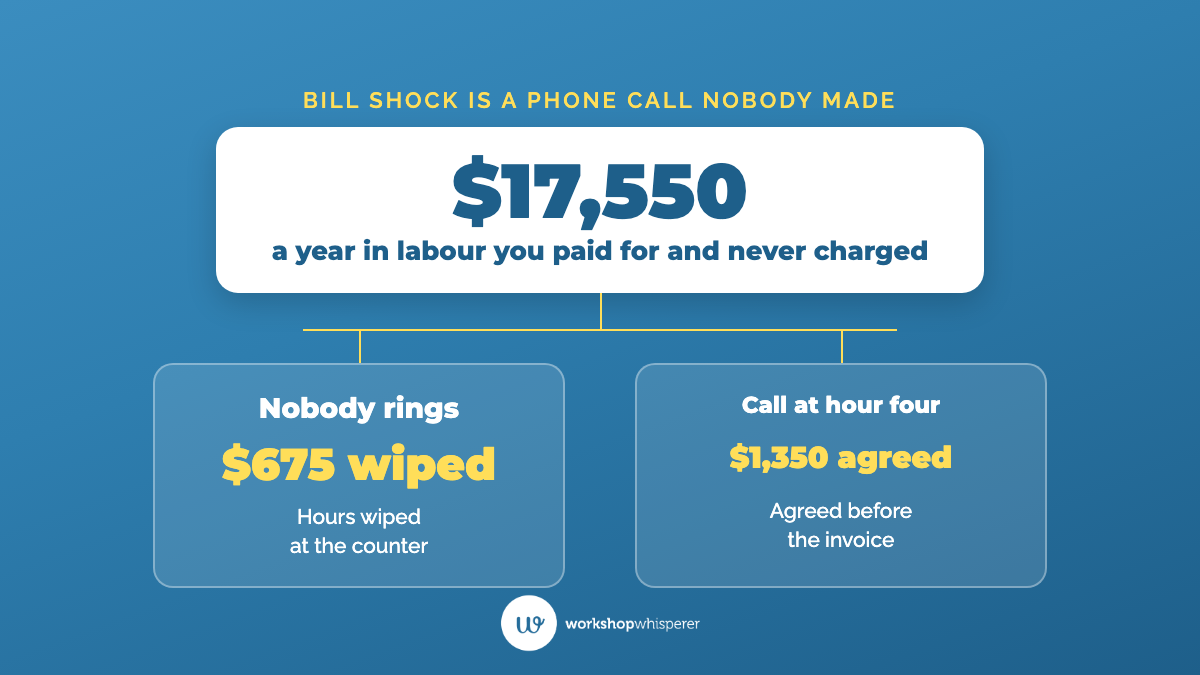
A worked example. These are my example numbers, so put your own in. A job is estimated at 5 hours at a labour rate of $135 an hour, which is $675 in labour. It runs to 10 hours. Nobody rings. The invoice says $1,350 and the customer says "what the heck is this?" If you wipe the extra five hours to calm them down, you've given away $675 of work your technician did and you paid wages for. If that happens once a fortnight, that's $17,550 a year in labour you paid for and never charged.
Now run the same job the other way. At hour four your service advisor rings: "We've found more than we expected. Here's what it is, here's what it means for you, and it's another five hours. Are you happy for us to go ahead?" Either they say yes, and the $1,350 is agreed before it's on the invoice, or they say no and you stop. There's no shock at the counter and nothing to write off.
When the job takes longer, the hours still count, as long as you made the call. The example we use is a surgeon. You never negotiate with your surgeon about the cost of the operation, and if they finish early they don't say "I wiped two hours off." The customer is paying for your skill and your experience, not for how fast the job got done.
Put the right person at the counter. That's your service advisor, the service writer if you're in the United States, or the service adviser in the UK. It should not be the technician. As Rachael says, "you will teach your conflict resolution style to anyone else that is asked to handle a situation." If your own style is to fire back, that's what your team learns. Our Superstar Service Advisor program trains that person for exactly this conversation, so it doesn't end with money coming off the invoice.
Annie and Adrian De Rosa run Noranda Service Centre in Noranda, Perth. After "about 17 years", Adrian says, "I was probably at breaking point," with "lots of staff issues that we just couldn't get right". Their answer was the person at the front counter: "putting on a service advisor has been maybe the biggest change that we've made. It gives us a bit of freedom to get working on the things that we've got to get worked on." Watch Annie and Adrian's story.
Watch this before your next difficult conversation at the counter. In under ten minutes, Rachael and I talk through what wiping hours off an invoice really costs you, and the phone call that stops bill shock before it starts.
Questions auto repair shop owners ask about angry customers and the bill
Should I give a discount to calm an angry customer down?
No. A discount at the counter tells the customer your bill was wrong, and it hands back money for work you did. Work through what happened first. If the same customer asks for money off every visit, Rachael's answer is to stay polite and say it straight: "Well, you chose to get it done here. We discussed it before we went ahead."
What if we really did get it wrong?
Own it, and use the same four steps to agree how you'll put it right and by when. Rachael's rule is that in any bad feedback there's always at least one thing you can take on board, so the same thing doesn't happen again next time.
Who should deal with an angry customer, me or the technician?
Your service advisor, as the go-between for the customer and the technician. If your technicians are arguing with customers, ask why they're dealing with customers directly at all. And if the same handful of people cause most of your grief, Rachael's experience is that 80% of the problems come from the bottom 20% of the customer base. Her advice: "raise your gaze and raise your prices."
What if the customer refuses to pay?
General servicing and repair work shouldn't leave the shop without being paid for. For account customers, have terms of trade prepared by a professional and signed before you extend credit. Rachael once had a customer who kept paying up to 90 days late. She called in a debt collector, the signed terms let her pass the collection costs on, and they never paid late again.
What if they leave a bad review afterwards?
Contact them straight away and, in Rachael's words, "seek to understand before you start hurling defensive comments back at them." If you've genuinely tried to put it right and they won't accept it, say what you offered in your reply. People reading reviews are looking at how you handled it.
Where to start tonight
Pull up last month's invoices and find every job where hours were written off or money came off at pick-up. Next to each, write down when the customer last heard from you before they saw the total. If most say "when we gave the estimate", you've found where the money is going.
Then write the checkpoint line on a card and stick it at the front counter: "At the end of that two hours I'll update you, and if we need more time I'll get your permission to proceed." From tomorrow, every job that heads past its estimate gets a phone call before the work goes on.
Related questions:
- What Do I Say When a Customer Asks What Our Labour Rate Is?
- How Do I Keep Customers Coming Back to My Auto Repair Shop?
See what changes for the people who do this work. On our Our Clients page, auto repair shop owners, named and on camera, tell you what actually changed in their shops and their numbers.
More on this topic: all Customer Experience articles.
Whenever you're ready, here's how we can help.
- Not ready to spend anything yet? Start free with Shop Talk, a 30-day reset for auto repair shop owners on our YouTube channel, and our free resources for auto repair shop owners.
- Want your service advisor to handle an upset customer without giving the money away? Superstar Service Advisor trains the person at your front counter to present the work, keep the customer informed and hold the price. Rachael teaches the role and the selling, and I teach the conflict side myself.
- Running an auto repair shop under $50,000 a month? Auto Superstars Academy builds the foundations, with one-on-one coaching on demand from a business coach who is a current or former auto repair shop owner.
- Over $50,000 a month? The Engine Room changes how the whole business runs, from your numbers to your team, delivered online with one-on-one coaching on demand.