Why Has My Auto Repair Shop Gone Quiet?
Because around 18% of your customers stop coming back every year, and nobody told you. That number has been ticking away in the background for about three years, and this is the month it finally showed up in your bays.
So the quiet didn't start this week. It started three years ago, and the fix is not where you're about to look for it.
I know what the instinct is. There's a quiet week coming, you can feel it, the bays are going to be half empty and the techs will start walking around looking for something to do. So you throw a bit of money at Facebook, boost a post, run a special, do whatever pulls a few fresh cars through the door.
That instinct is the most expensive move available to you. This is not a lead problem. It's a database problem, and the most profitable work you'll do this year is already sitting inside your system.
Where did 18% of my customers go?
Rachael put that figure in front of auto repair shop owners in 2020, and again in December 2025, and it has not moved: the average shop loses about 18% of its customer database every year. That's almost a fifth, gone, every single year, and five years apart it is still the number.
There are only ever three reasons. They chose somebody else. They moved out of your area and you're no longer the convenient option. Or, unfortunately, they passed away.
Stopping that leak in the first place is its own job, and we've written it up separately in how to keep customers coming back. This article is about what to do once the quiet has already arrived.
Here's why it stays hidden. When you're flat out, marketing feels like something you don't need to think about. You're busy, the phone rings, the board is full. Rachael calls attrition the quiet killer for exactly that reason. It runs unacknowledged for three years or so while you're too busy to notice, and then you get a stretch of quiet you cannot explain, usually around the time you're closest to burnt out.
Most owners, asked what their retention is like, say it's pretty good. Dig into the actual numbers and it's always lower than they thought.
How many new customers do I actually need?
This is the bit that stops people, and you can do it on the back of an invoice.
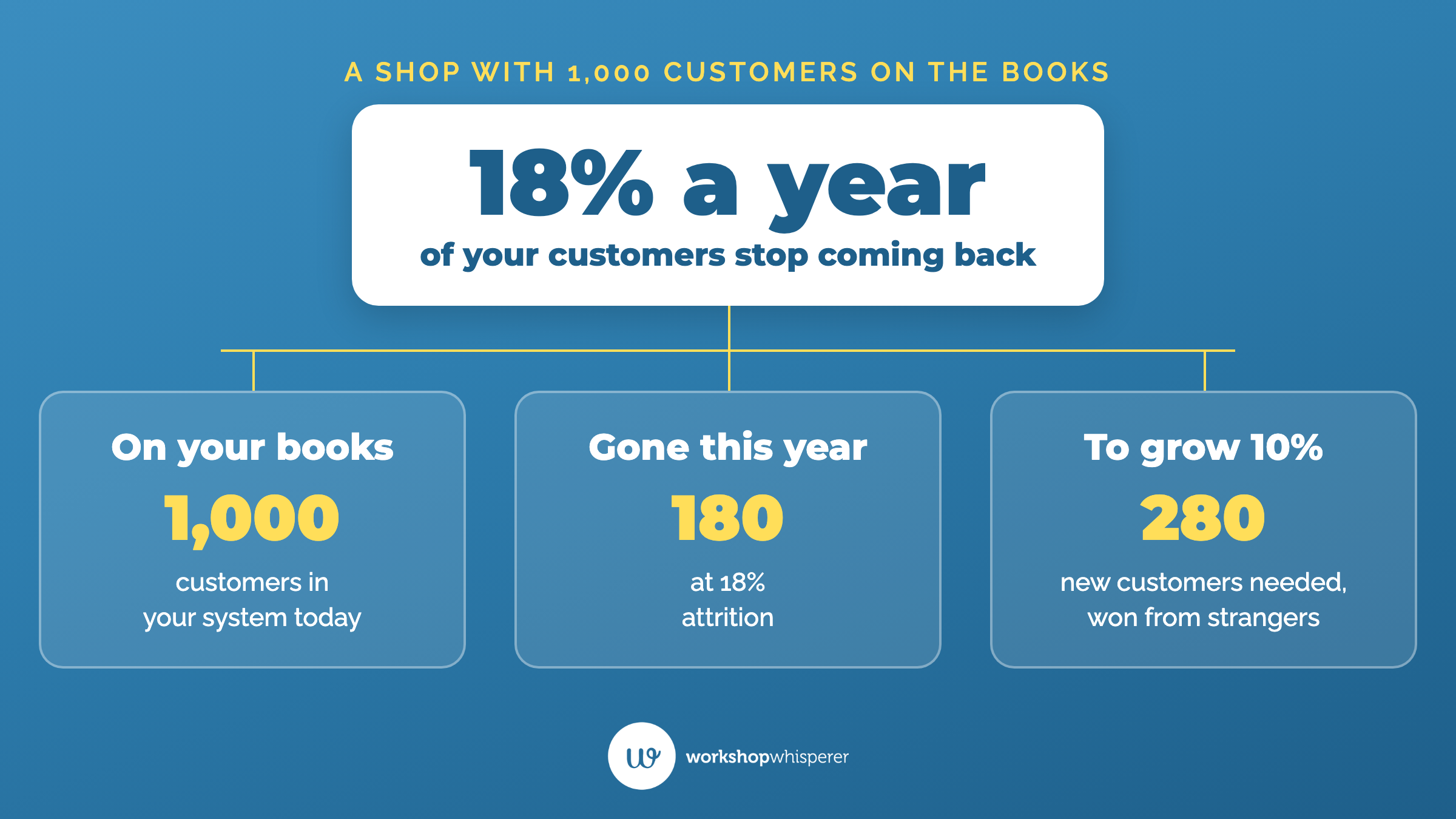
Say you have 1,000 customers on file. At 18%, you will lose 180 of them this year. That means you need 180 new customers to stand exactly still. Not to grow. To stay where you are.
Now say you want to grow 10%. You need those 180 replacements plus another 100, so 280 new customers. That's 28% of your entire database, won from strangers, in twelve months.
Most mechanic workshops have no marketing that could deliver a fraction of that. Which is the point. If you're trying to outrun an 18% leak by buying strangers, the maths was never going to work.
Why is chasing new customers the most expensive thing I can do?
Every customer sits somewhere on a scale from cold to hot.
At the cold end is a stranger. They have never heard of you, they don't trust you, and they have no reason to pick you over the garage down the road. In the middle is a warm customer, someone who has been to you before, knows who you are and has paid you, but hasn't been back in a while. At the hot end is a current customer who was in recently, knows you, likes you, trusts you, and would say yes to more from you if you ever offered it.
It costs five to seven times more to win a new customer than to bring back one you already have. You're paying the most money, for the hardest customer to win, who trusts you the least.
I call that the stranger tax. And almost every owner pays it while the warm customers sit there uncontacted, not because they wouldn't come back, but because nobody ever asked them to.
Watch: Rachael walks through the attrition number and what it does to your car count, in 10 minutes. This is the number behind the quiet, and most owners have never been told it exists.
Where is the work hiding in my database?
Three places. Three seams, and every one is cheaper to work than winning a single stranger.
Reactivate. The customers who went quiet. They were coming in, then they drifted. They moved house, they got busy, they went somewhere closer one time and never came back. They're not angry and they didn't fire you. They forgot you were there. Most automotive workshops have hundreds of these sitting in the system, and what brings a chunk of them straight back is a reminder that sounds like "we've missed you, your car's probably due".
Ascend. The customers already with you who are doing less than they could. The bloke who brings you his work ute and takes the family car to the dealer. The customer still sitting on the work your service advisor flagged six months ago. They're in front of you. It's a conversation: "we noticed your wife brought the other car in somewhere last time."
Refer. Your happy customers would gladly send their mates in, and you've probably never asked. You do good work, you're a skilled tech, and they mean to tell someone, but life gets in the way and it never happens. One ask turns your best customers into your best salespeople.
Worth saying: a referral and word of mouth are not the same thing. When you ask a customer to refer people they like, there's a trust transfer and the quality holds. When people tell anyone and everyone, the quality drops.
Reactivate, ascend, refer. Not a dollar of advertising in any of them.
What this looked like for one shop
I sat down with an Engine Room member who was about to drop two grand on Facebook ads to get himself through a slow patch. Every business has them.
Before he spent it, I asked him to pull out his customer list. Every name in the system.
He had over 800 customers who had not been back in more than twelve months.
He didn't need new customers. He was sitting on more work than he could handle, from people who already trusted him. He hadn't spoken to them in a while, that's all. Working that list is the first thing we put in front of owners when they come into The Engine Room, because it fills a shop fast and it happens before anyone spends a cent on ads.
Three questions to answer before you spend anything
How many customers in your system haven't been back in over twelve months? If you don't know, that number is the size of your first seam. Go and find it this week. Your workshop management software will tell you in about ten minutes.
When did you last ask a happy customer for a referral? Not hope for one. Ask. If you can't remember, that's an entire seam you have never touched.
Are your best customers bringing you every vehicle they own, or one of them? The gap between one car and all their cars is ascension, and it's sitting in your customer list right now.
Questions owners ask
Won't I annoy people if I contact them?
No, if what you send is useful. "Your car is probably due" is a service reminder, not a sales pitch. Most of them forgot, and plenty will thank you. If your software can set automatic service reminders and you're not using them, turn them on this week.
How is my shop busy and quiet at the same time?
Because attrition works in the background. You can be flat out for three years while the database shrinks underneath you, and the quiet only arrives once the gap gets big enough to see. By then it looks sudden. It isn't.
Is 18% normal, or is something wrong with my shop?
It's the average. People move, people change their minds, people pass away. You cannot get it to zero and you shouldn't try. What you can do is know the number and replace it deliberately instead of hoping.
Should I still advertise?
Yes, once the seams are worked. Advertising to strangers is the right tool for genuine growth on top of a database you're already looking after. It's the wrong tool for fixing a quiet week, because it's the slowest and the most expensive way to fill a bay.
What if my customer records are a mess?
Then start with the last twelve months and work backwards. You don't need a perfect database to find the first hundred names, and most owners find more than they expected in the first hour.
The shift
Chase strangers and you'll pay the most to win the customer who trusts you the least. Work your database and you'll get the most profitable work of your year from people who already trust you.
The gold isn't out in the market. It's in your shop. Stop hunting and start mining.
Tonight, open your workshop management software and run one report: every customer who hasn't been in for twelve months. Don't contact anyone yet. Look at the number. That's the size of what you've been driving past.
If you want to compare notes with other owners working on exactly this, we run a free Facebook group called Your Profitable Auto Repair Shop. Come and join us.
Want to see what this looks like when it works? Our clients are named auto repair shop owners, on camera, telling you what changed in their own words.
More on this topic: all Sales articles.
Whenever you're ready, here's how we can help.
- Free. Shop Talk, a 30 day reset for auto repair shop owners, and our free resources.
- Under $50,000 a month? Auto Superstars Academy, $997 one off.
- Over $50,000 a month? The Engine Room, where working your database is one of the first things we do with you, with one on one coaching on demand from a business coach who is a current or former auto repair shop owner.