What Does an Auto Repair Business Coach Actually Do?
An auto repair business coach looks at your shop from the outside, with the numbers in front of them, and tells you where the money is leaking. Then they help you pick the one next thing to fix, show you how to fix it, and check back to make sure it got done. A good one has owned an auto repair shop themselves, so the advice comes from the shop floor rather than a textbook.
If you've never worked with a business coach, it's hard to picture what you'd be paying for, and plenty of auto repair shop owners have been burnt by advice from people who have never run a mechanics workshop or had to make payroll on a quiet week. Below is what the work looks like week to week, whether you run an automotive workshop in Australia or a garage in the UK, and what changes for the owners who do it.
Why can't I see the problems in my own shop?
Because you're standing in the middle of them. You're the first one there at dawn and the one locking up at night, and when a car has a problem late in the day, you're the one who stays to work it out. From where you stand, the whole shop looks busy, so it's easy to believe it's working.
Recently, on one of our Engine Room webinars, a client told us his service advisor (your service writer, if you're in the US) was largely free during the day. The technicians were flat out, but the person at the front counter was looking for things to do. After a few questions, it became clear the owner was still doing most of the service advisor's job himself, and because he was the one doing it, he couldn't see it.
That's the first thing a business coach gives you: someone outside the shop asking the questions you wouldn't think to ask yourself.
My colleague Dean Evans puts it well. Every single one of us already works with a coach, he says, "but they're called friendtors." A friendtor is the well-meaning mate who tells you what they'd do in your position. Maybe they're on a salary. Maybe they run a removalist business. They mean well, but how often do we go to the wrong person for the right advice? A mentor has relevant industry experience and can show you the results they've got in the business you're in.
The second thing is accountability. When I talk about why owners put off the decisions that would move their business forward, one of the five reasons is that you're not accountable to anyone. You haven't asked your team to hold you to it, there's no business partner checking, and you're not working with any kind of coach. So it feels like no one's watching, and the decision waits another month.
Ange Wall, who helps run a European vehicle specialist shop that grew its team from three to seven, described it simply. Her systems were in place, but "they weren't polished or they weren't regularly done because nobody was sort of checking in going... where are you at."
What does a business coach actually do with my shop?
Inside The Workshop Whisperer, we coach through two programs matched to the size of your shop: Auto Superstars Academy builds the foundations of the business if you're turning over under $50,000 a month, and The Engine Room changes how the whole business runs once you're over it. In both, the work falls into three parts.
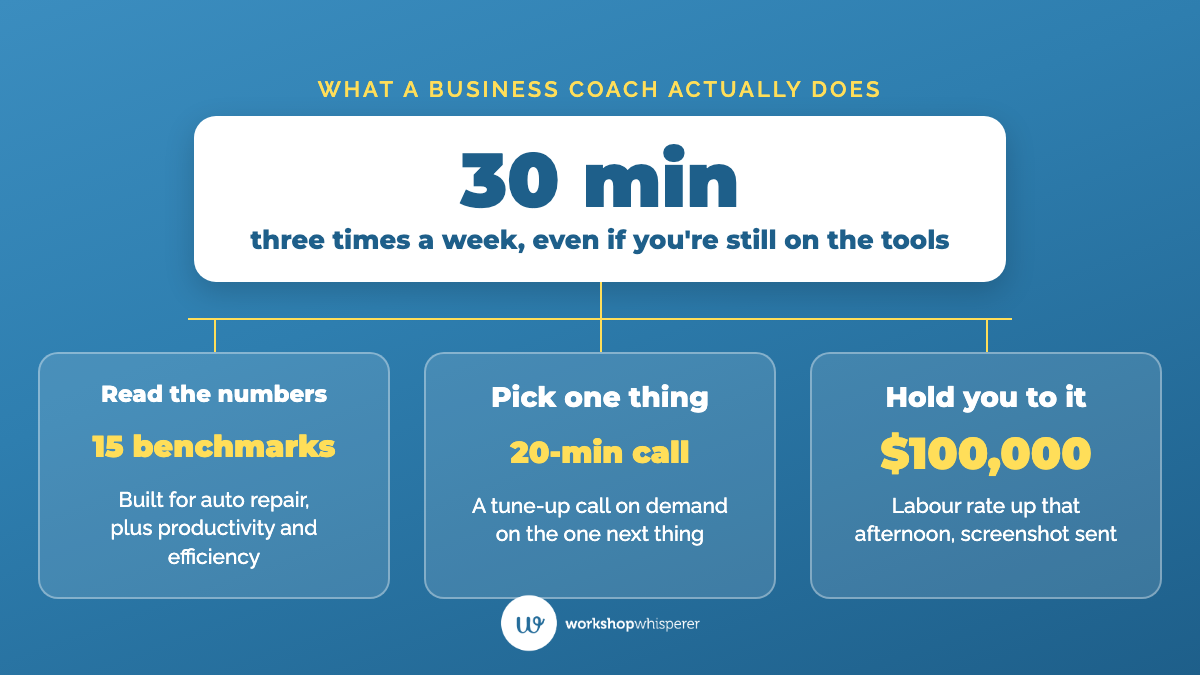
1. Read your numbers against benchmarks built for auto repair. Most of the work is pricing and labour rates, parts margins, billable hours, declined work and the numbers behind them. I can usually find where profit is leaking from the top section of your profit and loss. Take the shop that's booked out but still cash poor. When there's no money, it's only ever one of two things. Either your margins are wrong, so you're not pricing to make the profit you need, or your wages and expenses are outpacing your revenue. The first check is your gross profit on every job, which should sit between 58% and 62%. We work our clients towards 15 benchmarks of our own, plus productivity and efficiency, so you're never guessing which one is out.
2. Pick the one next thing, and show you how. You don't fix everything at once. Plenty of our clients are still on the tools, so for some of them the work is 30 minutes, three times a week. They log into our university and book a 20-minute tune-up call on demand, where we work on that one next thing that will move the needle for them.
One of those calls can uncover a lot, like a team that looks flat out but is billing far fewer hours than you're paying for. Dean explains why that happens and how to find the lost hours.
3. Hold you to it. Advice only changes a business once somebody acts on it, and that's where a coach earns their keep. One of our clients tells the story of a message I sent her: would she like an extra $100,000 on the bottom line each year? Of course she would. My answer was to put her labour rate up, change it in the system that afternoon and send me a screenshot. "So I hesitantly did it," she said, "and we had our record month ever in March." That's how we coach a labour rate rise: don't announce it to your customers, do it.
Belinda Zeuschner runs Brooks Motor Works in Legerwood, Tasmania, with her partner Justin. Her kids used to knock off school at 3:00 "and come and sit in the car and wait for me while I was finishing doing paperwork and sorting everything out." Today they have a team of five mechanics, Justin is off the tools practically full-time, and an admin assistant takes care of the work so Belinda can focus on the CEO role. The part of the program she credits most is the tune-up calls. "I could not breathe without a tune-up call each week," she said. It "has helped me improve bit by bit each week," and when she's been thinking about a change, "I actually just do it because I've got that backing." Watch Belinda's story.
The coaching goes past the numbers, too. Dean had another client, a member of our Million Dollar Mechanics Boardroom, whose senior technician couldn't make a decision unless the owner was standing there. After some profiling, the owner asked the tech one question: do you want the steps, or the options? The tech looked relieved and said he wanted the steps. The owner wrote him a checklist, and over the coming weeks the tech became more and more reliable. Nothing about the tech had changed. What changed was how the owner led him.
What changes when you work with one?
Brett and Ruth Gillard bought Sherson Automotive, a BMW specialist in Tauranga, New Zealand, with Brett on the tools, one fresh apprentice and Ruth in the front office. Ruth had been a stay-at-home mum for nine years, and she called the start "pretty terrifying." She's now the CEO of the business, and they've added a team member every year.
They described the difference like this: "before we joined the Engine Room we were coping financially and strategically day-to-day, literally just going from day to day. But now... we've got a really solid strategic plan and we're constantly working to improve the business."
Brett was still putting in 12 to 15-hour days. After a one-on-one conversation with Dean, he said, "it hit me quite hard," and he started taking steps "to re-engage in my family and actually be a present father."
When I first spoke with another of our clients, ten years ago, he was wondering if he'd be able to open the door of his shop the following day. He has since left his business in regional Victoria in the hands of a great team, and he and his wife spent six weeks travelling around the USA. We have clients who have paid off $250,000 of debt to the tax office once they installed a cash management system, and others buying their second investment property.
That's the track record behind the advice. We're the #1 business coaches for auto repair shops. In 13+ years we've helped more than 10,000 auto repair shops across 5 countries, and generated $175 million in additional profit for our clients. Every coach on our team is a current or former auto repair shop owner, and we work in auto repair and nothing else.
Ange Wall's advice to anyone thinking about getting a coach was to give it a go. Her daughter swam, and she couldn't have been as good as she was without the routine of her swim coach. Ange sees running a business the same way.
Watch Brett and Ruth Gillard tell it in their own words, about nine minutes: what they'd do differently, what changed in The Engine Room, and the talk with Dean that made Brett rethink his hours.
Questions auto repair shop owners ask about business coaching
Isn't that what my accountant is for?
Your accountant keeps you compliant and tells you what happened. A business coach works with you on what to do next, and checks you did it. Brett and Ruth's advice was to have both: an accountant who knows the automotive industry, and coaching so you don't have to do it all yourself.
Does my coach need to have owned an auto repair shop?
It makes the difference. Generalist advice misses the things that only exist in this industry, like billable hours, parts margins and the conversation at the front counter. Every coach at The Workshop Whisperer is a current or former auto repair shop owner, and our benchmarks are built for auto repair, not small business in general.
How much time does coaching take?
Less than most owners expect. For some of our clients it's 30 minutes, three times a week, including a 20-minute tune-up call on demand. Others make our weekly webinar a priority, and if a tech is off sick and they end up back on the tools, they watch the replay later.
I'm still on the tools. Is it too early for a business coach?
No. We have plenty of clients who are still on the tools. Looking back, Brett and Ruth said they would have joined much sooner, because it would have reduced their stress considerably at the start.
Is coaching done in person or online?
Our coaching is delivered online, so you can join from anywhere. We coach auto repair shop owners across Australia, New Zealand, the United Kingdom, the United States and Canada.
Where to start tonight
You can do the first part of a coach's job yourself. Tonight, put a sheet of paper on your desk, and from tomorrow, for one week, write down every time you change task, every time you're called away to solve a problem and every time you speak to a customer.
At the end of the week, read it back. Circle every item a skilled, qualified person on your team is already paid to do. Those are the jobs you're doing out of habit rather than necessity, and they're the first thing a coach would ask you about.
Related questions:
- Do I Need a Business Coach for My Mechanic Workshop?
- How Do I Hold My Team Accountable Without Micromanaging?
- How Do I Stop Winging It in My Auto Repair Shop?
See what changes for the people who do this work. On our Our Clients page, auto repair shop owners, named and on camera, tell you what actually changed in their shops and their numbers.
More on this topic: all Performance articles.
Whenever you're ready, here's how we can help.
- Not ready to spend anything yet? Start free with Shop Talk, a 30-day reset for auto repair shop owners on our YouTube channel, and our free resources for auto repair shop owners.
- Running an auto repair shop under $50,000 a month? Auto Superstars Academy builds the foundations of the business, delivered online, with one-on-one coaching on demand from a business coach who is a current or former auto repair shop owner.
- Over $50,000 a month? The Engine Room changes how the whole business runs, with one-on-one coaching on demand, group sessions over Zoom and three two-day intensives a year.