

How Do I Train a Service Advisor?
You train a service advisor by learning the role properly yourself first, so the two of you work from the same playbook. Then put a salesperson in the seat, not a receptionist. Teach them the three things the role is responsible for and how to present work to a customer, put their boundaries in writing, and step out of the way so your customers deal with them instead of you.
Most owners skip that first step, and it's not because they're lazy. You picked up everything you know about the front counter by osmosis, so you've never had to put it into words.
Whether your shop calls it a service advisor, a service adviser or a service writer, and whether you run an auto repair shop, a mechanics workshop, an automotive workshop or a garage, the role does the same job. It sets your average repair order, which some of you call your average job value, and it decides whether the labour rate you've set actually gets charged.
Who should I be training for the front counter?
When I first started coaching auto repair shop owners, the service advisor in Australia and New Zealand barely existed outside the dealerships. Shops that said they had one usually had a glorified receptionist. I spent 18 months going backwards and forwards to the States, working with my own mentors, because a mum and dad shop in the United States runs the service writer as a professional role. That's the model we brought home.
The first lesson is about who, not how. A good service advisor is a salesperson who loves the customer experience. A receptionist usually isn't. Michael from Rockingham asked us whether his receptionist could step into the role, and my answer was no, unless she was a salesperson before she was a receptionist. Put a list of repairs and a total in front of a customer, ask "are you happy to proceed with that today?", and a receptionist will hate it like no one's business. They're not comfortable with the word no, so they're reluctant to ask in the first place.
You can still train someone with no sales experience, if they have the right profile. In DISC terms, the D and I styles are your salespeople.
The second lesson is about you. As the owner you can do the role quite effectively, and the part where you stuff it up is that you get emotionally attached to the value of the invoice. You wipe off labour time, you make the margins finer than they should be, and you don't put some recommendations forward at all because you've decided the customer can't afford them. When clients start our service advisor training, I hear the same thing over and over: "I should have removed myself from the service desk sooner. I'm getting in the way. I'm the one pricing with my own wallet."
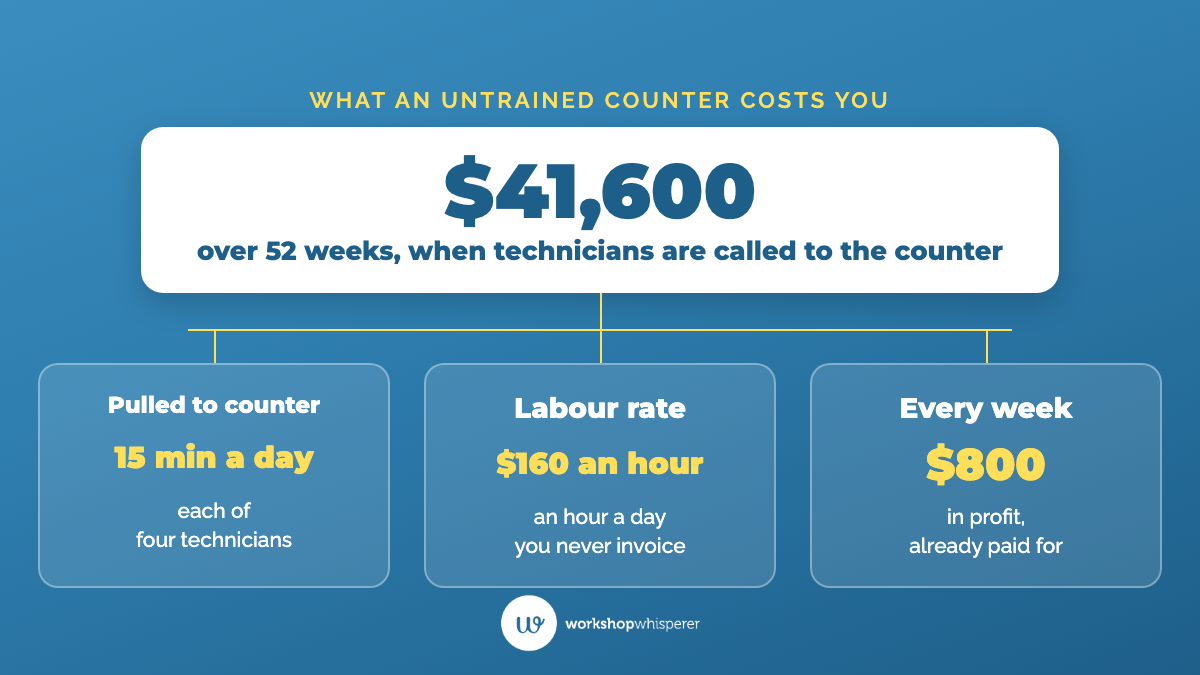
What an untrained counter costs you. Technicians sell minutes. Every minute a technician is pulled off a car to talk to a customer is a minute you can't charge. Here's an example with round numbers. Take a shop with four technicians and a labour rate of $160 an hour. If each technician is called to the counter for 15 minutes a day, that's an hour of labour a day you never invoice, or $800 a week. Over 52 weeks it comes to $41,600, in profit, because the wages, the rent and the hoist were all paid for anyway. Put in your own technicians, your own minutes and your own rate.
What does a service advisor actually need to learn?
In my book Poor to Profit I put the role down to three responsibilities:
- Increase customer satisfaction. Listen, show empathy and resolve a problem quickly and considerately when something goes wrong.
- Increase the average repair order. Build enough trust early that the customer is comfortable saying yes to the work on the day, instead of coming back again a short time later for the extra work.
- Increase gross profit. Make sure the right gross profit is made on each job, with correct pricing in the system and technicians working to the estimated times, rather than guessing and hoping the profit turns up later.
Everything you train hangs off those three, starting with who the advisor works for.
Teach them they're the advocate for the customer's car. When the car comes in, your service advisor takes ownership of it. They hand it to the technician and say, "I want to know everything that needs doing on this vehicle, because I need to report it back to the customer." The technician finds, the advisor reports, and the customer decides. Far too often owners decide for their customers that they can't afford something when all they had to do was ask.
Teach the order and the words. In Poor to Profit I set out the simple version of the order. The advisor starts with the work the car came in for, then any safety concerns, then the work that should be done while the car is on the hoist, and finally any elective work the customer asked about. How they say the number matters as much as the order. When a customer doesn't understand an estimate, nine out of ten will dismiss it with "No, I can't afford it." So the advisor slows down, educates, and gives one clear total rather than reading out a list of prices that adds up in front of the customer.
Teach the small things you've never had to explain. Saying the customer's name back to them when you take a booking. The tone of voice. Translating the technical language of a repair so the technician doesn't have to come to the front. Our best service advisors learn that language through repetition.
Keep it ethical. If the car doesn't need anything more, the advisor doesn't suggest anything more. Customers notice that, and it builds the trust that gets you the yes next time.
Watch the load. One service advisor can look after a maximum of 3.5 technicians. Past that, technicians wait for a go-ahead because the customer hasn't been called yet, and phones go unanswered.
How do I train them without doing it all myself?
Don't abdicate the training. An owner buys training, hands it to the new advisor and never looks at it. You'll never be on the same page or speak the same language, and your expectation of them will never match their performance. It's the blind leading the blind. If there's a manual, a process or a course you want your advisor to know, you have to know it too.
Write down what good looks like. A position description they agree to, and a pricing policy that says two things: we don't discount, and anything off an invoice is approved by the owner. A listener in Mandurah asked us how to get his service advisor to stop undercharging. If you have that policy and they keep discounting without authority, that's a breach of policy. You address it with a conversation first, then formally if it continues. If it keeps happening, they're showing you they're probably not the salesperson profile the role needs.
Dean puts the other side of this well. Give your advisor decision rights: a pre-agreed boundary inside which they can act without coming to you. His example is letting the advisor fix any unhappy customer up to $250 without asking. That's very different from an advisor who discounts because nobody taught them how to handle pushback. One of our clients was flat out every day with nothing left in the bank at the end of the month. When we mapped out their discounting, including what the service advisor gave away under pressure, they were averaging 12 to 15% off right across the board.
Make your check-ins specific. Picture two owners sitting down with their advisor about the same problem: customer update calls aren't happening by 2pm. The first sets the standard ("every customer called with an update by 2pm, every single day"), finds out the morning admin is keeping the advisor off the phone, removes it and checks in at 1:30 the next day. The second says "you need to be better at getting back to customers," and has the same conversation again two weeks later.
Then step out of the way. In our free Facebook group I occasionally see an owner say the customers want them, so nobody else can do the counter. As I said on the podcast, "I'm here to tell you that that is just bollocks." Introduce your service advisor as a professional role, and your customers will build the relationship with them that they have with you now. A technician comes to the front for the occasional technical explanation, and that's the exception rather than the rule.
Kristen and Scott Vanderzalm run V-Mech Automotive in North Brisbane. Before they joined us, they described the business as "pretty much no structure," with "no procedures" and "nothing in place." They wrote their procedures down and put a service advisor at the counter. "We've got a beautiful service advisor on board, and she's literally stepped in," they told us. She "has literally just been able to do everything" because "we've got all of the right procedures in place." They're "charging what we're worth" now, and the two of them could leave the shop in her hands to come to one of our events. Watch Kristen and Scott's story.
If you'd rather not build all of this from scratch, Superstar Service Advisor is our online service advisor training, and it's built for the owner and the advisor to work through together.
Watch this five-and-a-half-minute episode before you hand anyone the training, because Dean and I explain why an owner who doesn't understand the service advisor role can't expect anyone else to succeed in it.
Questions auto repair shop owners ask about training a service advisor
Can I train my receptionist to be a service advisor?
Usually not, unless they were a salesperson before they were a receptionist. People in reception and admin roles tend to like detail and dislike asking for money. Check their behavioural profile before you decide.
Should my first hire be a service advisor or another technician?
Get clear on where you make the most money for the business, on the tools or at the counter, and stop doing a bit of both. If you don't have a service advisor, that's usually the gap. If you'd rather be the service advisor, hire the technician, then start growing a second advisor straight away so you can have time off.
How many technicians can one service advisor look after?
A maximum of 3.5 technicians. Beyond that, work gets left off invoices, customers miss the contact they need, and recommendations never get put to the customer.
Will my customers leave if they can't talk to me?
No. They want to know why the extra work is needed and why it costs what it costs. A trained service advisor can tell them that.
What do I do if my service advisor keeps discounting?
Check you have a written policy first. If you do, and they keep discounting without approval, it's a breach of policy: an informal conversation, then a formal warning, and if it doesn't change, a decision. Discounting out of sympathy is pricing with their own wallet, and the price is there to fund the gross profit the business needs, including their wage.
Where to start tonight
Take one sheet of paper and write the three responsibilities at the top: customer satisfaction, average repair order and gross profit. Under each one, write what good looks like at your counter in a sentence. Then add the two-line pricing policy. Tomorrow, sit down with whoever is on your front counter and read it through together. If you can't fill that page in ten minutes, start the training with yourself, because that's the step most owners skip.
Related questions:
- How Do I Deal With an Underperforming Technician?
- How Do I Hold My Team Accountable Without Micromanaging?
- How Do I Stop Winging It in My Auto Repair Shop?
See what changes for the people who do this work. On our Our Clients page, auto repair shop owners, named and on camera, tell you what actually changed in their shops and their numbers.
More on this topic: all Performance articles.
Whenever you're ready, here's how we can help.
- Not ready to spend anything yet? Start free with Shop Talk, a 30-day reset for auto repair shop owners on our YouTube channel, and our free resources for auto repair shop owners.
- Want your service advisor trained properly? Superstar Service Advisor trains the person at your front counter to present the work, hold the price and convert what your technicians find, without more cars or more hours from you. It's self paced and online, so you can put every advisor you ever hire through it.
- Running an auto repair shop under $50,000 a month? Auto Superstars Academy builds the foundations, with one-on-one coaching on demand from a business coach who is a current or former auto repair shop owner.
- Over $50,000 a month? The Engine Room changes how the whole business runs, from your numbers to your team, delivered online with one-on-one coaching on demand.