

How Do I Deal With an Underperforming Technician?
You deal with an underperforming technician in four steps. First, check whether the problem is the person or the way you've set them up. Then tell them clearly what good looks like, give them a fair chance and the training to get there, and follow through. If nothing changes after that, you move them on, lawfully and quickly. The one thing that never works is waiting and hoping it sorts itself out.
If you've been putting this off, you're not alone, and it doesn't make you soft. Whether you run a mechanics workshop, an automotive workshop or a garage, owners feel the same pull: you know they need to go, you're worried about the pushback, and you can't see how you'll get the work out without them.
What is an underperforming technician really costing me?
Here's how it usually starts. You're short of technicians, the ads aren't working, and someone finally applies. You don't look too hard at their employment history or why they were on the job market in the first place, because you need the hands. A few months later they're selling half their hours.
In your head you reconcile it. Twenty hours a week is better than no hours a week. Having someone is better than having no one.
Except it's having a ripple effect across your team. The one or two good team members you do have are watching what you tolerate from this person, and it's costing you their respect. Leave it long enough and your good technician can go and find somewhere else to work, and you're blindsided by the resignation. You're left with the one who sells half their hours, and now you have to recruit and train a replacement for the good one. That's a double hidden cost.
Dean describes what goes through the good technician's head: "Why am I busting my backside here to produce better or to deliver better quality work when I can see Dave on the hoist next to me that's only working half as hard, but he's making the same amount that I am."
There's a third cost. Once someone is in the seat, you stop advertising and stop reading applications, so the right person can't find their way to you.
When an auto repair shop owner wrote in to our podcast about this, I put it to him this way. A technician you haven't been able to turn around will damage three things: your revenue, through shoddy work and comebacks; your retention, because the rest of the team will see you're not dealing with it and go and find another job; and your reputation, because bad word of mouth spreads at least as far as good.
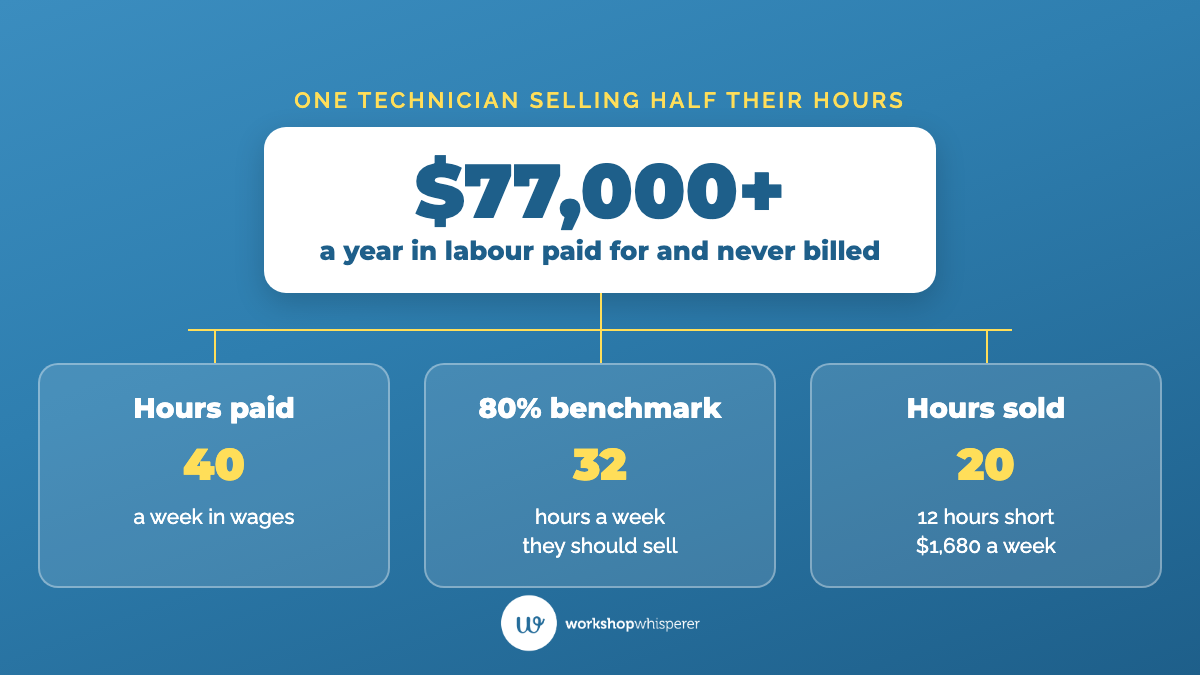
A worked example. Take one technician paid for 40 hours a week who sells 20 of them. The benchmark we hold technicians to is a minimum of 80 to 85% productive, and 80% of 40 hours is 32. That's a gap of 12 hours a week. At an example labour rate (labor rate, if you're in the US) of $140 an hour, that's $1,680 a week in labour you've already paid wages for and never billed. Over 46 working weeks it's more than $77,000 a year, in one seat, before you count the good technician who might walk. Run it with your own rate and your own hours.
Is it the technician, or is it me?
With our clients, we ask them to take extreme ownership of their own leadership before they decide anything about the employee. Often when someone isn't succeeding, it's because we haven't set them up to succeed. They didn't get the right training. The systems weren't in place. We weren't communicating properly. Or we've been so flat out that we haven't spent any time with them at all. When that's what you find, that person deserves a second chance.
Then look past the person. When a technician isn't charging out close to the time you're paying them for, there are at least five things to check before you settle for it:
- Work ethic. Do they have the drive to charge out more hours?
- Experience. Do they have the skill and the confidence to work faster without making errors?
- Bottlenecks. Is something in your workflow stopping them, like waiting on parts, approvals or a free hoist?
- Not enough work. Are you feeding them enough jobs to sell their hours, through your marketing and your upselling?
- Too many technicians. Are you carrying more technicians than the work you have?
Only the first two are about the person. For those, your options are more training or performance management. The other three are your problems to fix, and moving someone on won't fix them. If the gap is training, Ultimate Team Advantage is a self-paced program that trains every employee in your shop to the standard you expect: you hire them, I train them, you coach them.
The fifth one surprises people. Dean has seen it in the shops we've benchmarked: many are carrying too many technicians, skills shortage or not, and when a technician leaves, the shop's productivity or profitability improves.
Dean is blunt about the standard itself: "If you cannot clearly articulate the standard to your team, do not be disappointed when that standard is not met." Most owners have the rules of the game in their own heads and nowhere else. If yours are still in your head, write them down before you hold anyone to them.
When good work comes slowly. Daren, from Adelaide, wrote in about a technician who did good work but was incredibly slow, and the rest of the team felt they were carrying him. Before you decide anything, weigh up what he gives you. Is he a cultural fit? Does he live your values? Does he mentor the younger ones? If he goes faster, does he make mistakes? Is there a physical reason he's slower? And ask the team how it's affecting them, because what they're feeling might be a misunderstanding rather than the truth. If he ticks every box and the cost is 90 minutes a day, that might be a trade worth making. I'd only roll the dice on the job market if there were toxic issues as well.
How do I fix it, and what if nothing changes?
Have the conversation, calmly and early. We call it a feedback forum rather than a performance review, because calling it a performance review puts fear into people before they've sat down. A good opening question is "How do you feel you're going? Do you think we've seen the best of you yet?" If they say yes and their best isn't up to the standard, you both know where the rest of the conversation is going.
Dean's rule for these conversations is to go soft on the person and hard on the problem. The problem isn't them and it isn't you, it's their performance. Leave your frustration at the door, talk about what changes from here, and finish with an action plan they've agreed to.
Set the standard, the timeframe and the consequence. If it's a repeated performance problem, they need to know three things: what's expected, that they'll get a fair opportunity to get there, and what happens if they don't. Give them the instruction or training they need to change, and a fair amount of time to show it. That might be 7, 14 or 30 days. You can't tell someone that if their productivity isn't at 80% by Friday, they're gone. That isn't fair, and it won't stand up.
Know your employment law before you act. Call Fair Work Australia, the employment department in New Zealand, or the equivalent where you are, and get your ducks in a row. Outside of gross misconduct, you have to performance manage someone out, with proper documentation and proper meetings. If you skip the steps, you can end up at a tribunal, and by then it's usually the former employer paying.
Kirsty Gardner runs Ja-Max Industries in Blackwater, Central Queensland. They started as a mobile business and have grown to 14 staff. "I think we just grew too quick and we never had our SOPs and that in place," she told us. So they set aside a whole day with no work, went through every SOP, trained the whole team in one go and put a handbook in place. When they later had issues and personality clashes to sort out, that groundwork is what put them in a position to take disciplinary action. They now have "clearer communication on what's expected with our team". Kirsty works from home full time, 200 kilometres from the shop: "I can basically just drop stuff and walk away and I know it's fine."
Then follow through. Once a toxic or underperforming person realises you're serious, they're more likely to decide for themselves that they don't belong in your workplace and leave of their own accord. Sometimes the process alone sorts it out.
If it doesn't, it's time to let them go. Hire slow, fire fast. You've done everything you could to help that team member choose success, and they chose otherwise. Your team is watching what you tolerate, not listening to what you preach. So put your big boy or big girl pants on, take a teaspoon of cement and make the call. You may have to work on the tools a little longer in the short term, and that's a better trade than carrying the cost of one person for months more.
Watch this eight-minute episode before you sit down for the conversation. Dean and I talk through the hidden cost of carrying an underperformer, and why replacing a technician the moment one leaves can be the wrong move.
Questions auto repair shop owners ask about underperforming technicians
How long should I give an underperforming technician to improve?
Long enough to be fair, and with a date set from the start. Agree the standard, give them the training or instruction they need, then meet again in 7, 14 or 30 days depending on what has to change. Check your local employment law for what counts as a fair period where you are.
Can I dismiss a technician straight away?
Only for gross misconduct, and check your employment law first. For anything else, you performance manage them out: clear expectations, a fair chance to improve, documented meetings and warnings, and dismissal at the final meeting if nothing has changed.
Should I keep a bad technician because I can't find anyone better?
Rarely. Having someone isn't better than having no one when they're costing you hours, comebacks and the respect of your good people. A vacant seat leaves room for the right person to come along. Ask first whether you need the seat at all, because many shops are carrying more technicians than their work needs.
My technician does good work but he's slow. What should I do?
Weigh up everything he brings, not only his speed. Look at cultural fit, values, mentoring and quality. Then find out whether training would help him go faster without errors, and whether there's a physical reason he's slower. If he ticks every box, a slower technician who does good work and lifts the team can be worth keeping.
My apprentice is finishing his time and he isn't performing. Do I have to keep him?
Speak to the RTO you apprenticed him through and to Fair Work first. In Australia, an apprentice's employment ends when they finish their time, and you can choose whether to rehire them as a tradesperson. Before you decide, reflect honestly on whether your own leadership with this person has been top-notch. If it has, and four years hasn't changed things, the trade certificate won't either.
Where to start tonight
Pull the last four weeks of timesheets for the technician you're worried about. Add up the hours you paid them for and the hours they actually sold, and work out the percentage. Then write down, in one sentence, what good looks like in their role.
If you can't write that sentence, start there. If you can, and the number is well below 80%, you're ready for the conversation.
Related questions:
- How Do I Hold My Team Accountable Without Micromanaging?
- How Do I Train a Service Advisor?
- How Do I Stop Winging It in My Auto Repair Shop?
See what changes for the people who do this work. On our Our Clients page, auto repair shop owners, named and on camera, tell you what actually changed in their shops and their numbers.
More on this topic: all Performance articles.
Whenever you're ready, here's how we can help.
- Not ready to spend anything yet? Start free with Shop Talk, a 30-day reset for auto repair shop owners on our YouTube channel, and our free resources for auto repair shop owners.
- Want your whole team trained to the standard you expect? Ultimate Team Advantage is a self-paced program for every employee in your shop. You hire them, I train them, you coach them.
- Running an auto repair shop under $50,000 a month? Auto Superstars Academy builds the foundations, with one-on-one coaching on demand from a business coach who is a current or former auto repair shop owner.
- Over $50,000 a month? The Engine Room changes how the whole business runs, from your numbers to your team, delivered online with one-on-one coaching on demand.