

How Do I Hire My First Service Advisor?
You hire your first service advisor as soon as you've become the bottleneck, which for most owners is earlier than they think. Start part-time if you need to, even school hours. Look for someone who enjoys selling and looking after people, rather than someone who likes paperwork. Work out what you can pay from your profit and loss, not your gut. Then run a simple process: an ad that leads with what's in it for them, a phone screen, a proper interview, one honest reference question and a fast offer.
If you've put it off, it's usually because the money looks too tight to add a wage. That's a fair worry, and it's the one I hear most, so I'll show you below how to check the numbers for your own shop.
Your shop might call the role a service advisor, a service adviser or a service writer. You might run an auto repair shop, a mechanics workshop or a garage. The hire works the same way. As I said on Talking Shop, hiring your first service advisor, even part-time, "isn't as difficult as you thought it would be, and training's not that difficult, either."
When is the right time to hire a service advisor?
If it's still only you, your first hire should always be somebody to answer the phone, talk to your customers and do your invoicing. I know that sounds backwards when what you need is more money coming in. Ask yourself one question: where do you, the owner technician, make the most money for the business? In those early years the answer is on the workshop floor, getting cars serviced and repaired and back to their owners.
I see far too many of you doing your invoices on a Saturday or a Sunday when you should be with your family. Every phone call pulls you off a car, so the car you're working on goes back late. You become the bottleneck for your workflow, your cash flow and your customers, and you won't grow unless you let go.
If you already have two or three technicians and you're running backwards and forwards between the front and the back, the decision is a little different. Decide whether you're better placed out the front or out the back. Think about where you make the most money, and be honest about what you enjoy. If your body is telling you it's had enough of the tools, hire the technician and move out the front yourself. Bear in mind that if you're the only person at the counter, the shop can't run when you take time off.
Bek and Trent Jackson run Busselton Automotive Repairs in Busselton, WA. When they moved to a bigger workshop, Trent came off the tools and into the office to do the service advisor side of things, and they worked out pretty quickly it wasn't the role for him. Hiring a service advisor "wasn't even something on our radar," they told us. "I guess we both had the mentality that we needed to be at the front of our business for it to work because our customers would only want us." They were three years into business by the time they hired one, and "that completely changed not only our business but our life." Watch Bek and Trent's story.
Once you do have a service team, these are the signs it needs another pair of hands:
- Things are left off job cards. Parts and time go uninvoiced.
- Calls, texts and emails go unanswered. Walk-ins wait, and quotes go back late.
- Upsell conversations don't happen. There's no time to have the right conversation, so the approvals never come.
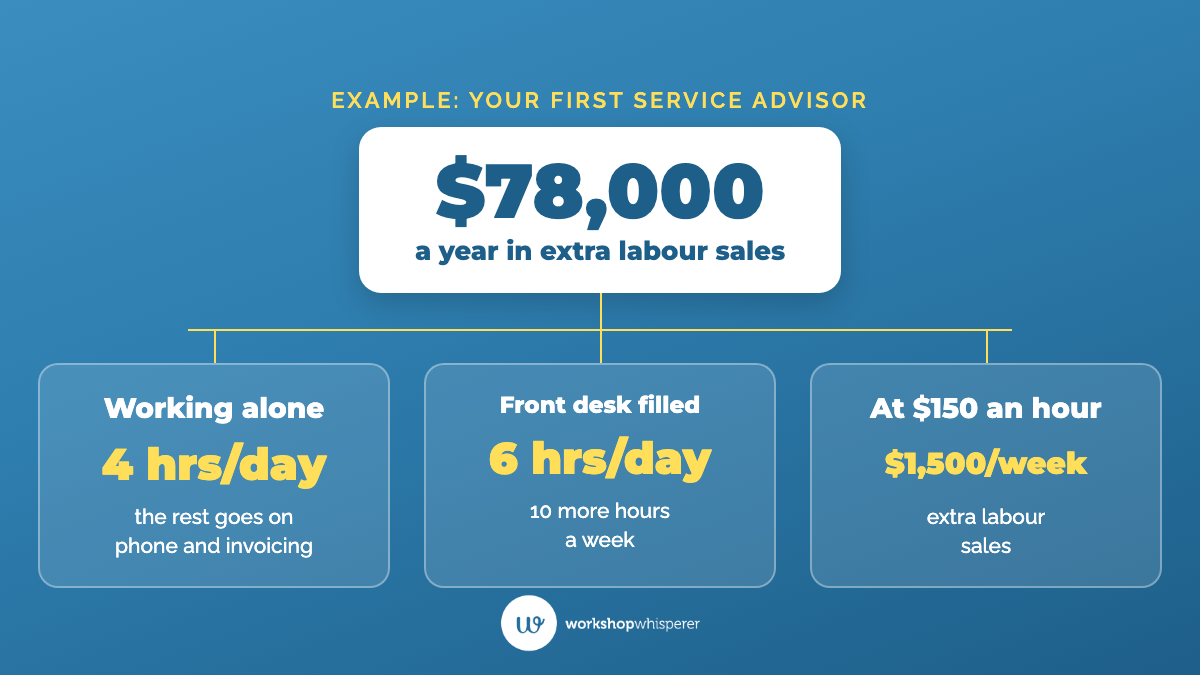
What it's worth. Here's an example with round numbers. Picture an owner technician working alone who sells about four hours a day, because the rest disappears into the phone, the counter and the invoicing. With someone on the front desk, I'd expect you to invoice somewhere around six hours a day. That's two more hours, five days a week, or 10 hours a week. At an example labour rate of $150 an hour, that's $1,500 a week in extra labour sales, or $78,000 a year, before you've sold a single extra part. Put in your own hours and your own rate, then set that against what a part-time person costs in your area.
So treat the wage as an investment, and look for a return of five or six times what you pay. Then check it against our wages benchmark: wages and salaries at 25% or less of your total turnover. If you're under it, you have room. If you're over it, look harder at what the new person will let you sell before you commit to a figure. Take every one of these numbers from your profit and loss report, not a guesstimate.
Who should I be looking for?
Start with what the job is. Your service advisor is the liaison between the customer and the technician. Their job is part sales, part customer-loving guru. They become the advocate for the customer's car.
A receptionist is not a service advisor. People drawn to reception and admin roles are usually office trained, and they don't like asking people for money or hearing the word no. A good service advisor likes sales, and enjoys presenting the technician's findings to the customer in a way that's genuine and ethical. If you're hoping your receptionist can step up, it usually only works when they were a salesperson first.
Hire for culture, then train the skill. As I said on Talking Shop with Dean, "there aren't that many highly qualified service advisers around the traps, even ones that come from dealerships." Most will need training to get up to speed, so they have to be open to it. You can teach the skills, so hire the attitude and the cultural fit.
Your first person may already be close to home. I'd love you to go straight to recruiting a service advisor, even part-time. Often it starts with a partner, or a mum who wants to work school hours, and that can be your best option. Whoever it is, train them to be your gatekeeper. They take the bookings and the messages, they hold the boundaries you set, and you stick to those boundaries too.
Amy wrote in to our podcast from Geelong. She ran the business with her husband and had always done the admin, until they had kids and the work had to be squeezed in around small children. She was stressed, and wondering how to do it all. My advice was to write down every task she was doing first: the bookkeeping, the invoices, chasing receipts, greeting customers. Some of those tasks are a bookkeeper for a few hours a week. The customer-facing ones are a service advisor.
Know where they sit on your org chart. Before your next hiring decision, draw your org chart for three to five years from now, with every role you'll want, including the ones you're doing yourself. Cost each one out. It tells you who comes next, and stops you hiring in a panic.
How do I find and hire the right one?
Most hiring in our industry is born out of an emergency. Someone leaves, an ad goes online that night, and the interview is a handshake on the workshop floor and "bring your toolbox over tomorrow", with no uniform waiting. The person you want is weighing up other offers, and a professional process is how you win them.
Write the ad around what they want. Put lifestyle, values, growth and flexibility at the top, and the skills you need at the bottom. Once someone's basic needs are met, that's what they're looking for. Ask for a cover letter. It's a simple instruction, and it weeds out the resumes you don't want to read.
Put it where people will see it. Use your social media, keep a careers tab on your website so you're always recruiting, and try your local community. I filled a position from the notice board at Coles.
Phone screen before you interview. Call without booking a time first. How someone reacts when you catch them off guard tells you a lot about how they'll handle a busy counter and an unhappy customer.
Interview properly. Find out what lights them up and what they're working towards outside work, so you can match it to what you offer.
Check references. This is the step that gets skipped most, because a little voice says this person looks good and you really need someone. There's really only one question to ask a previous employer: "Would you hire them again?" If they say yes, ask why. If they say no, definitely ask why.
Make the offer fast. If you say you'll be back to them in 24 hours, be back in 24 hours. Speed of hiring is key, because good people are entertaining more than one offer. Have the paperwork and the uniform ready, and have an onboarding plan that supports them past probation.
Protect them once they're in. As Dean says, A players want to play with other A players. If you tolerate poor behaviour from the rest of the team, your new service advisor won't stay.
If you'd like this whole process built for you, No More Bad Hires is our low-cost online recruitment program for auto repair shops. It covers the job ad through to onboarding, for service advisors, technicians and apprentices.
Watch this before you decide your next hire is another technician. It runs under eight minutes. In it I explain why your first hire belongs at the front counter, what your gatekeeper needs to do, and why your customers won't leave because they're not talking to you.
Questions auto repair shop owners ask about hiring a service advisor
Can I afford a service advisor if I'm not paying myself properly yet?
That's when most owners make the first hire, and it's always hard. Work out how many more hours you could sell if someone else had the phone and the invoicing, and what they're worth at your labour rate. Then check the wage against your wages benchmark.
Should my first service advisor be part-time?
It can be. Half a person, in school hours or part-time, often covers the bulk of the day and frees you to sell more hours. Once you're past about three and a half technicians to one advisor, add at least another half a person.
Should I hire a service advisor from a dealership?
Not automatically. There aren't many highly qualified service advisors around, even from dealerships. Look for a sales personality and someone open to learning how your shop does things.
Should my partner work the front counter?
Often that's how it starts. Treat it as a real role with boundaries. If your partner prefers the books to the customers, give the books to a bookkeeper and find a salesperson for the front.
What's the one reference question I should ask?
"Would you hire them again?" Then ask why, whichever way they answer.
Where to start tonight
Get your interview ready before you write the ad. Our free checklist, 5 Smart Questions to Ask Before You Hire, gives you five interview questions and shows you what an A player's answer sounds like next to a bad hire's. Print it, add the reference question at the bottom ("Would you hire them again?"), and put it in the drawer at the front counter. When the first application lands, you'll interview from a process instead of a panic.
Related questions:
See what changes for the people who do this work. On our Our Clients page, auto repair shop owners, named and on camera, tell you what actually changed in their shops and their numbers.
More on this topic: all Culture & Meaning articles.
Whenever you're ready, here's how we can help.
- Not ready to spend anything yet? Start free with Shop Talk, a 30-day reset for auto repair shop owners on our YouTube channel, and our free resources for auto repair shop owners.
- Ready to hire, and want to get it right the first time? No More Bad Hires is a complete recruitment system for finding and keeping the right people.
- Hired them, and want them trained properly? Superstar Service Advisor trains the person at your front counter to present the work, hold the price and convert what your technicians find.
- Running an auto repair shop under $50,000 a month? Auto Superstars Academy builds the foundations, with one-on-one coaching on demand from a business coach who is a current or former auto repair shop owner.
- Over $50,000 a month? The Engine Room changes how the whole business runs, from your numbers to your team, delivered online with one-on-one coaching on demand.