

How Do I Keep Good Technicians and Apprentices?
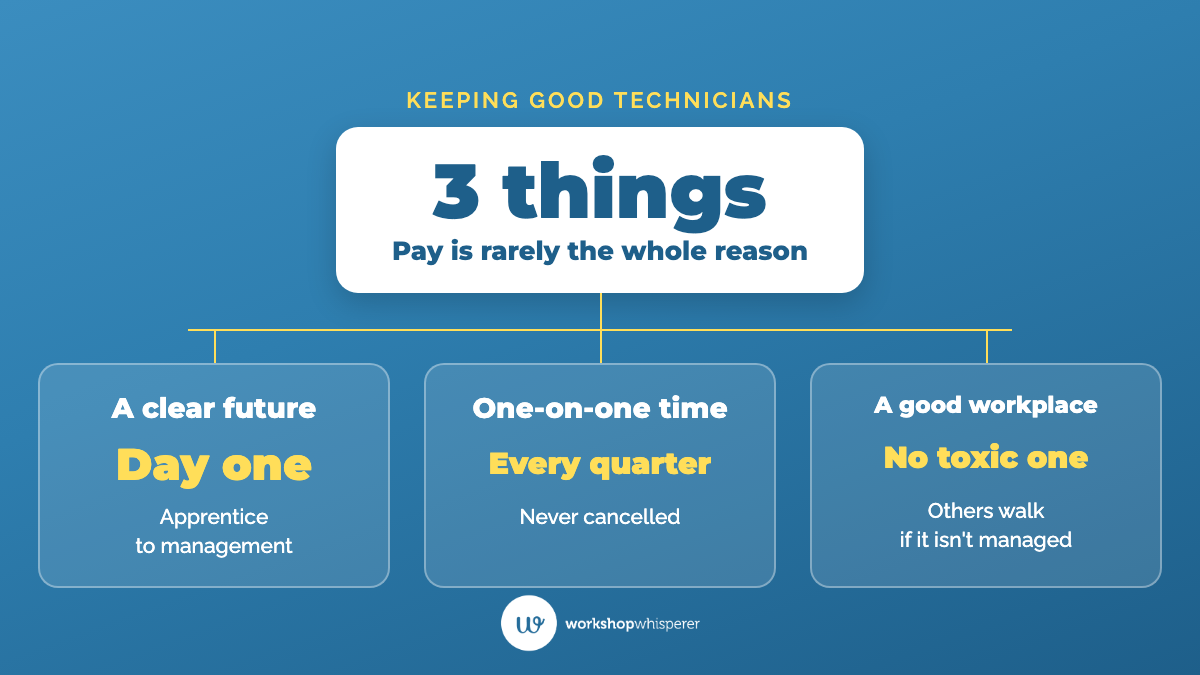
You keep good technicians and apprentices by showing them a future in your business from their first day, sitting down with each of them every quarter without fail, and dealing with the person who makes the place hard to work in. Pay has to be right, but it's rarely the whole reason a good person leaves.
If you've lost good people and can't work out why, it rarely comes down to being a bad boss. More often, nobody asked them the right questions while they were still there.
Whether you call it a mechanics workshop, an automotive workshop or a garage, skilled technicians are in short supply, and the ones you already have are worth more to you than any you're trying to find.
Why do good technicians leave?
When a good technician resigns, they'll usually give you one reason. They've been offered ten grand more down the street. Matt Taylor, an HR specialist from Heart HR who joined our recruitment summit, says there's often an underlying reason they're not telling you, and it's usually the work environment rather than the pay.
He told the story of an automotive workshop he worked with that moved on a toxic employee, "a nightmare to put it politely". The response from everyone else was a huge sense of relief. Afterwards, they were told that other people would have walked if that person hadn't been managed.
Good people can be driven out by one bad one while you're busy on the floor. As I said that day, none of us wants to think our leadership is poor, but sometimes we have to get the old mirror out and recognise where not wanting to feel uncomfortable, or not wanting to have the conflict, leads to good people going.
Josh Mullock owns The Caravan Hub in Townsville. It's caravan repairs rather than cars, but the team problem will sound familiar. "We had a very toxic team," he told us. "We had guys intentionally damaging other people's work, just to put them behind. We had tools getting hidden." He was hiring people for bodies and "felt like my team had all of the power over me." What turned it around was "hiring for culture and training for skills", and calling them his team, not his staff. Now, "my whole team is on side. They love being at work," and they're "taking on more responsibility, putting their hand up more."
The second reason is a lack of a future. Some of your team are hungry to progress, and if they can't see where they're going with you, they'll go and find it somewhere else. As Matt put it, two or three years down the track they've left, and they say, "Well, I left because nobody cared about my future growth."
Be realistic too. Matt's figure for the average time anyone stays in a job is about three years, and younger people move around more. Give them every reason to stay, and stop pulling your hair out over the ones who were always going to move.
Why do my apprentices keep quitting?
Travis wrote in to our podcast from Camden in New South Wales. "We've had three apprentices bail in 18 months. How do I find someone who actually sticks?"
If that sounds like your shop, you're probably in one of two camps. Either you can't face training another one, or you know that if we as an industry don't start growing our own, the technician shortage will go on forever.
Before you look for the next apprentice, look back at the last three:
- Were they showing signs before you put them on that they weren't invested in a career, or were they there to see if they liked it?
- Were you able to support them in a way that set them up to succeed, from you or a senior technician?
- Is someone on your team sabotaging them? Apprentices are usually young, and getting a hard time at work, or working beside someone toxic, is enough to make them head for the hills. Sometimes that person is the owner.
When an apprentice isn't cutting it, slow right down before you pull the pin. Paul from Mildura asked me exactly that. Start with a deep conversation about whether they really want a long-term career in the industry. Some kids learn differently, and some are so petrified in a team of older technicians that they shut down and look disinterested. Ask their TAFE or technical college teacher if they behave the same way there. Talk to their mum and dad. Bring in the apprenticeship company so the message is clear: here's what we need to see from you, and by this date.
Do it with compassion. Apprentices who stay are our best shot at replacing the qualified technicians the industry is missing.
Then change where you find them. Make friends with the TAFE or technical college so you hear about apprentices who've lost their host employer. Make friends with the local high school and offer school-based training to the students doing a Certificate II in automotive as part of Years 11 and 12, so you get the pick of the bunch.
What actually keeps good people?
Show them the pathway on day one
An apprentice needs to see from the first day where they could end up with you: apprentice, technician, senior technician, foreman, then management. Or a specialist path, like diagnostics or performance work. If they buy into that picture, they stick around longer, because you helped map it out.
If you'd rather not build that path from scratch for every person, apprentices included, that's the job of Ultimate Team Advantage. It takes your whole team from self-leadership through to leadership while you coach them along the way.
Sit down with every one of them, every quarter
Inside The Workshop Whisperer we call this a feedback forum, and we deliberately don't call it a performance review, because that word puts people on edge. Once a quarter, every team member gets uninterrupted time with you, in the staff room or out for a coffee. New starters on probation get one every six weeks.
You open by asking how they feel they're going in the role, and whether you've seen the best of them yet. Then you ask what they're working towards, at work and in life. One might want to run a team one day. Another might be saving for a deposit on their first house. Then ask how you can help. For the house deposit, splitting their pay across two bank accounts can make that goal feel real.
When a team member believes your business is helping them get where they want to go, they're more likely to be loyal, to buy into your vision and to stay.
Matt added one warning. If you've told someone you're meeting on Friday afternoon, meet on Friday afternoon. Keep moving it and they won't feel you're taking them seriously.
Skip these catch-ups altogether and you can lose the confidence of a team member over the course of a year. Meet at least once a quarter and you get the chance to talk through any resentment before it festers, rather than lose an A player because you weren't aware of it.
Reward what they value, not what you assume
Before you build a bonus scheme, ask each technician, one at a time, what would reward them. One wants extra money for the house deposit. Another already has the house and the family, and wants time off. You could put together the world's best pay plan, and if it doesn't float their boat, it's useless.
And only reward people who are already doing the job. If your technicians aren't above 80% productivity, sort that out first.
What keeping someone is worth. Here's a worked example with round numbers. Say you have three technicians and you set aside a bonus of up to $300 per technician a month, $100 for each of three targets: productivity, efficiency and effective labour rate. That's a pool of $10,800 a year, budgeted and put in its own account. Now say one good technician who sells 30 hours a week at $150 an hour walks out, and the bay sits empty for six weeks while you hire. That's $27,000 in labour sales you never made, before you've paid a cent to recruit or train the replacement. A full year of bonuses costs less than half of that one empty bay. Run the same sums with your own hours and rate.
For the ones who value time, look at a four-day week. We've helped hundreds and hundreds of repair shops in Australia and New Zealand make that change. One of our clients in Busselton, WA, Beck, made a job ad video asking her team what they liked about working there. Every single one of them mentioned the four-day week.
Deal with the toxic one
It's the owner's job to set the culture. Leave it to chance and the culture becomes whatever your loudest person brings, and the good people in your team are the ones who pay for it. When someone who needed to go finally resigns, pay out their notice and let them go that day, within your local employment laws, so they can't undermine you on the way out. What we've seen time and again is that team members you didn't even know were being affected come and tell you how much better they feel at work.
I've used this exact rhythm to grow my own team from a team of one: a seven-minute huddle every morning, a weekly team meeting, a longer monthly one, and a feedback forum every quarter for every person. It's the best way we've found, in 13+ years and more than 10,000 auto repair shops, to develop people so well they could succeed anywhere, inside a culture they don't want to leave.
Watch this before your next team meeting. In about 19 minutes I walk through why "I don't have time to develop my people" is the trap that costs you good people, and the daily, weekly, monthly and quarterly rhythm that fixes it.
Questions auto repair shop owners ask about keeping technicians and apprentices
How much should I pay to keep a good technician?
More than the minimum. The award, or your local legal minimum, is the floor. Pay is only part of the package. Flexible hours, a four-day week, a fuel card, lunch on a Friday and a clear career path all count, and the right mix comes from asking each person what they value.
How do I tell a freshly qualified apprentice they won't be on top dollar straight away?
Have an honest conversation. Finishing the certificate is the first day of their learning journey, not the last. The real learning happens when they're working on their own jobs, so give them a safe place to make mistakes and show them how they'll progress from here.
Do I have to keep an apprentice on when they finish their time?
In Australia, an apprentice's employment generally ends when they're signed out, and you can choose to rehire them as a tradesperson. Check with the apprenticeship company and Fair Work, or your local equivalent, before you act. If one has struggled for four years, don't expect qualifying to change them. The way they do one thing is usually the way they do everything.
When should I give up on an apprentice who isn't cutting it?
Only after you've opened every door and had every conversation: with the apprentice, their TAFE teacher, their parents and the apprenticeship company, with a clear date for what needs to change. Check your own leadership honestly too. If nothing has moved after all that, letting them go is the right call.
Where to start tonight
Open your calendar and create a recurring quarterly catch-up for every person on your team, starting with the ones you'd least like to lose. Then write each name on a piece of paper, and next to it, what that person is working towards in their life. Where you can't fill in the blank, you've found your first question for that catch-up, and probably the person most at risk of leaving.
Related questions:
See what changes for the people who do this work. On our Our Clients page, auto repair shop owners, named and on camera, tell you what actually changed in their shops and their numbers.
More on this topic: all Culture & Meaning articles.
Whenever you're ready, here's how we can help.
- Not ready to spend anything yet? Start free with Shop Talk, a 30-day reset for auto repair shop owners on our YouTube channel, and our free resources for auto repair shop owners.
- Want a team that grows without you training every person yourself? Ultimate Team Advantage is a low-cost program that trains your whole team, from self-leadership to leadership, so they can see themselves growing and you get to coach it.
- Running an auto repair shop under $50,000 a month? Auto Superstars Academy builds the foundations, with one-on-one coaching on demand from a business coach who is a current or former auto repair shop owner.
- Over $50,000 a month? The Engine Room changes how the whole business runs, from your numbers to your team, delivered online with one-on-one coaching on demand.