
How Do I Build a Team That Takes Ownership?
You build a team that takes ownership by giving each person a clear, measurable result, asking what's getting in the way, removing it, and agreeing two or three actions. Then you hold them to that standard every day, including the busy ones. Ownership comes from accountability that sticks, and a pep talk at the Monday toolbox meeting can't do that job for you.
If your team keeps bringing every problem back to you, it's rarely because they don't care. As Dean, who co-hosts Talking Shop with me, puts it, it's rarely a people problem.
The pattern is the same whether you run a mechanics workshop in Brisbane, an auto repair shop in Texas or an independent garage in Leeds, and whether the person on your front counter is called a service advisor, a service writer or a service adviser.
Why won't my team take ownership?
Dean asked me this exact question on Talking Shop, and my answer was simple. There's one main reason your team doesn't take ownership: you've never truly held them accountable.
Every person on your team arrived with a history. They've worked for other bosses, under other standards, and some of those bosses never asked for much. You might be lucky and get the odd self-starter who turns up wanting to help you hit your goals. As I said on the show, "those employees are more like unicorns than they are stock standard coming out of the factory." Everyone else needs an instruction guide on what the expectation is and what it looks like to be held to it, and writing that guide is your job.
Most owners have tried. You put a good system in place, say continuous time clocking. You train the team on it. Then it doesn't stick. Your intentions were good. You got busy, your team was watching, and they went back to the way they'd always done it.
Dean names the other half of the problem. Ownership is usually assumed, mentioned in passing at a meeting, and hoped for. "You can't wish ownership into existence," he says. "You can't inspire it with a good speech or a toolbox meeting on a Monday morning."
Asking your technician to "take more ownership of productivity" gives him a direction with no destination. He'll head off roughly the right way and stop where he thinks good enough is, which is rarely where you had in mind.
Is it them, or is it me?
Usually a bit of both, and the part that's yours is the part you can change this week. There are three places owners quietly give ownership away.
You want to be liked. I call it a rookie leadership error, and it's one we've all made. You think that if you're the nicest boss, the fun boss, with no consequences for poor workmanship and no tough conversations, you'll get a great culture. What you get is a team that turns up to collect a pay packet. Dean's view is that a little tension is healthy, enough that everyone knows exactly what the standard is.
You're afraid they'll leave. With a technician shortage across Australia, New Zealand and the US, plenty of owners worry that holding someone to a benchmark will push them out the door and they'll never replace them. So they put up with a substandard result. The moment you do that, you're losing money. If you've got the system and you don't hold the team to it, that's on you, and it's costing you.
You answer every question. A technician comes to you stuck, and you walk over and do it yourself because you're faster. It feels efficient. It also teaches them to come straight back next time, and the time after that.
Rob McKenzie and Ben Pace run East Coast Customs. They've been mates, cousins and "partners in crime for nearly 40 years", and for a long time they thought their business was different. When they started being coached, they were told they were the problem. "We were like get out," they say. "It then took us a little bit of time" to realise "that extreme accountability and ownership meant that we were the problem." Now they use "protocols and procedures" to take the emotion out of decisions, and one of them says The Engine Room taught him "to be a better leader for my team members to be a bit more accountable." Watch Rob and Ben's story.
Letting it slide has a price you can work out. Dean's example on Talking Shop is a qualified technician expected to sit at 90% productivity at least, and he says to explain why: that level is what helps pay the technician's own wage and makes their contribution to the gross profit of the business.
A worked example. You pay a technician for 38 hours a week, and you need them to sell as much of those 38 hours as possible. Capture an extra 3 minutes an hour and move it onto the invoice. Across an 8-hour day, that's 24 minutes. Once you take out public holidays and annual leave, that's around $10,000 a year in labour profit on your bottom line, for every technician. Three technicians, $30,000. Seven, $70,000. If your team only sticks to the system some of the time, I guarantee you'll find more than 24 minutes a day.
How do I get my team to take ownership?
You build it into every conversation, one team member at a time. Dean teaches this as the four Rs, and it's the clearest version of it I know.
1. Result. Start with a result that is clear, measurable and agreed by both of you. "Every customer called with an update by 2pm every day" is a result, where "be more accountable" is only a direction. Either it happened or it didn't, and nothing gets lost in translation.
2. Risk. Ask one question, then listen: "What's getting in the way?" Dean says the answer will be one of four things. They've never been shown how (knowledge). They're being pulled in three directions at once (priorities). The process only lives in your head (process). Or they don't feel safe to make the call and get it wrong (confidence). Don't assume which one it is. Solve the wrong blocker and three weeks later you'll be having the same conversation.
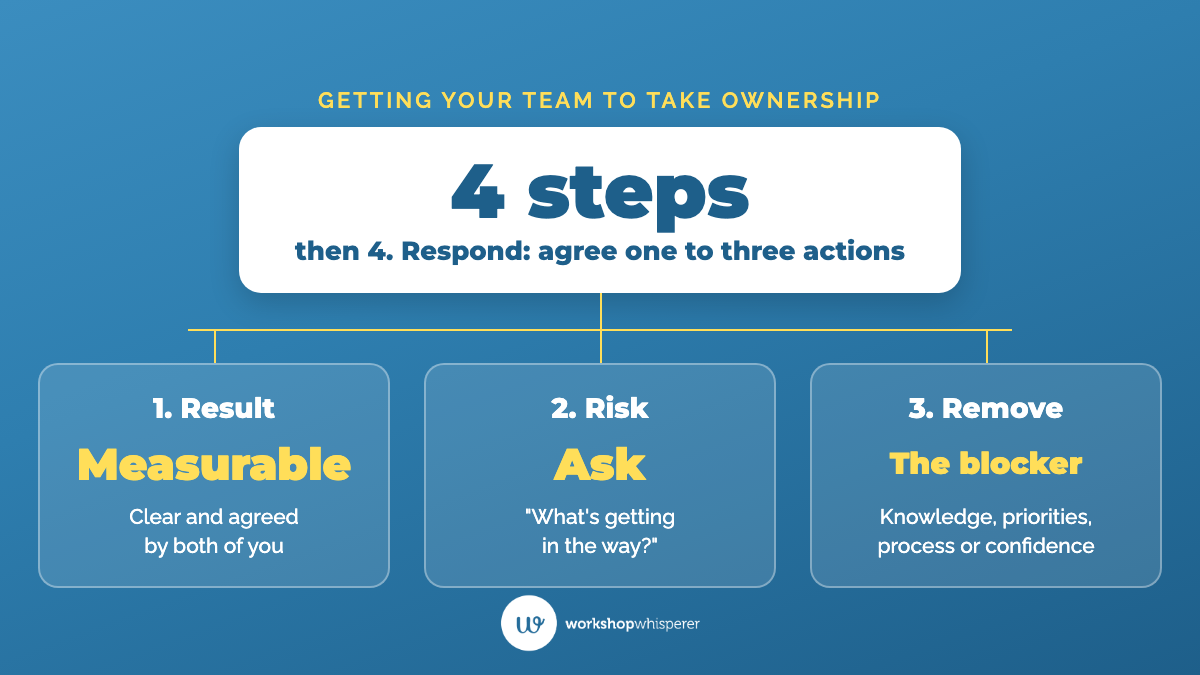
3. Remove. Fix that specific blocker. Show them, film it, or point them to the written procedure. Take something off their plate. Write the process down. Or give them a clear decision line, such as your service advisor being able to solve a customer problem up to a set dollar amount without coming to you. Sometimes the blocker is you, and what needs removing is your hand on a decision that belongs to someone else.
4. Respond. Agree on one, two or three actions, never a long list, with who does what and by when. Both of you leave with something to do. Your service advisor commits to the 2pm update calls this week. You commit to taking away the admin job that's been eating their mornings. You check in on Thursday.
Pair that with the 1:3:1 Method for the questions that come to you during the day. When a team member brings you one problem, they also bring three possible solutions and tell you the one they favour. It works whether you've got one team member or fifty. An apprentice might only manage one solution at first, and that's fine, because they're still having a crack. Hold to it when you're flat out, because that's when the habit gets built or broken. Mistakes are allowed as long as they learn from them. Making the same one over and over is not.
Then make it visible every day. In your daily toolbox meetings, tell the team how they're tracking against what you need from them. Reflect on the day before, and ask, "What do we need to do to get closer to our goal?" As I said on Talking Shop, "gradually you will earn their trust that you are watching, but that you're also there to help."
And when you get it wrong, say so. The best leaders I've seen come through The Engine Room and the Million Dollar Mechanics Boardroom are the ones willing to put their hand up when they've made a mistake. That shows the team it's safe to own theirs.
If you'd rather not build that training for every person yourself, Ultimate Team Advantage trains your whole team, from self-leadership to leadership, to the standards you expect, and your job becomes holding the standard rather than teaching it from scratch.
Watch this seven-and-a-half-minute episode before your next toolbox meeting: Dean and I talk through the real reason your team isn't taking ownership, and the conversation that resets it.
Questions auto repair shop owners ask about building a team that takes ownership
Will time clocking make my team feel micromanaged?
Some may grumble at first. Time clocking is a record of where the 38 hours you pay for actually go. It only builds ownership if you use it, so clock 100% of the day, apply it to everyone it covers, and stop writing time off because someone forgot.
Why does one of my technicians run with a job while another freezes?
They take instructions differently. Dean calls them set menu people and buffet people. Set menu people want the steps in order, and if you hand them open options they freeze. Buffet people want the outcome and room to choose, and if you hand them a strict checklist they push back. Ask each one: "Do you want me to give you the steps, or do you want me to give you the options?" One of our Million Dollar Mechanics Boardroom members asked his senior technician that. The answer was "tell me the steps", so he set up a checklist, and over the following weeks that technician became more and more reliable.
What if someone still won't take ownership?
Have the same conversation with every team member, and give each one the training and the chance. Some still won't meet the standard. When an owner finally parts ways with someone who can't hit the mark, productivity, efficiency and morale go up. We've watched shops perform better with fewer people on the floor, because they're the right people.
Do I have to stop being the nice boss to hold people accountable?
No. You can be warm and still hold the standard. What you can't do is be the fun boss on Friday night and expect the business owner to be taken seriously on Monday morning. Set the boundary, write the standard down, and then follow through on it, because a standard that only lives on paper changes nothing on the floor.
Where to start tonight
Pick the one team member who frustrates you most, and one number that matters in their job. Write down the result you want from them, with a date on it, and one sentence on why it matters to the business. Tomorrow, sit down with them, agree on that result, and ask, "What's getting in the way?" Then listen to the whole answer before you say a word. Agree no more than three actions, and make sure one of them is yours.
Related questions:
See what changes for the people who do this work. On our Our Clients page, auto repair shop owners, named and on camera, tell you what actually changed in their shops and their numbers.
More on this topic: all Culture & Meaning articles.
Whenever you're ready, here's how we can help.
- Not ready to spend anything yet? Start free with Shop Talk, a 30-day reset for auto repair shop owners on our YouTube channel, and our free resources for auto repair shop owners.
- Want your whole team to step up and own their work? Ultimate Team Advantage is a low-cost program that trains your whole team, from self-leadership to leadership, to the standards you expect, so you get to coach it instead of carrying it.
- Running an auto repair shop under $50,000 a month? Auto Superstars Academy builds the foundations, with one-on-one coaching on demand from a business coach who is a current or former auto repair shop owner.
- Over $50,000 a month? The Engine Room changes how the whole business runs, from your numbers to your team, delivered online with one-on-one coaching on demand.