Do I Need Terms of Trade for My Auto Repair Shop?
Yes, and signed by every customer before work starts. They are the cheapest protection available to an auto repair shop, and most shops either have none or are relying on a few lines printed on an old cardboard job card.
That is not enough. It was never enough.
Terms of trade are the legal baseline that sits under everything else you build. When something goes wrong, and occasionally it will, the difference between a sleepless fortnight and a short conversation is usually whether the customer signed something enforceable.
Australia has the PPSR legislation behind this. New Zealand has its own version. If you are reading this from a garage in the UK or a shop in the US, check your own jurisdiction for the equivalent, because the principle travels even when the statute does not.
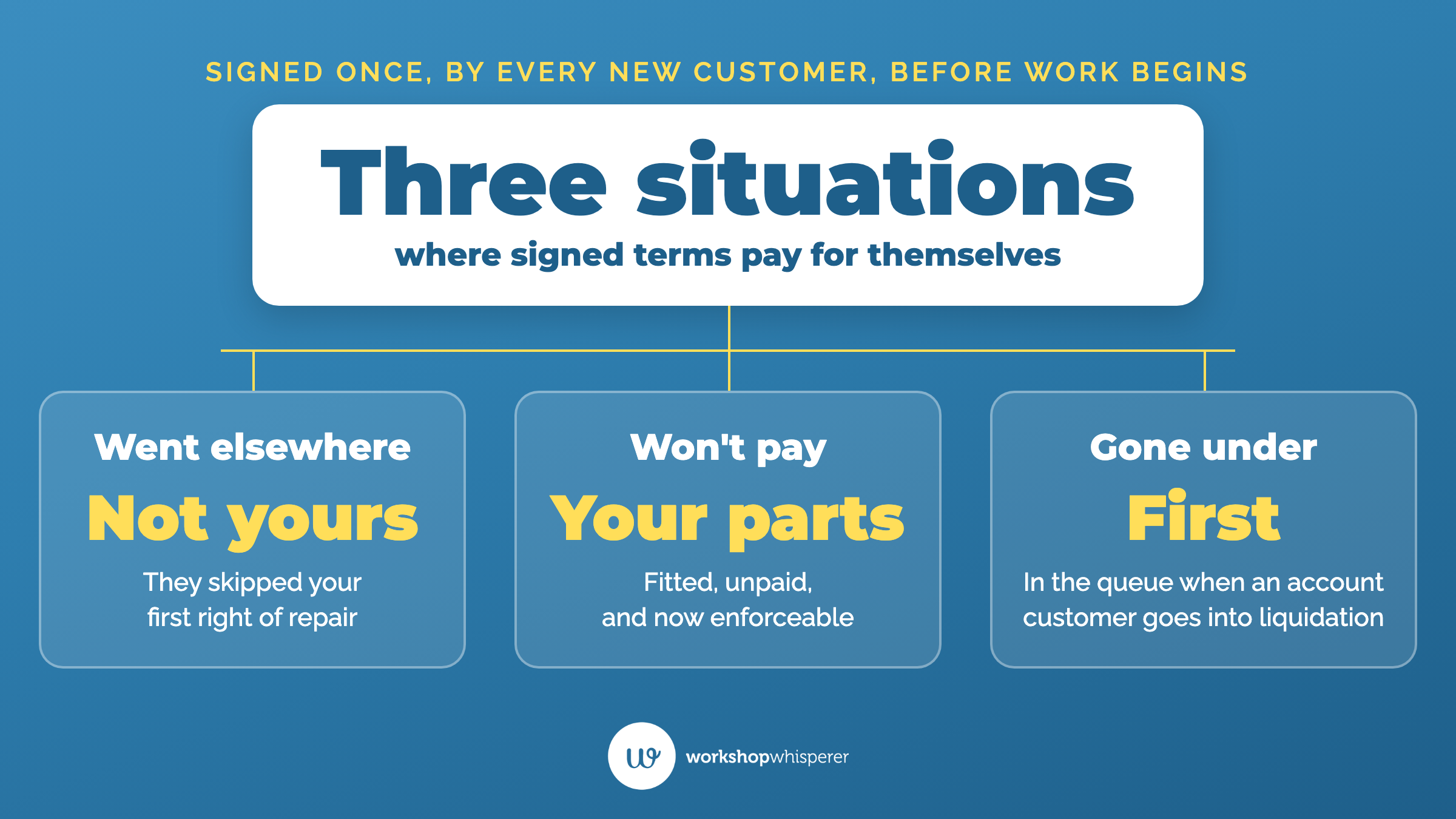
The three situations where they earn their keep
The customer who went somewhere else first. They are unhappy with your work. Rather than bringing it back, they take it to another shop, get an independent assessment, pay for it, and then try to recover that money from you. With properly prepared terms of trade you can show them the line they signed saying anything they were unhappy about came to you first. Taking it elsewhere voids that obligation, and you are not bound to pay the other invoice.
The customer refusing to pay with your parts in their car. You have fitted the parts. They will not settle. Signed terms are what turn that from an argument into a process.
The account customer that goes under. A bigger business on account goes into liquidation owing you $15,000, or $50,000. If they signed your terms of trade, in Australia you can jump the queue when creditors are paid. Without them, you cannot.
That last one alone pays for the document many times over.
Watch: the full version, including what to say when a customer asks why they have to sign, in about 12 minutes.
Where to get them, and what "properly prepared" means
Legally enforceable means prepared by somebody who references the correct legislation: an industry association working with a lawyer, an independent law firm that understands automotive, or a credit collection agency. In Australia we point owners at EC Credit Control, and I should say plainly that we receive nothing for that. I used them when I owned a workshop, our clients use them, and we have had occasion to use them here as well.
Expect to pay a sum of money. That is the point.
It is an investment, not an expense. Equipment makes you money. Team members make you money. Software makes you money. Terms of trade protect the money you have already earned, and protect you from substantial loss. Once the initial pack is done, have them reviewed every couple of years, because legislation moves. Those updates cost a fraction of the first one.
What not to do
Do not get hold of another shop's terms, swap their name for yours, and call it done.
It is too delicate and too detailed for that. You might end up with something that protects you around 65 to 70%, and you will not find out which 30% is missing until the day you need it. If you want million dollar systems in your mechanics workshop while it is still small, so you grow into them rather than scrambling later, make the investment properly. It will serve you for as long as you own the place.
It also makes you look like a better outfit
There is a second benefit nobody mentions.
A customer signing proper terms before work begins reads as a professional operation. The shop down the road that has nothing looks like what it is.
And if a customer does ask why they have to sign, you do not need to be nervous about it. They sign once, not every visit, unless they move from paying on the day to an account or the nature of the work changes completely. It can be done digitally now, which covid forced on most workshops anyway, so a brand new customer can sign before they even arrive.
What you say is simple: every new customer signs the terms of trade before work begins, you are welcome to read through it, and I am happy to answer any questions. What they are reading is things like all work being paid for on the day before the vehicle leaves. Things you would be explaining anyway. The document just does it for you.
And if they still will not pay
With signed terms you can push a genuinely unpaid invoice to a debt collector, and because the terms are signed, the collector enforces the collection costs onto the customer rather than onto you.
Without them, you are chasing it yourself and wearing the cost of chasing.
Questions owners ask
How much should I expect to pay?
Enough that it feels like a decision. Treat it the same way you would a scan tool: a real number up front, reviewed every couple of years for a smaller amount, serving you for as long as you trade.
Do customers need to sign every time they come in?
No. Once, unless they switch from paying on the day to an account, or the type of work changes substantially. Digital signing has made this close to frictionless.
We do mostly fleet work. Does this still matter?
More, if anything. Fleet and account customers are where the large unpaid balances live, and liquidation is the scenario where signed terms decide whether you see any of it.
Can my workshop management software handle this?
Most can attach or capture a signed document against the customer file, which is where it needs to live. The file is the point: terms nobody can find are terms you do not have.
What if a customer refuses to sign?
That is information, and it is better to have it before you touch their car. Very few refuse once it is framed as standard practice for every new customer rather than something aimed at them.
The shift
Terms of trade are systems work, not legal work. You are putting one thing in place now so that the rare bad week later costs you a conversation instead of thousands.
This week, find out what you actually have. If the answer is a few lines on a job card, or nothing, get a quote from a proper provider and put it on the list as an investment rather than an expense.
If you want to ask other owners what they used and what it cost, we run a free Facebook group called Your Profitable Auto Repair Shop. Come and join us.
Want to see shops running on proper systems? Our clients are named auto repair shop owners, from automotive workshops and garages across five countries, on camera, telling you what changed.
More on this topic: all Systems articles.
Whenever you're ready, here's how we can help.
- Free. Shop Talk, a 30 day reset for auto repair shop owners, and our free resources.
- Under $50,000 a month? Auto Superstars Academy, $997 one off. Your service advisor is who presents these at the counter.
- Over $50,000 a month? The Engine Room, where we build the systems that protect what you earn, with one on one coaching on demand from a business coach who is a current or former auto repair shop owner.