
Working So Hard With Nothing in the Bank? Ruth and Brett's Fix
Ruth Gillard of Sherson Automotive in Tauranga says it in one line:
"We were working so hard, but didn't have any money in the bank at the end of the week to show for having worked so hard."
If that is your week, the problem is almost never effort. It is what you charge, who you say yes to, and whether anybody is deciding where the money goes before it goes somewhere.
What it looked like
Brett was in at 6:15 in the morning. And then the detail that gives it away:
"I couldn't tell you what I'd done all day."
A full day, no account of it. That is not forgetfulness. It is what happens when the day is made of other people's priorities arriving one after another.
The cost landed where it always does:
"I didn't see my kids. I was always pretty angry, uptight."
Why working harder cannot fix this
Because effort multiplies whatever your pricing already does.
If a job is priced below what it costs you to produce, doing more of them produces more loss, faster. If you give away half an hour here and a diagnostic there, the giving scales perfectly with how busy you are. A flat-out week in an underpriced mechanics workshop is the most efficient way to go backwards that exists.
The second half is who you say yes to. An owner who accepts every job takes on the customers nobody else wants at prices nobody else would accept, and those jobs consume the capacity that the good work needed.
So the week fills, the bank does not, and the only available explanation from inside it is that you need to work harder. Which is the one thing guaranteed not to help.
Ruth's reframe on pricing is the best I have heard from an owner:
"Solicitors don't think twice about charging. Doctors don't think twice about charging. We keep people safe in their vehicles, so we shouldn't think twice about charging as well."
You keep people safe in their vehicles. Price like it.
What they changed
They set boundaries, and started charging for their time instead of giving it away.
They stopped saying yes to everyone, and let go of customers who were not the right fit. That sounds ruthless until you notice those customers were being funded by the good ones.
They took control of the day. In their words, "we run the day", rather than the day running them.
Ruth became CEO. One decision maker, clearly.
Profit First, which Ruth describes better than any textbook:
"We're telling our money where to go rather than the money going where it wants to go."
And the two of them got aligned on roles and direction, which in a couple-run business is half the battle.
Where Sherson Automotive is now
No big number, and they do not offer one. What they offer is more telling.
Ruth, who used to avoid the accounts: "Now I love numbers because I see them in the bank."
The chaos is reduced. The two of them communicate far more effectively and are aligned on what they are focused on.
And a detail that says everything about the pricing change: their customers still think they are too cheap.
The arithmetic of giving it away
Put a number on the half hours and it stops being a personality trait.
Say you give away thirty minutes on three jobs a week. At a labour rate of $150 that is $225 a week, which is $11,700 a year, gone, from a mechanics workshop that is already flat out. Add the diagnostic you waved and the part you chased without charging, and most shops are well past twenty thousand a year before anybody has discounted anything deliberately.
That money is not the difference between a good year and a bad one. For a lot of shops it is the entire difference between a profit and a loss, and it never appears on a report because it was never invoiced in the first place.
The reason it survives is that each instance is small and each one feels like good service. Nobody decides to give away twenty thousand dollars. They decide, sixty times, to do somebody a favour.
Which part of this sounds like your shop?
If you could not say what you did all day, your day is being assembled by other people.
If you have never turned a customer away, you are subsidising somebody, and it is being paid for by your better customers and your evenings.
If money arrives and leaves without anybody directing it, that is the gap Profit First closes, and it does not require earning more first.
Questions auto repair shop owners ask
Won't I lose customers if I put my prices up?
Some, and they will be the ones costing you money. Ruth and Brett's remaining customers still think they are cheap, which tells you how much room there was.
How do I let a customer go without it being awful?
Usually you do not have to say anything dramatic. Charge properly, hold your normal booking priority, and the ones who were only there for the price leave on their own.
What is Profit First in a workshop?
Allocating money to its purpose the moment it arrives rather than paying everyone else and hoping something is left. Ruth's version, telling your money where to go, is the whole idea.
My partner and I disagree about all of this.
That is extremely common and it is worth settling who decides before you settle anything else. Ruth stepping into the CEO role is what let the rest of it move.
I'm a mechanic, not a salesperson. Charging properly feels wrong.
Ruth's comparison is the answer. Nobody expects a solicitor to apologise for an invoice. You are keeping families safe on the road and the work is worth what it costs to do properly.
What to do tonight
Write down the last three jobs where you did not charge for everything you did. The half hour on the phone chasing a part. The diagnostic you waved. The favour.
Add them up. That is one week. Multiply by fifty.
Then pick one of those three and decide that next time, it goes on the invoice.
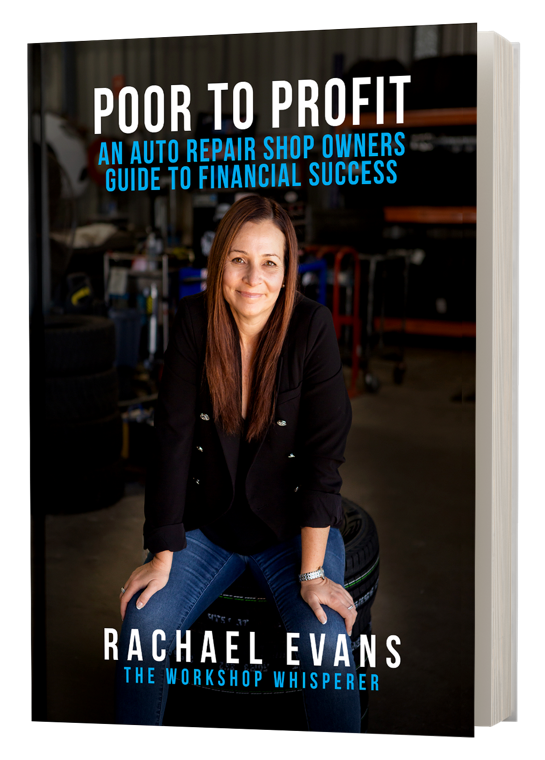
If your numbers have never made sense, start with Poor to Profit. It is free, and it is where this starts.
Where to go next
- Why am I busy but not making any money?
- How to fix cash flow in your auto repair shop
- Should I discount to win more customers?
- How to stand out without discounting
Our clients are named auto repair shop owners, from automotive workshops and garages across five countries, on camera, telling you what changed.
More on this topic: all Money & Profit articles.
Whenever you're ready, here's how we can help.
- Free. Shop Talk, a 30 day reset for auto repair shop owners, and our free resources.
- Under $50,000 a month? Auto Superstars Academy, $997 one off. Your service advisor, service writer or service adviser is where the giving away happens.
- Over $50,000 a month? The Engine Room, where Ruth and Brett did this, with one on one coaching on demand from a business coach who is a current or former auto repair shop owner.