

Why Do I Have to Do Everything Myself?
You have to do everything yourself because your business was built around you. The way jobs get done lives in your head, and nobody else has been given the right to make decisions. Every time you step in to fix something faster, your team learns to wait for you. The way out is to write down everything you do for one week, hand over the tasks someone else is already paid to do, agree what "done" looks like, and then stay out of it.
It's one of the questions we hear most from auto repair shop owners, and it's rarely because your team is hopeless. Most of what fills your day, you're doing out of habit rather than necessity. That's the same whether you run a mechanics workshop in Australia, an auto repair shop in the United States or a garage in the UK, and so is the fix.
Why does everything end up on my plate?
Picture the shop that owns you. You're the first one there at dawn and the one locking up at night. You've missed dinner, the kids have had their baths and are on their way to bed by the time you get home. On the worst nights you're still at the shop late, because there was an issue with a car and you had to be the one to work it out.
Everybody who's been through the early startup years knows that phase, and you should be moving out of it by the three to five year mark. If you've got a few team members on board by then and you're still doing the dawn-till-dark shift, what's missing is systems, and the team being accountable for their own work.
One owner wrote in to our podcast who'd run her automotive workshop in Campbelltown with her husband for 20 years. Annette said they "still can't leave when we want to have time off without there being some major mishap in the workshop... We are tired and we don't know what to do." That's a good business, never short of work, and after two decades the owners still couldn't take time off.
It usually starts the same way. Something goes wrong on the floor and you think, "I'll stop what I'm doing and fix this, because I can do it faster and better." You're right, you probably can. You solve the problem in front of you, but nobody on the team learns anything. So the next time it happens, they come and find you again. Do that for a few years and you've trained a whole team to bring every problem to your door.
Two more reasons are harder to admit. The first is that the rules live in your head. You know how a job should run and what good looks like. Your team doesn't, because nobody has written it down or shown them. As Dean puts it, the owner ends up thinking, "These guys just aren't motivated... It's just easier for me to do it myself." What looks like a motivation problem is usually a team that's never been told the rules.
The second is control. When we ask owners applying for the Engine Room to name their own self-sabotaging behaviour, one of the two answers we hear most is that they're a control freak who doesn't want to let go of anything and tries to do everything themselves. There's often something underneath it too. When you hand a job over and keep coming back in, it's partly through control and partly through the need to be needed. Being the one who knows everything feels important, and it also keeps you chained to the business.
What should I stop doing first?
Start by finding out where your time actually goes. Get a sheet of paper out and keep it with you for a week. Every time you change task, every time you're called to solve a problem or speak to a customer, write it down. At the end of the week, sit down with the list and you'll find yourself saying, "I've actually got skilled, qualified people here that are paid to do that, and I'm doing it out of habit rather than necessity."
One of our Engine Room clients told us on a webinar that his service advisor was largely free during the day. The technicians were all flat out, and the service advisor was looking for things to do. After a few questions it became clear why. The owner was still doing most of the service advisor's job himself, so the person he'd hired to take it off him had nothing to do.
When you look at your list, start with the foundations: admin, data entry and the repetitive tasks. Then look at the front counter, because if you've got a service advisor (a service writer in the US, a service adviser in the UK), their job should be theirs.
Bookkeeping is one owners hang on to far too long. A qualified bookkeeper can do in a couple of hours a week what might take you a whole weekend, without coming into the shop. Ask your accountant for a recommendation.
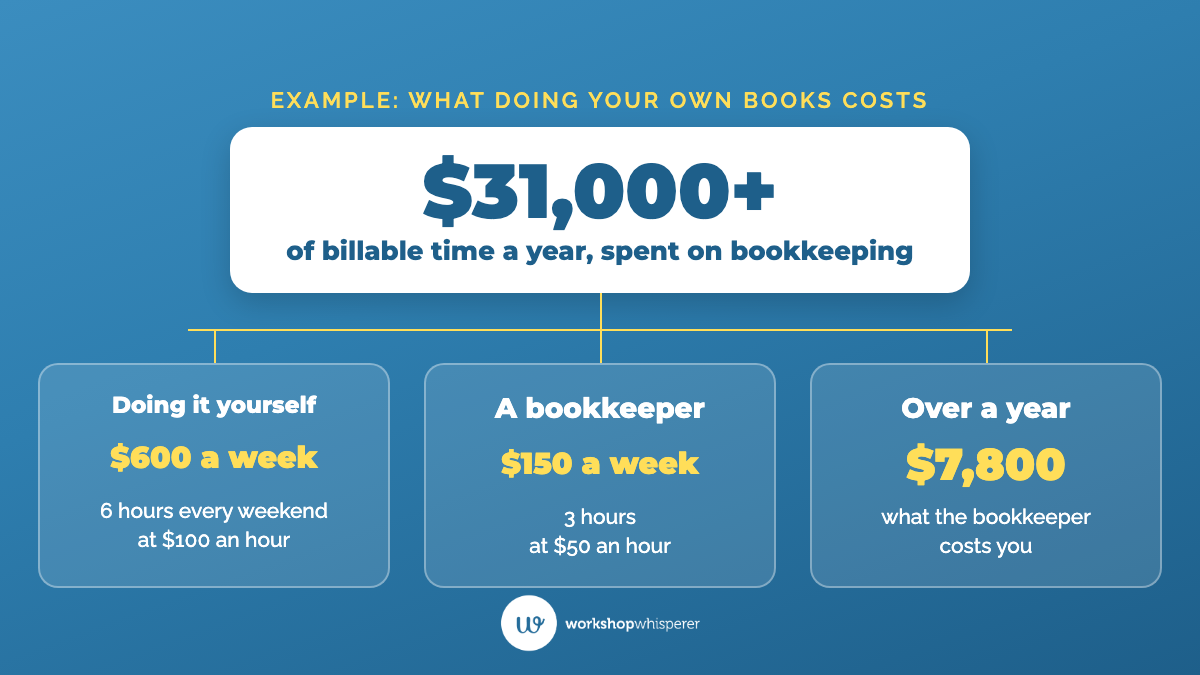
What doing it yourself really costs. This is an example, so put your own numbers in. Say you spend six hours every weekend catching up on the books, and your labour rate is $100 an hour. A bookkeeper does the same work in three hours at $50 an hour, which is $150 a week. Those six hours, spent on cars or on running the business, are worth $600 at your labour rate. Over a year, the bookkeeper costs you around $7,800, and the weekends you get back are worth more than $31,000 of billable time, before you count the weekends themselves. As Dean says, you're not only losing that time, you're losing the time you'd bill out at your labour rate, which is usually the highest rate in the business.
How do I hand it over without it coming back to me?
Delegation fails when you skip the framework. Say you hand your first technician the inspection on every car that comes in for its scheduled service. Then you keep hanging over their shoulder, even though they've given you no evidence they can't do it. You haven't bought back any time, because you're still there, still watching and still giving input.
Delegation that sticks goes like this:
- Make it really clear what done looks like. The finished job, and the quality you expect from it. Your checklist or written process is the framework they follow.
- Ask them what they understand. Get your technician, service advisor or front counter person to tell you, in their own words, how they'll deliver it.
- Agree on when you'll check in. Come back at those moments, and not in between. You're not watching the whole job, and you're not coming back at the end to fix all the mistakes. Ask them how they'll avoid those mistakes along the way.
- Then stay out of it. Once they're doing it well, and some will do it better than you did, resist the urge to get back into the process.
That last step is the hardest. One of our Engine Room members ran a quick check on his finances and found he was giving bigger discounts than anyone on his team. His service advisor was working exactly to the agreement, and doing it brilliantly. It was the owner, coming back in over the top of the invoices, who was hurting the bottom line. When you've handed over the job and the person is doing it well, you end up fighting your own instinct to go back in.
Letting go feels risky because, as the owner, the responsibility still lands on you. It's like holding a ball with your hands squeezed around it. Your fear tells you, "I can't take my eyes off this." That puts a lot of owners off growing leaders at all. They think, "I may as well just do it myself," and that's what keeps them stuck.
It's worth pushing through. One of our Million Dollar Mechanics Boardroom members, the program where installing middle management is one of the three pillars, messaged me with a win. A written warning had gone out in his business. Nobody likes giving one, but this time his leaders delivered the whole performance process and he didn't have to. It took a couple of years to build leaders who could do that.
Chad Condipodero owns Auto Response in Stratton, Perth. When he first joined us, he told us, "I was working 40, 50, 60 hours and feeling like I had to do it all." He'd come from a technician's background, like a lot of owners do. He put the systems in place and got his team taking ownership of the work. Later, when life took a huge turn and he stepped back from the business for a while, those foundations held. "That 3 years allowed my team to step up," he said. Today he has a team of six. "I get to choose if I go to work or not... I get to pick them up from school." Watch Chad's story.
Brett and Ruth Gillard, who own Sherson Automotive in New Zealand, put it plainly when they looked back on their early years. Ruth said they'd have delegated the admin much sooner: "Freeing me up to look at the bigger picture stuff. Getting our systems in place... We would have been a lot further ahead." Their advice to other owners: "You don't have to do it all yourself."
If you're the first one in and the last one out, watch this 8-minute episode. Dean and I talk about what it looks like when your auto repair shop owns you, why bookkeeping is the first thing to hand over, and the one-sheet-of-paper exercise that shows you what you're doing out of habit.
Questions auto repair shop owners ask about doing everything themselves
Isn't it faster if I do it myself?
Today, yes. You'll fix that one problem faster than anyone on your team. But you'll be fixing it again next week, and the week after, because nobody learned how. The hour you spend showing someone how to do it is the hour that stops it coming back to you.
I can't afford to pay someone else to do it. What then?
Compare what you'd pay against what your own hour is worth. Dean's example is a labour rate of $100 an hour against $20 to $50 an hour for someone to do the admin. Often the money is already being spent, on a team member who isn't being given the work.
What if my team makes mistakes?
They will, especially at the start, and that's part of how they learn. Agree what done looks like, check in at agreed points, and ask them how they'll avoid the mistakes before they happen. Watching closely while someone proves they can meet the standard is performance management. Staying involved once they have is micromanagement.
What if I train them and they leave?
Some will. As Dean says, the only thing worse than training your team and having them leave is not training them and having them stay. Give good people no room to step up and they'll decide there's no future for them, and the ones who stay won't be your best.
How long does it take to stop doing everything?
When owners join the Engine Room, we tell them their minimum expectation should be that systemising the business is a 12 to 15 month job. Most businesses that come to us for the first time have no real systems in place. Document one process a week and by the end of a year you'll have a fair chunk of an operations manual. If your shop is turning over under $50,000 a month, Auto Superstars Academy builds those systems with you, with a business coach who has run an auto repair shop themselves.
Where to start tonight
Put a sheet of paper and a pen where you'll see them first thing tomorrow, on your bench or the front counter. From the moment you walk in, write down every time you change task, solve a problem or speak to a customer. Do it for a week. On Friday, circle everything someone on your team is already paid to do. That circled list is your delegation plan.
A business without systems owns you. A business with systems sets you free.
Related questions:
- How Do I Build an Auto Repair Shop That Runs Without Me?
- How Do I Delegate When My Team Keeps Making Mistakes?
- Working Every Day and Getting Nowhere? How James Got His Shop Running Without Him
See what changes for the people who do this work. On our Our Clients page, auto repair shop owners, named and on camera, tell you what actually changed in their shops and their numbers.
More on this topic: all Systems articles.
Whenever you're ready, here's how we can help.
- Not ready to spend anything yet? Start free with Shop Talk, a 30-day reset for auto repair shop owners on our YouTube channel, and our free resources for auto repair shop owners.
- Running an auto repair shop under $50,000 a month? Auto Superstars Academy builds the foundations, including the systems that take the work out of your head, with one-on-one coaching on demand from a business coach who is a current or former auto repair shop owner.
- Over $50,000 a month? The Engine Room changes how the whole business runs, from your numbers to your team, delivered online with one-on-one coaching on demand.
- Want your team to step up and own their work? Ultimate Team Advantage trains your whole team to the standards you expect, so fewer problems land on your desk.