
How Do I Build an Auto Repair Shop That Runs Without Me?
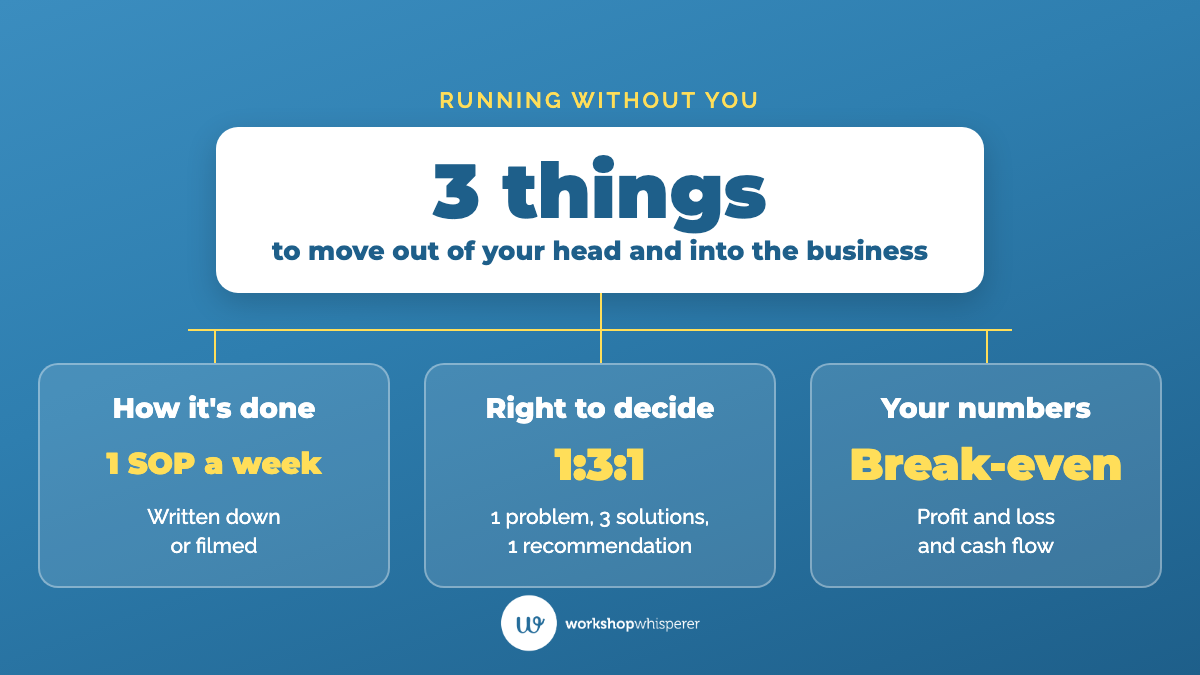
You build an auto repair shop that runs without you by getting three things out of your head and into the business: how the work gets done, the right to make decisions, and your numbers. Write down or film each job so your team can find it, hand decisions to people you trust, and keep your numbers where you can see them when you're not standing in the shop. Then test it with a day off, then a long weekend, then a real holiday.
If you can't remember the last time you switched your phone off, you're in good company. Nobody hands you an operations manual when you open a mechanics workshop. That's as true for an automotive workshop in Australia as it is for an auto repair shop in the US or an independent garage in the UK, and the method for getting out is the same.
Why can't my shop run without me?
A while ago Artie wrote in to our podcast from Darwin. His business had 14 people in it, and he was struggling to take a single break. His team couldn't seem to solve problems on their own, so he felt he always had to be there.
I told him what I tell most owners in his position. When your team needs you to put out their fires, two things are missing. One is in your leadership, and I know that doesn't feel good to hear. The other is that your team members aren't solutions focused. Both can be fixed, and that's the good news. There's a holiday waiting.
Dean, who coaches alongside me, explains why it happens. Every auto repair shop already has a how-to guide, he says. It lives in one of three places. There's the binder on a shelf in the back office that nobody reads or updates. There's the drawer full of sticky notes and half-written pages. And there's the one that does the damage: the guide that lives in the owner's head.
The binder and the sticky notes don't stop you leaving. The guide in your head does, because it goes with you every time you take a day off or try to switch off for one evening.
Every question your team brings you makes that habit stronger. Dean borrows a line from psychology: what fires together wires together. Each time you answer from memory instead of pointing to a document, your team learns that problems go to you, and you learn that you're the one who decides. As he puts it, "When the system exists, the team goes to the system. When the system doesn't exist, the team comes to you because you're the folder. You're the file."
Something else often holds you there too. When we suggest an owner spends less time on the tools, nine out of ten feel real discomfort. It gets called guilt, but the guilt is actually fear: that the team will think you're lazy, or that you're less useful off the floor.
Where do I start building systems when I have no time?
Most owners know they need systems. They picture hours at a computer typing out every step, so they talk themselves out of it, and never get the time back.
Start somewhere smaller. Listen for what Dean calls the "how do I" signal. Any question your team asks that starts with how, where, when or what is a system you don't have yet. How do I order parts? Where do the invoices go? What do I do when a customer disputes the bill? Write those questions down as they come in, and the list becomes your plan for getting out of the shop.
Then document one procedure a week, and don't over-complicate it. Best practice is to write a process so that a five year old could read it and understand it.
You don't have to type it either. Dean's approach is to film the job while you do it and talk through each step: a screen recording for anything on the computer, a phone camera for anything on the floor. Run the audio through a free transcription tool and you have a video to watch and a page to read. Once the first ones are out of your head, your team can document the jobs they do, too.
If the front counter is where you're stuck, break the role into the parts of the day: opening up, customers arriving, the middle of the day, mid-afternoon, customers collecting their cars, and closing up. Write a few dot points for each, then turn them into one finished standard operating procedure (SOP) at a time.
Start with the people you can't afford to lose. Your key person risk might sit with your best diagnostic technician, or with your service advisor (your service writer, if you're in the US). When that person is away for a week in a small shop, a technician comes in off the floor to do the invoicing. That's like taking a fish out of water and expecting it to walk on land.
A worked example. These are illustrative numbers, so put your own in. Say your team brings you 20 questions a day, and each one costs you five minutes once you've stopped, answered and found your place again. That's 100 minutes a day. Across a five-day week it's more than eight hours, a full working day spent being the folder. Now say you write one SOP a week. Dean's experience is that owners expect to find 10 or 15 things living in their head, and it's usually closer to 50 or 100. At one a week you'll have around 50 documented by the end of the year. At two a week, around 100. The first ones you write should be the questions you're asked most, because those are the ones that hand you back the most time.
How do I get my team to make decisions without me?
Documents tell your team how. They still need to know they're allowed to decide.
The tool we use with clients is the 1:3:1 Method. Instead of bringing you a problem, a team member brings you one problem, three possible solutions, and the one they recommend. Then you have a conversation about it. Hold that in place long enough, even with your apprentices, and your team starts to see that they knew the answer all along. Dean puts the habit simply: be slow to answer their question and quick to ask one. Ask "what would you do in this situation?"
Then stay out of the way once you've handed something over. The most disempowering thing for a team member is being told they have the authority and the responsibility, only to have you come in over the top.
The last piece is your numbers. You need to know your numbers before you can leave your business: your break-even, your profit and loss, your cash flow. Without them, the financial things start going wrong the moment you're not there, and you'll never feel safe to go.
When those three come together, test it in small steps. Chad and Sarah run a general repair shop in Western Australia. When they started, it was the two of them and an apprentice. They came through our online Auto Superstars Academy, then systemised the business piece by piece. Then they packed the three girls into a camper and drove across the country for six weeks.
In six weeks away, Chad reckoned he'd had three phone calls. They touched base most days to go over the figures, and the business made money the whole time. His advice to anyone who doesn't think their shop would survive without them was to start with a long weekend, or a day off during the week. And when the phone does ring, "look forward to that phone call, because that's another system you need to make."
Nicola Van Huenen at Coastal Autos in New Zealand used to come home at night with her husband Brett saying they were done and ready to sell. Once they carved out two to four hours a week to work on the business, one step at a time, they grew from a team of four to a team of eight, with a growing book of systems and procedures behind them. A business without systems owns you, and a business with systems sets you free.
James Walker owns Ballarat Roadworthy Centre in Ballarat, Victoria. Before he joined us, he said, "I was here most of the time, even on weekends." He wanted to be home more with his first child, but "without me being at work, we weren't making money." So he put systems in place and moved the shop off a diary, a phone and paper. Today, in his words, "I can go away and the business still runs," because "people know what to do." His team has worked a four-day week for the last two years. "I always thought you had to work 15 hours a day to be able to make a living," he told us. Read James's story.
Watch this before you plan your next day off. In six minutes, Dean asks me how you know it's safe to step away from your auto repair shop, and I walk through the three things that tell you: your numbers, the right team, and your systems.
Questions auto repair shop owners ask about running a shop without them
How long does it take to build a shop that runs without me?
When owners join the Engine Room, we tell them to expect at least 12 to 15 months to systemise the business properly. Most come to us with no written systems at all. The work never fully ends, because a new piece of equipment, new software or a change in the economy all need systemising too, so review your SOPs every year.
When should I come off the tools?
We use your annual turnover as a guide. Up to about $1 million, you'll spend a good amount of time in the business. Between $1 million and $1.5 million, more of your time should go into working on it: systems, performance, KPIs. Above $1.5 million, you should be planning to step back, with people in middle management carrying out your plan whether you're there or not.
What if my team thinks I'm lazy for not being on the tools?
If you're a decent leader and someone resents you for taking the risk of owning the business, they don't belong on your team. Your job is to make sure the business can operate with or without you, and staying on the floor when your team can sell the hours is blocking your growth.
What happens if a key person leaves?
If their role isn't documented, their knowledge walks out with them. Document how your best technician and your service advisor do their work while they're still with you, so performance and money don't drop when they take a holiday, or when they move on.
Where to start tonight
Write down the last "how do I" question someone on your team asked you. Tomorrow, film yourself doing that job on your phone and talk through each step. Save it in a shared folder your team can reach, and next time someone asks, point them to the video instead of answering. That's your first SOP, and the beginning of a shop that runs without you.
Related questions:
- Why Do I Have to Do Everything Myself?
- How Do I Delegate When My Team Keeps Making Mistakes?
- How Do I Save My Mechanic Shop From Closing? Marcus's Turnaround
See what changes for the people who do this work. On our Our Clients page, auto repair shop owners, named and on camera, tell you what actually changed in their shops and their numbers.
More on this topic: all Systems articles.
Whenever you're ready, here's how we can help.
- Not ready to spend anything yet? Start free with Shop Talk, a 30-day reset for auto repair shop owners on our YouTube channel, and our free resources for auto repair shop owners.
- Over $50,000 a month and ready to step back? The Engine Room changes how the whole business runs, from your numbers to your team, delivered online with one-on-one coaching on demand.
- Running an auto repair shop under $50,000 a month? Auto Superstars Academy builds the foundations, with one-on-one coaching on demand from a business coach who is a current or former auto repair shop owner.