
How Do I Avoid a Bad Hire?
You avoid a bad hire by slowing down at the points where you're most tempted to rush. Check you actually need another person before you advertise, run every stage of the interview even when you're desperate, and call the person's last direct boss to ask one question: would you hire them back? If you still get it wrong, act inside your probation period, not six months in.
If you've hired the wrong person before, it's not because you're careless. You were a technician down, the work was piling up, and someone walked in who looked like the answer to all your problems. Whether you run a mechanics workshop or a garage, and whether you're hiring a technician or a service writer, the process that protects you is the same.
Why do I keep hiring the wrong people?
Usually because you're hiring in a hurry. There's a gap on the floor, the pressure is on, and the pressure ends up making the decision for you.
I've watched this play out more times than I can count. You're one or two technicians down. Somebody walks through your front door one afternoon, resume in hand, and on paper they look perfect. They tell you they're worth a lot more than you've ever paid a technician, and because you're in a bind, you say, "I'll find a way to make it happen." So you pay them $20,000 or $30,000 a year more than anyone before them. You throw them out on the workshop floor, you're too busy to spend much time with them, and before you know it their probation has passed. Then you discover they're not what they promised. They can't produce the work, they're toxic, and they're upsetting the rest of your team.
That extra salary is what I call stupid tax. You pay it when you skip the due diligence.
There are two traps underneath that story.
Experience doesn't equal performance. Ten years in the trade tells you how long someone has held a qualification. It tells you nothing about what they can do on your hoist. Most of us have hired the person with 15 or 20 years behind them who couldn't work at the level that experience suggested. They usually seem too good to be true, and then you find out they were. We say we're hiring A players, not "a player": the A player will genuinely lift your business, while "a player" has learned how to talk their way through a recruitment process.
One applicant is not a shortlist. In a tight market you might get one application and feel you have to take it. The question I ask owners is this: are you prepared to hire this one person, knowing they're not who you need and will probably cause you trouble down the track? Or can you wait a little longer, or try a different way of finding people?
And sometimes you don't need another person at all. Before you hire another technician, check your total team productivity. If it isn't at 80% or more, your workshop is busy because of workflow problems, not because you're short of hands. Another technician won't fix that.
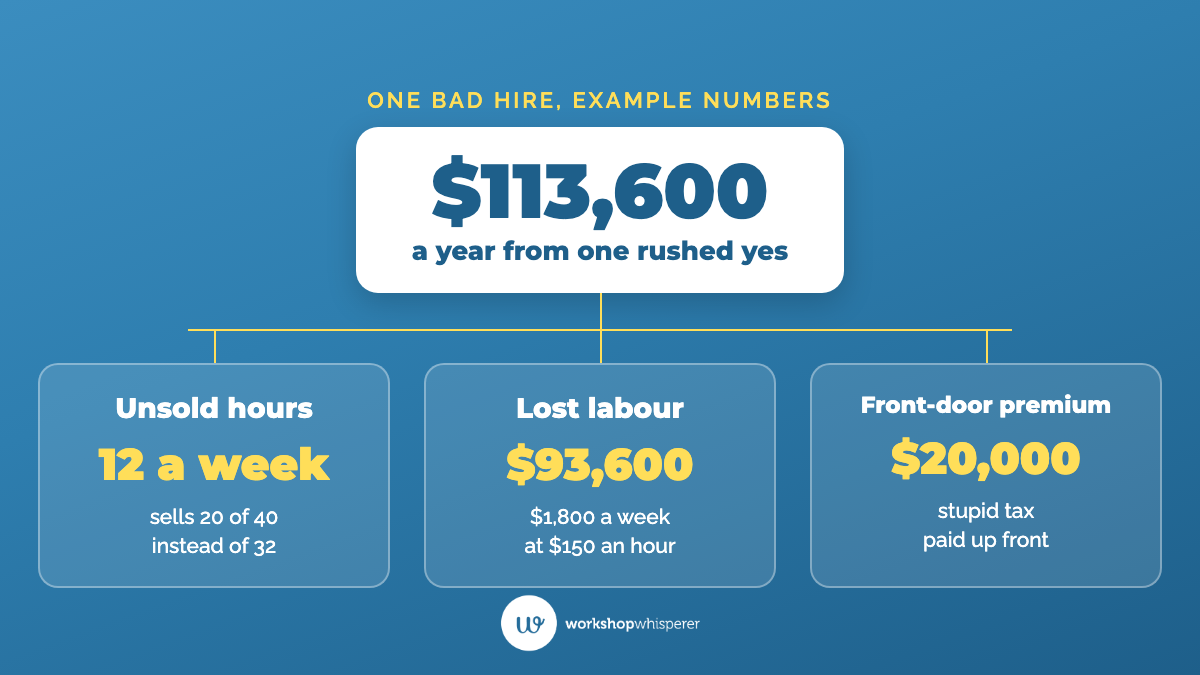
What a bad hire costs you, as an example. Say you hire a technician who sells half the hours they're paid for, 20 hours in a 40-hour week. A technician at 80% productive would sell 32. That's 12 hours a week you're paying for and not selling. At a labour rate of $150 an hour, that's $1,800 a week, or $93,600 a year in lost labour sales. Add the $20,000 premium you agreed to at the front door, and one rushed yes is costing you $113,600 a year before you count the comebacks or the good technician who leaves because they're sick of carrying someone. These are example numbers. Run them with your own labour rate and your own hours.
What should I check before I say yes?
This is where most bad hires could have been stopped, and it's the part busy owners skip.
Read the referee section properly. If the candidate is already off the job market, even for a week or two, and their most recent employer isn't listed as a referee, ask about it directly: "I noticed that your most recent employer isn't listed as a referee. Would they not be willing to speak about your employment with them?" You'll find out pretty quickly whether the story you've been told is accurate.
Yes, you're allowed to ask questions like that. It feels uncomfortable because by this stage you've started to like the person, and you don't want a skeleton to turn up in their closet. Ask anyway.
Never accept a co-worker as a reference. A workmate isn't their boss, and if someone gives a reference for a friend, it's rarely going to be a bad one. Ask for the details of their direct supervisor. If they've left that company, ring the company yourself. There's really only one question you need answered: "Would you hire this person back if the opportunity arose?" If the answer is no, there's something in that person's time there that they're not telling you.
Ask about the job changes. If they've had several jobs in the last 12 to 24 months, ask, "Can you tell me about the reason for changing so frequently?" If every answer is about how bad the bosses were, you'll be the next bad boss on the list. There are bad bosses out there, we all know that. But you have to believe people when they show you who they are the first time. An answer like that tells you they don't take responsibility for their own workplace outcomes.
Don't leave out a stage. Do a phone interview before you meet face to face. Ring them when they might not be expecting it, so you see how they handle themselves on the spot. Do the reference checks. Then the face-to-face interview, and a group interview if you can, so you see how they behave around a team. A proper recruitment process has up to five points of contact with each candidate. If you've been hiring off one half-hour chat, that's the gap.
Interview for attitude, not only for skill. You can train skill. Attitude has to be there from the start. Ask, "Tell me about a mistake you made at work. How did you fix it?" Someone worth hiring takes responsibility and explains the fix. A bad hire blames someone else or avoids the question.
Bek and Trent Jackson, who run Busselton Automotive Repairs in Busselton, WA, learned this the hard way. As they put it, "We've had it before where we've had guys that have been awesome mechanics but just their personality traits are just shocking." Their rule now is "hire for personality, train for skill", because there's always a way to upskill someone, and what they look for is "someone that's the right fit for the team." The team they have now runs a four day work week, and in their words, "We work less and we're making more and the team's happier." Watch Bek and Trent's story.
Let them name the money first. At the end of the interview, ask them to write down what they're prepared to accept for the role, and tell them you'll come back to them by midday tomorrow. I've done it this way for years, and so have many of our clients. You'll often find their number is lower than you expected, and you never get caught paying stupid tax at the front door.
If you want every stage laid out for you, from the job ad to the reference checks, No More Bad Hires is our complete recruitment system built for auto repair shops.
What if I've already hired the wrong person?
Then you move quickly, because the longer you leave it, the more it costs you.
There's a settling-in period, of course. But some signs aren't time-dependent, so they show up early:
- Punctuality. Turning up late while they're still new.
- Clock-watching. Packing up 20 minutes before close, rocking in 10 minutes after start.
- Shortcuts. If you've hired an experienced tradesperson and their work looks rushed, you'll see it in your comebacks.
- How they treat the team. People bring habits from their last workplace. You have to decide whether your culture is strong enough to overcome those habits.
What makes waiting so expensive is who's watching. Your one or two good team members see what you tolerate from the new person, and they start to lose respect for you. Leave it long enough and you're blindsided by the resignation of the good one, with the underperformer still on the books. Once someone is in the seat, you also stop looking for the right person, so the job you needed filled stays unfilled.
Protect yourself before day one, too. Have the employment agreement ready and signed before they start. In New Zealand it has to be signed before they commence for the probation period to be effective.
Watch this eight-minute episode before your next interview: the reference check question, the job-hopping question and the warning signs once they've started.
Questions auto repair shop owners ask about avoiding a bad hire
What is the most important reference check question?
"Would you hire this person back if the opportunity arose?" Ask it of their direct supervisor, never a co-worker. A no tells you something happened that the candidate hasn't mentioned.
Is it better to leave a position empty than hire the wrong person?
Usually, yes. A technician selling half their hours feels better than nobody, but they cost you in wages, comebacks and the respect of your good people. You also stop looking once the seat is filled.
How long should I give a new hire before deciding they're not right?
Allow a settling-in period for learning your systems. Punctuality, clock-watching, shortcuts and how they treat the team aren't time-dependent, so they tend to show early. If those signs are there, act inside your probation period.
Should I put the salary in my job ad?
I don't. Lead your ad with what working for you looks like: the culture, the training, the career path, and any flexibility such as a four day work week. Then ask the candidate to name their expected salary at the end of the interview.
Can I ask a candidate why they left their last job?
Yes, and you should. Ask it directly, and ask why their most recent employer isn't listed as a referee. How they answer tells you whether they take responsibility for their own work.
Where to start tonight
Before your next interview, grab our free checklist, 5 Smart Questions to Ask Before You Hire. It gives you five interview questions, what each one reveals, and what a strong answer and a bad hire's answer sound like.
Then pull out the resume of the next person you're about to interview. Check two things: is their most recent employer listed as a referee, and was each referee their direct boss? Write down the gaps, and write "Would you hire this person back?" at the top of your reference notes. That one page will tell you where to push before you say yes.
Related questions:
See what changes for the people who do this work. On our Our Clients page, auto repair shop owners, named and on camera, tell you what actually changed in their shops and their numbers.
More on this topic: all Culture & Meaning articles.
Whenever you're ready, here's how we can help.
- Not ready to spend anything yet? Start free with Shop Talk, a 30-day reset for auto repair shop owners on our YouTube channel, and our free resources for auto repair shop owners.
- Hiring soon and want to get it right the first time? No More Bad Hires is a complete recruitment system, self-paced with instant access, for finding and keeping the right people.
- Running an auto repair shop under $50,000 a month? Auto Superstars Academy builds the foundations, with one-on-one coaching on demand from a business coach who is a current or former auto repair shop owner.
- Over $50,000 a month? The Engine Room changes how the whole business runs, from your numbers to your team, delivered online with one-on-one coaching on demand.