
How Do I Find Good Mechanics?
You find good mechanics by looking where they actually are. Most of them already have a job in someone else's mechanics workshop, and they aren't reading your ad. So you build a list of qualified technicians before you need one, and you write job ads that sell what a good tech gets by working for you, not what you want from them. Then you run a proper hiring process, so the good one says yes to you instead of the shop across town.
If your last ad drew a pile of applicants and not one you'd trust with a customer's car, you're not being fussy. Your ad went to the one place good technicians rarely are, and that's fixable.
Why can't I find a good mechanic?
Picture the ad that's been up for nine weeks. You've had 200 applicants, and almost none are close to what you need. Meanwhile you're a tech short, booked out four weeks ahead, and back on the tools this Saturday, missing the kids' sport again.
So you do what everyone tells you to do and put the wage up. Dean's answer to that is blunt: "The wage was never the reason you can't find a good quality technician." The shops in your town that never seem to struggle for technicians aren't paying more than you. They're doing something before their job ad ever goes up.
Dean explains it with a drawing of water in three bands.
- The top band is thin. It's every technician looking for work today. Some genuinely good people land here when a shop closes or a family moves, but it's also where everyone who got let go ends up first.
- The middle band is deeper. These are qualified technicians who are employed and doing all right. They'd move for the right shop, but they're not reading job ads. Why would they? They already have a job.
- The bottom band is the biggest. These are A-grade techs who aren't looking at all and have never heard of you. Your next hire is probably in here right now, changing someone else's brake pads, maybe four hours away.
Your job ad floats on the top. It only ever reaches the thinnest, most picked-over layer, and every other garage in your town is fishing there too, on the same day, with the same bait.
Then there's what Dean calls the hiring merry-go-round. A tech resigns. You're short, the bays back up, so you post an ad in a hurry, interview whoever turns up and hire the best of a bad bunch. It doesn't work out, they leave, and you're back at the top of the circle. Each lap costs you the advertising, the interviews, the training, the comebacks, and the good people who got sick of carrying a poor teammate.
By the third lap most owners stop saying "my recruitment process is broken" and start saying "there are no good techs out there". Once you believe that, you stop looking anywhere except the ad, and the circle keeps turning.
As I told owners at our recruitment summit this year: "If you're sat in the mindset that those people just aren't in your area, you will be 100% right. You will never find them."
There will never be a shortage of poor quality candidates. The real gap is that the good technicians in your area don't know your shop exists yet.
Where are the good mechanics, and how do I reach them?
They're working for someone else. So the job is to become known to them long before you have a vacancy.
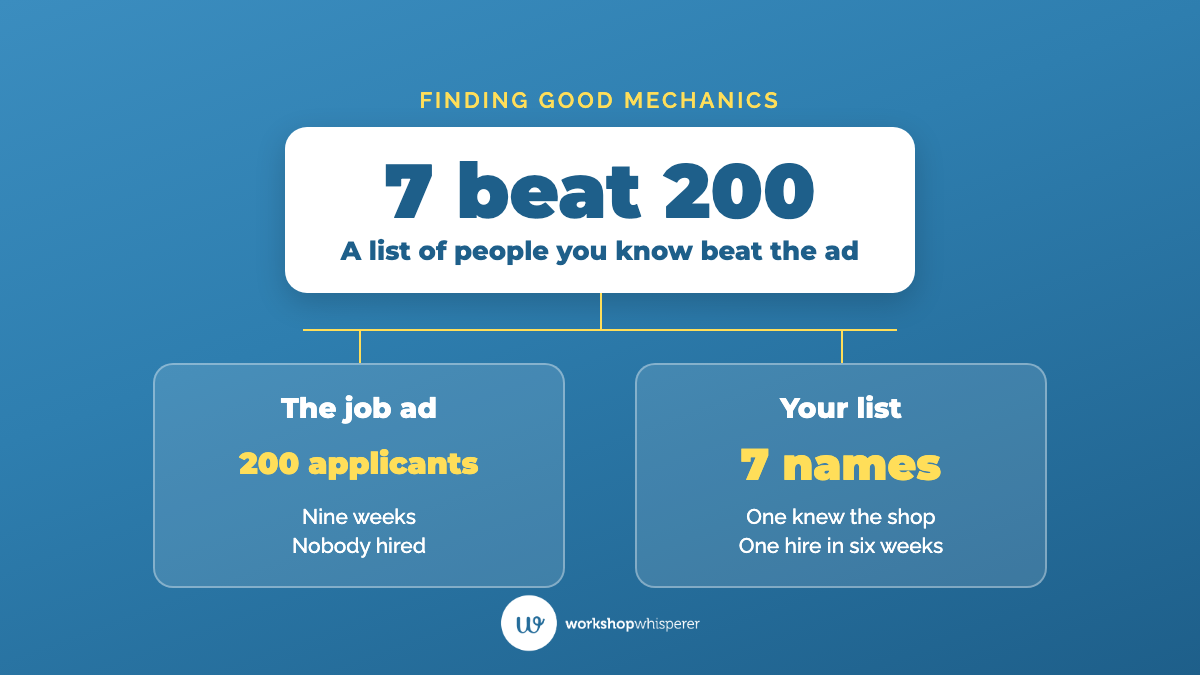
Write down every qualified tech you know. One of our Engine Room clients, a good regional operator, was nine weeks into an ad and convinced the trade had emptied out. We asked him to write down the name of every qualified technician he knew of. Not the ones looking for work, everyone. He got to seven.
Then we asked how many of those seven had ever set foot in his workshop, heard him speak, or knew what it was like to work there. One had. Six weeks later he hired one of the seven, off a conversation, not an ad.
A worked example, using Dean's numbers. The ad that opened this article: 200 applicants, six close to the mark, two who didn't turn up to the interview, one who wanted more than the shop's best tech, one you wouldn't let near a customer's car, and two who never called back. Nine weeks, nobody hired. The list: seven names, one who knew the shop, one hire in six weeks. On those numbers, seven names he already knew did more for him than 200 applicants did.
Build a talent pipeline and keep it warm. Whoever is working on your floor today is the only talent you have access to, unless you're having conversations with people who might work for you one day. Get out to the trade shows. Get out to the TAFEs and technical colleges and see who's coming through. Go where technicians and service advisers hang out, and introduce yourself. You have to be the recruitment officer for your own shop.
Some of those conversations take time. A good tech might need two years to feel ready to move, and you might touch base every three or four months in that time, so that when they're ready, yours is the first shop they think of.
Always be recruiting. If the right person walks in at the wrong time, take their name anyway. The owners who never seem to struggle always have someone to call, because they built the list 12 months before they needed it.
Look further than your postcode. For the right automotive workshop, good techs will move suburbs, sometimes cities, sometimes states. Some owners look overseas too (more on that below).
How do I get a good mechanic to choose my shop?
Recruiting a technician is marketing work, so treat your job ad as a sales page and the technician reading it as your customer.
A typical ad reads like this: five years' experience, own tools, current licence, own transport, reliable, immediate start. Every line is about you. As Dean points out, you'd never run a service special that said "must have a car, must have a credit card, must be available Tuesday". Yet that's how plenty of shops advertise the most important job in the business.
A list of hurdles only appeals to someone desperate for a job. The employed technician in the middle and bottom bands isn't scanning for a licence requirement. They're weighing up whether Monday at your place beats Monday where they are now. If your ad gives them nothing to weigh up, they'll stay where they are.
So turn the ad upside down and write it in this order.
- Sell the dream first. Open with what they get. A four-day work week or a nine-day fortnight. The equipment they'll use and who they'll learn from. Real hours. Jobs that are booked properly, so they're not chasing parts that should have been on the bench. A path into leadership. An opening line can be as simple as "Are you sick of working five days a week from seven till five?"
- Then your values. You can't find someone who fits your culture if you can't say what your culture is. You can train for skill. You can't train for good manners, common sense or a team attitude.
- Qualifications last. Everyone knows the role needs a trade qualification. Put it at the bottom.
- Add a filter. Ask applicants to attach a cover letter saying why they're the best person for the job. If they can't follow a simple instruction when they apply, how will they follow yours when they work for you?
People sometimes post their ad in our free Facebook group and ask why nobody good is applying. Too often it's two sentences: qualified technician required, great benefits. That ad reaches the people who can't get a job anywhere else.
Then run the process, every step. In a tight market it's tempting to skip steps the moment someone decent turns up with their toolbox. Start with a quick phone call, so you see how they handle being caught unawares. Then have a longer conversation to find out what motivates them most: family time, freedom, money, fun or fitting into the culture. That tells you how to package the offer. Then a reference check, an in-person interview and an offer made quickly, because a good tech is likely weighing up more than one.
The reference check is the step owners skip most, because a little voice says "I don't really want to know". Ask the person who supervised them, not a workmate, and ask one question: would you hire them again? Then ask why.
The ad and the process only work if the shop behind them is somewhere a good tech wants to be. Mick Manzi runs M&R Auto Care in Sandgate, on Brisbane's north side. Towards the end of 2024, he says, "I had basically pretty much all my staff except for one left." When he asked himself what needed fixing, "it just kept coming back to my leadership." He rewrote every contract and put proper processes in place. "It took me three to six months to fully rebuild," he says. "We were down to myself and one mechanic, and now we're back up to one SA, myself, and three mechanics."
If you'd rather not build the ad and the process from scratch, No More Bad Hires is our complete recruitment system for finding and keeping the right people, including a job ad writer trained for auto repair shops.
Watch this before you write your next job ad. In about 26 minutes, Dean draws the three bands of water on the board, shows you where the good technicians actually sit, and walks through rewriting an ad so it reaches them.
Questions auto repair shop owners ask about finding good mechanics
Should I offer more money to attract good mechanics?
Money alone rarely fixes it. The shops that never struggle for technicians aren't paying more than you. They're offering a better week. Find out what each candidate values most, whether that's family time, flexibility or a path into leadership, and build the offer around it. A four-day week, a nine-day fortnight or a fuel card can matter as much as the hourly rate.
Should I hire the best applicant I've got if I'm desperate?
Usually not. Hiring the best of a bad bunch is how the merry-go-round starts. Dean once watched a shop go through three technicians in 18 months, each hired within a week of the last one walking out. Wait a little longer, or try a different way of finding people, before you take a bet you already suspect is wrong.
Is an experienced mechanic always a safe hire?
No. Experience doesn't equal performance. Someone with 10 years in the trade can talk the talk and still not walk the walk. Ask more questions in the interview and do a proper reference check with their supervisor before you trust the résumé.
What should I ask a mechanic's previous employer?
One question: would you hire them again? Then ask why. Their answer will tell you a lot about why this person is on the market in the first place.
Can I find good technicians overseas?
Yes. If you've tried locally without success, a technician on a work visa is worth a serious look. We've had clients bring technicians into regional Victoria. The faster they connected their new tech with the local community, the better that tech settled, because they had people to talk to and somewhere to belong.
Where to start tonight
Grab a pen and write down the names of three qualified technicians you'd be happy to have working in your shop tomorrow. Not people looking for work. People who are employed somewhere else right now, and don't stop at your postcode.
Then ask yourself who you'd call first if your best tech resigned this afternoon. If the answer is "I'd post an ad", you're starting from zero every time. If you can't get to three names, the problem is visibility rather than recruitment, and you can start fixing that this month.
Related questions:
See what changes for the people who do this work. On our Our Clients page, auto repair shop owners, named and on camera, tell you what actually changed in their shops and their numbers.
More on this topic: all Culture & Meaning articles.
Whenever you're ready, here's how we can help.
- Not ready to spend anything yet? Start free with Shop Talk, a 30-day reset for auto repair shop owners on our YouTube channel, and our free resources for auto repair shop owners.
- Tired of hiring people who don't work out? No More Bad Hires is a complete recruitment system for finding and keeping the right people, including a job ad writer trained for auto repair shops.
- Running an auto repair shop under $50,000 a month? Auto Superstars Academy builds the foundations, with one-on-one coaching on demand from a business coach who is a current or former auto repair shop owner.
- Over $50,000 a month? The Engine Room changes how the whole business runs, from your numbers to your team, delivered online with one-on-one coaching on demand.