Why Doesn't Working Harder Fix My Auto Repair Shop?
Because the problem was never the workload. It's the design of how the work reaches you, and no amount of effort fixes a design fault.
Two things are almost always missing. Nobody on your team has decision rights, meaning the authority to answer a customer question without finding you first. And the systems live in your head rather than on paper. With those two gaps open, every question in the building routes to one person, and that person is you.
So you can work harder, start earlier and finish later, and arrive at the same place more tired.
When did flat out become something to be proud of? I talk to auto repair shop owners every week who are first in and last out, whose phone goes flat every day, whose bays are full. They wear it like a badge of honour. On the surface that makes sense, because busy looks like things are happening.
Busy almost never means profitable. Flat out certainly does not mean free. And working harder on the wrong things gets you to the wrong place faster.
What is it actually costing me?
Here is where it stops being a feeling and becomes a number.
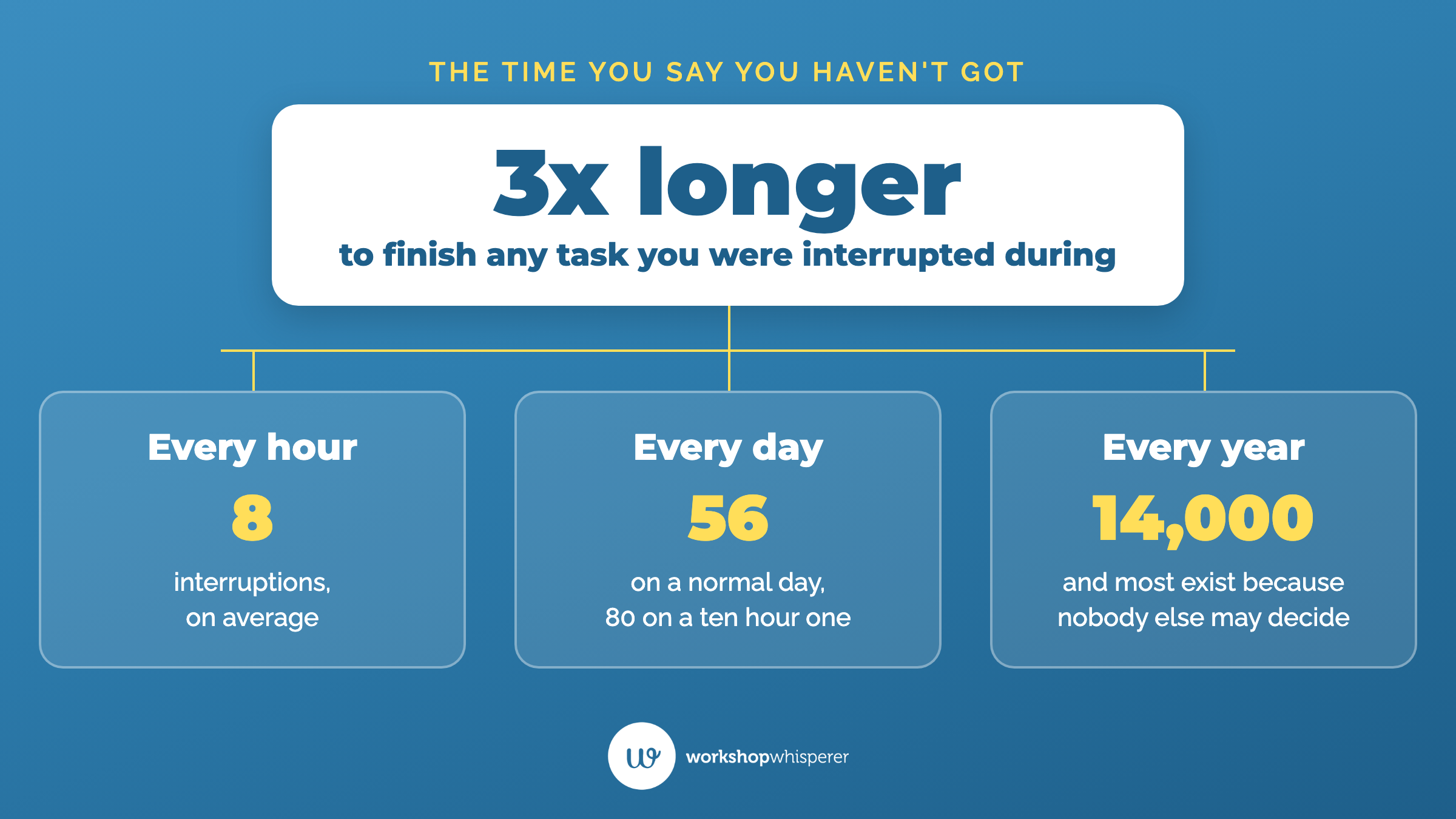
A US Navy study found that for every interruption, the task you were doing takes three times as long to finish, because your brain has to go back, work out where you were, and rebuild the thread.
On average we are interrupted about eight times an hour. In a normal day that's 56 interruptions. On a ten hour day it's 80. Across a year it's somewhere near 14,000.
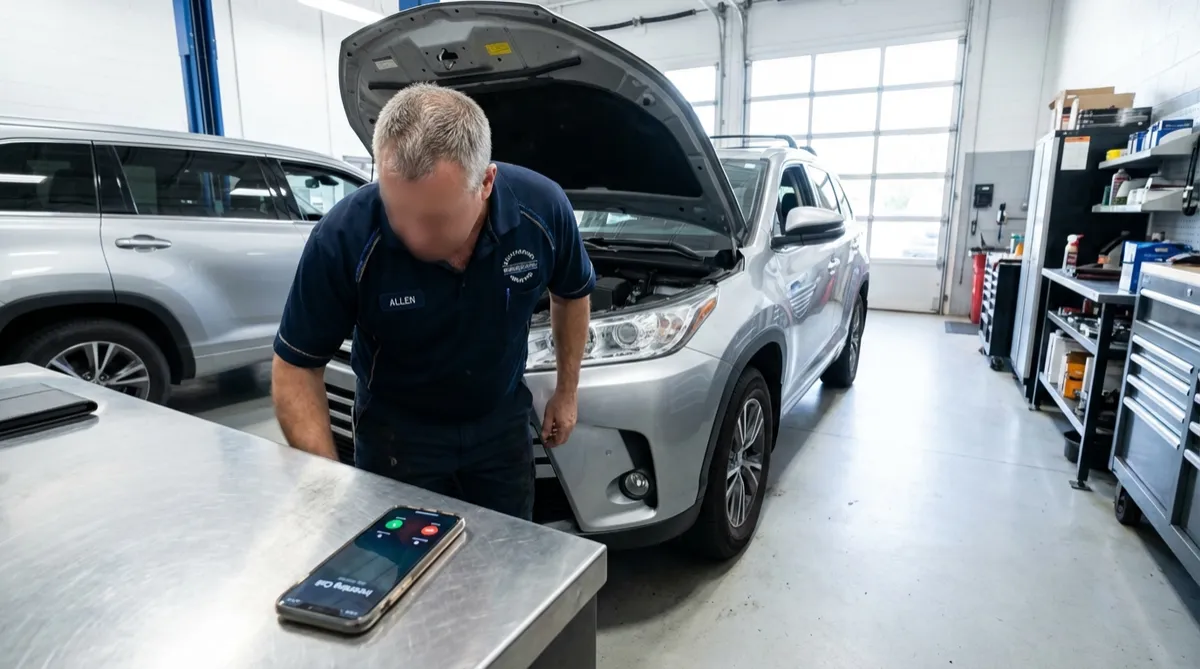
Read that against the thing most owners tell me, which is that they haven't got time to work on the business. The time is there. It is being absorbed by interruptions, and most of those interruptions exist because nobody else is allowed to make the call.
Why does every question end up with me?
Two gaps, and they are both fixable.
Decision rights. Your service advisor, your workshop controller, your senior technician: can any of them answer a customer query, approve a small variation or make a call without finding you? If not, you have not delegated authority, you have delegated tasks. Every question comes back, and in a mechanic workshop the questions never stop.
Documented systems. The how-to guides are standard operating procedures, and in most automotive workshops, and most garages, they are still in the owner's head. If the only copy of how something gets done is you, then you are the manual, and people have to open you every time.
This is how a capable owner becomes the bottleneck in their own business. Not through any failure of effort. Through never writing anything down and never handing anyone the authority to act.
The athlete and the personal trainer
Think about getting fitter. You could figure it out yourself, hit the gym, throw a plan together. Or you could work with a personal trainer who knows what they are doing.
A good trainer does two things. They ask what the end result actually looks like, in specifics rather than "lose a bit of weight". Then they build a program for you: the right exercises, the right sets, the right reps, calibrated to that outcome.
The athlete and the trainer use the same gym and the same equipment. One throws weights around hoping for a result. The other designs a program that produces a specific one.
Most owners I speak to work like the athlete.
Picture two circles. In the first, you are in the middle of everything: the jobs, the team, the phone, the problems, the accounts, the pricing, every decision, the systems, the marketing. You are playing every position on the field at once.
In the second, it's the same business, but you are standing outside it. You are watching how it runs, recording what the numbers say, and adjusting the plan where it needs adjusting. You are not playing. You are directing how the game gets played.
That is the whole shift, and it is not about working less hard. It is about changing what you work on.
Watch: I go through the two circles and what separates a six-figure owner from a seven-figure one, in 21 minutes. Same hours in the week for both. Completely different results.
What a deliberate day looks like
The opposite of reactive is not busier. It's sequenced. Each thing you do is chosen because it sets up the next one.
A day built that way might run: start with the team and the jobs that are booked. Then a short conversation about what could go wrong today. Then the markers of progress, so everyone knows what is done, not done and in progress. Then the financial conversation, with your partner, your bookkeeper or your accountant. Then back to the jobs. Then admin, calls or marketing at the end.
Nothing in that list is harder than what you did yesterday. It is the same work in an order that compounds instead of scattering. An A-grade owner can tell you exactly what they are working on and why, and what result it is meant to produce.
Where to do it, because this is the part people skip
You cannot work on the business while standing in the middle of it. One of our Million Dollar Mechanics Boardroom members, running multiple seven figures, kept trying and kept getting pulled back in.
Home is usually no better, especially with a young family. Kids come in and out, the chores are in your eyeline, and now it is a test of mental discipline rather than a change of conditions.
What works, and we see it over and over, is going somewhere that is neither the shop nor the house. A café. A park. Changing your physical location tells your brain this is a different kind of work. Owners routinely get more done in two hours there than in two days at the bench.
It is the reason clients who come to our two-day intensives often book a hotel for those two days while their team runs the shop. The distraction-free space is the point.
Questions owners ask
Isn't delegating decisions how mistakes get made?
Some, early on, and they are cheaper than the alternative. A team that cannot decide anything produces 14,000 interruptions a year and an owner who never gets out of the game. Start with decisions that have a low cost of being wrong, set the boundaries clearly, and widen them as people prove themselves.
I don't have time to document systems. Where would I even start?
With the job that gets interrupted most often. One procedure, written by whoever does it rather than by you, in whatever form they will actually use. You are not building a manual this month. You are removing the single most expensive question in the building.
My shop isn't big enough for middle management.
Then this is about decision rights rather than hiring. A tier of workshop managers and service advisors running the day to day becomes the goal above seven figures. Below that, the same principle works with the people you already have: give one of them the authority to answer the question they keep bringing you.
What if I like being on the tools?
Plenty of good owners do, and nothing here says stop. It says be deliberate about it. Being on the tools because you chose it and designed around it is a different business from being on the tools because nothing moves unless you are.
How do I know if it's working?
You can answer two questions without hesitating: what am I working on this week, and what result is it meant to produce. If both answers come straight out, you are designing. If they don't, you are still reacting to whatever was loudest.
The shift
The owners getting the best results, the ones with the time and the money and the freedom they wanted when they started, are almost never the hardest working people in the room. They stopped lifting the weight and started sharing the load. They changed what they work on, not how hard they work.
Tonight, write down the last five times somebody interrupted you. Next to each one, write the name of the person who could have handled it if they were allowed to. That list is your first set of decision rights.
If stepping back from the bench is where you want to end up, our 4 Day Work Week ebook shows what it takes to get there.
Want to see owners who have made this exact shift? Our clients are named auto repair shop owners, on camera, saying what changed and what it took.
More on this topic: all Productivity articles.
Whenever you're ready, here's how we can help.
- Free. Shop Talk, a 30 day reset for auto repair shop owners, and our free resources.
- Under $50,000 a month? Auto Superstars Academy, $997 one off.
- Over $50,000 a month? The Engine Room, where we build the decision rights and the documented systems with you, alongside one on one coaching on demand from a business coach who is a current or former auto repair shop owner.